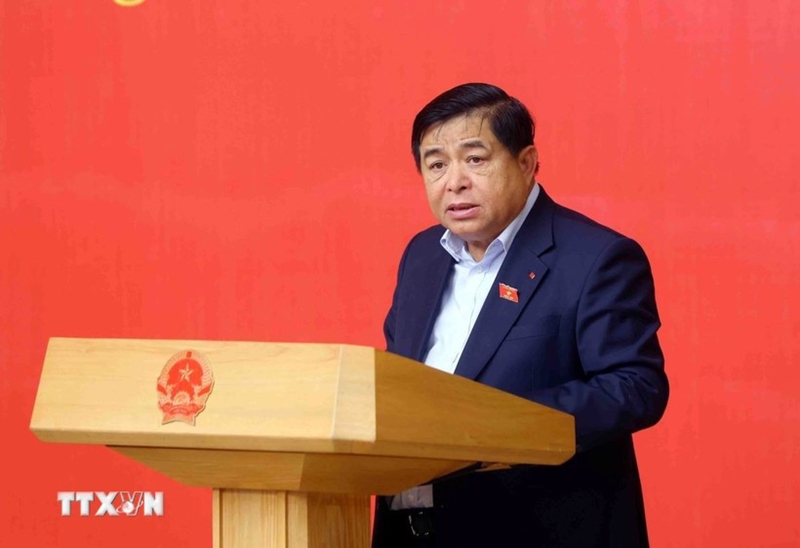
Addressing a conference on December 10 to roll out the Congress Resolution, Deputy PM Dung, a member of the Standing Board of the Government Party Committee, requested Party committees within the Government Party Organization to directly lead and oversee the implementation of tasks under the Action Program, ensuring progress, quality and effectiveness, and striving to fulfil all objectives set for the 2025–2030 period.
    |
 |
|
Deputy Prime Minister Nguyen Chi Dung addresses a conference on December 10 to roll out the Resolution of the first Congress of the Government Party Committee for the 2025–2030 term. |
He urged Party committees of ministries, sectors, Government agencies and localities to review and update measures to boost growth; mobilize, allocate and utilize resources appropriately; and promptly and flexibly realize sectoral and local targets. He also called for strict compliance with monitoring, inspection and evaluation mechanisms, with annual and ad-hoc reports submitted in accordance with regulations.
Deputy PM Dung highlighted the need to continue refining programs and tasks based on practical requirements. The Executive Committee and the Standing Board of the Government Party Committee will adjust and supplement tasks when necessary, ensuring alignment with new demands in Party building and national development in a period of strong reform.
According to the Deputy PM, the Resolution’s objectives are detailed through 27 key socio-economic indicators for 2026–2030: 10 on economic development, 9 on social development and 8 on environmental protection and climate adaptation.
Economic development targets include annual GDP growth of at least 10%, with total factor productivity (TFP) contributing 55% or more to growth. Social targets include raising the HDI to 0.78, average life expectancy to 75.5 years with 68 years of healthy life, and reducing the multidimensional poverty rate by 1–1.5% annually. Environmental and climate-related targets include ensuring 80% of rural households have access to standard clean water; cutting greenhouse gas emissions by 8–9%; and maintaining forest coverage at 42%.
To realize these goals, the Action Program sets out three major task groups comprising 14 solution groups and 208 specific tasks.
The first task group focuses on strengthening Party building and rectification, and building a clean, modern and service-oriented Government. It contains four solution groups and 41 tasks, with Party rectification in politics, ideology and ethics identified as a decisive factor for successfully implementing the Resolution.
The second task group centers on leading and directing the implementation of socio-economic development tasks. The eight solution groups and 131 tasks prioritize rapid institutional improvement, unleashing production capacity, mobilizing all resources and creating new growth drivers.
They outline establishing a new growth model, restructuring the economy, advancing industrialization and modernization, and promoting science, technology, innovation and digital transformation as key engines. They also focus on modernizing education, developing high-quality human resources; building synchronous, modern infrastructure; developing new growth spaces; advancing new-style rural development; promoting cultural and social progress; improving people’s wellbeing; ensuring sustainable resource management; strengthening environmental protection and climate resilience; and enhancing governance and anti-corruption efforts.
The third task group concerns strengthening national defense, security and foreign affairs. Its two solution groups and 36 tasks prioritize consolidating defense and security capacity; building a revolutionary, regular, elite and modern military and police force; firmly safeguarding the Fatherland; and promoting comprehensive, creative and effective external relations and international integration.
Source: VNA