Guiding nation through existential shock
From the mid-1980s, the world underwent profound upheavals. The socialist system fell into a comprehensive crisis and, by the early 1990s, that system collapsed. Beginning with the Soviet Union, a domino effect unfolded across the system. At the time, widespread speculation predicted that Vietnam would share the same fate. Yet Vietnam not only endured but also rose above adversity, overcoming formidable challenges and asserting its own path forward.
This spring, looking back upon those memories, forty years on, Vietnam can take pride in its remarkable transformation as it enters a new era, an era of nation’s rise, toward a country that is peaceful, independent, democratic, prosperous, civilized, and happy, in line with President Ho Chi Minh’s aspiration and the will of the entire nation.
    |
 |
|
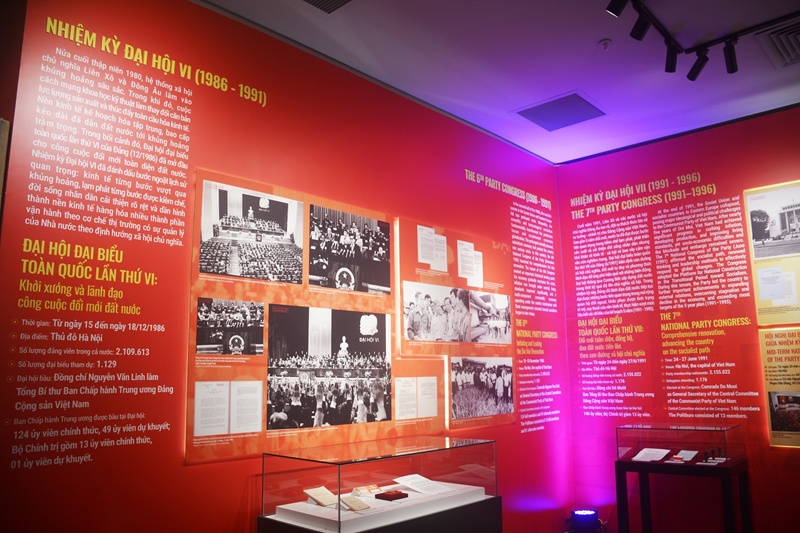
Photos and documents of the Sixth National Party Congress term (1986–1991) displayed at the exhibition, titled “The Communist Party of Vietnam: From congress to congress” |
Such achievements stem from the Party’s sound leadership and its renewal line, formally established at the Sixth National Congress in December 1986. Over time, the Party has steadily refined the theoretical foundations of this process.
The renewal line comprises a comprehensive system of goals and orientations for national development. It centers on the people as the primary driving force and defines the Vietnamese socialist model through three pillars: a market economy, a rule-of-law state, and democracy. This approach fulfills President Ho Chi Minh’s “final wish” to build a peaceful, unified, independent, democratic, and prosperous Vietnam.
While a correct line is paramount to avoid deviation, it must be translated into reality through effective Party leadership and the strength of the great national unity bloc. Amid historical trials, the Party’s most remarkable feat was rallying popular support. By remaining close to the people, the Party maintained a unified force that propelled rapid, sustainable development and avoided the collapse seen elsewhere.
Vietnam’s path involved immense sacrifice. By adhering to objective laws, the Party fulfilled its mission of leading a resilient nation toward renewal. In that urgent historical moment, there was no alternative: “Renew or die!”
Defending and building nation
Over 40 years of Doi Moi under Party leadership, Vietnam has successfully safeguarded its fundamental national rights: independence, sovereignty, unity, and territorial integrity.
In today’s volatile geopolitical landscape, Vietnam continues to uphold the indomitable spirit of its history—from the Ly Dynasty’s assertions of sovereignty and the Tran Dynasty’s Dong A spirit to the Tay Son victories and the "Binh Ngo dai cao." This legacy culminated in President Ho Chi Minh’s 1945 Declaration of Independence at Ba Dinh Square.
Despite modern challenges involving cyberspace, soft power, and non-traditional security threats, the Party and people remain steadfast against forces seeking to undermine national development. Following arduous border defense struggles, the nation transitioned into a "gigantic struggle" against poverty. Since 1975, Vietnam has dismantled outdated mechanisms, embracing transformative thinking to achieve rapid, sustainable growth.
Emerging from the 1990s crisis, Vietnam transitioned into accelerated industrialization and a socialist-oriented market economy. Having achieved the Millennium Development Goals, it is now among Asia’s top 15 economies with a GDP exceeding USD 500 billion, projected to enter the top 10 within five years.
Crucially, the Party has resolutely fought the "internal enemy" of corruption. Recognizing this internal threat as no less dangerous than external aggression, the Party has demonstrated the courage to confront deep-rooted systemic issues to ensure continued national progress.
Pro-active and active international integration
Never before in the past 40 years has Vietnam enjoyed such high international standing. The Party has realized President Ho Chi Minh’s vision that Vietnam should be a friend to all democratic nations and harbor no enmity toward any country.
|
|
 |
|
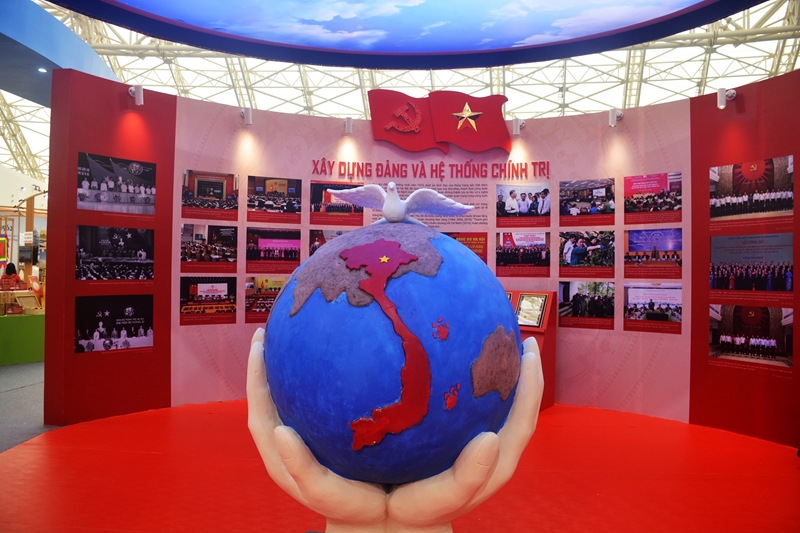
Hanoi’s Exhibition space on Party and political system building at the exhibition on Vietnam’s 80-year achievements |
Over four decades, the Party has consistently pursued an independent and self-reliant foreign policy based on peace, friendship, cooperation, and development; multilateralization and diversification of external relations; and pro-active, active international integration. This policy rests on respect for independence, sovereignty, unity, and territorial integrity; non-interference in internal affairs; equality; and mutual benefit. Vietnam has established itself as a friend, a reliable partner, and a responsible member of the international community, contributing to peace, independence, democracy, and social progress worldwide.
By safeguarding a peaceful environment for development, prioritizing internal strength while valuing external resources, and expanding international relations in a spirit of openness, Vietnam has achieved significant outcomes, even amid a world facing numerous headwinds and uncertainties.
This spring, Vietnam stands at the threshold of a new era. In the Year of the Horse, there is hope that the nation, like a vigorous horse, will gallop forward with steady and confident strides.
Prof., Dr. MACH QUANG THANG
Translated by Tran Hoai