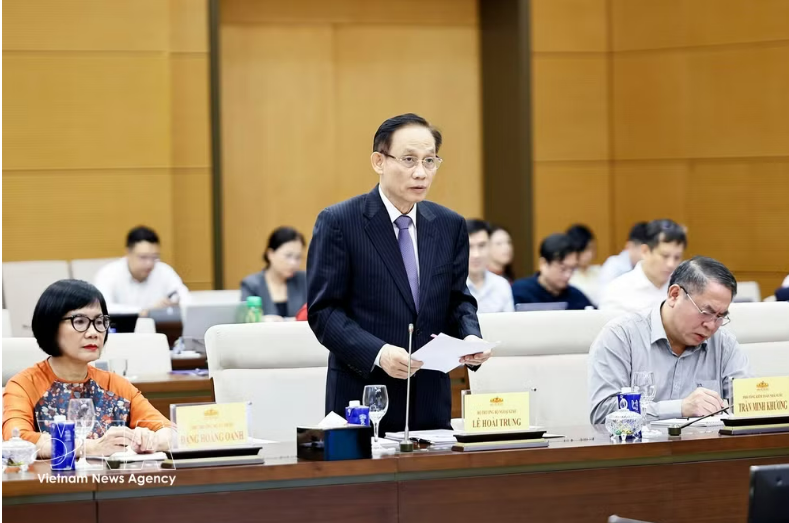
Presenting the Government’s proposal, Minister of Foreign Affairs Le Hoai Trung said the draft law aims to institutionalize the Party’s guidelines set out in the documents of the 14th National Party Congress and the strategic resolutions of the Politburo, particularly Resolution No.59-NQ/TW on international integration in the new situation and Resolution No.06-NQ/TW on implementing the foreign policy outlined by the 14th National Party Congress.
    |
 |
|
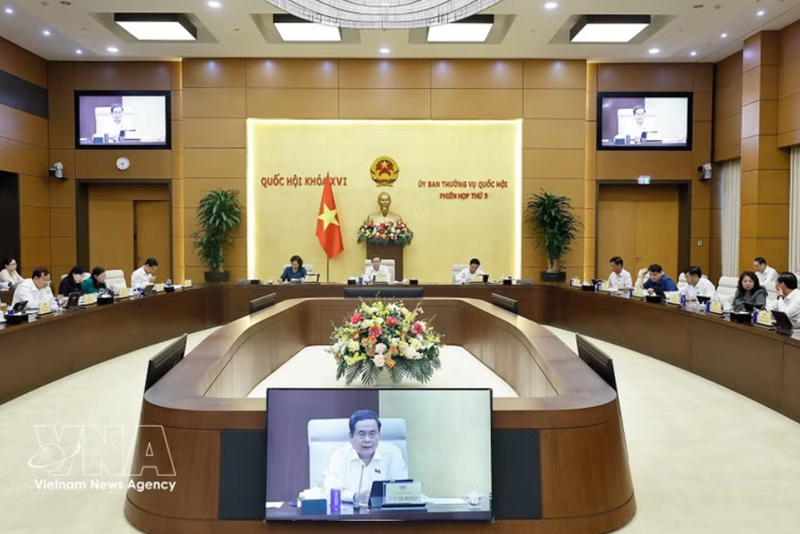
The National Assembly (N.A.) Standing Committee discusses the draft revised Law on International Agreements at its fifth session on August 28. |
The draft also reflects Directive No.56-CT/TW of the Party Central Committee’s Secretariat on strengthening Party leadership over the negotiation and implementation of international commitments, and promoting external relations and international integration in the new era.
It seeks to address shortcomings in the current legislation, expand the entities authorized to sign international agreements, increase decentralization and delegation of authority, simplify procedures and boost the application of science and technology to improve implementation effectiveness.
The bill comprises six chapters with 48 articles. Notably, it further clarifies the distinction between international agreements and treaties, stating that international agreements do not create, alter or terminate Viet Nam’s rights and obligations under international law.
It also adds several Vietnamese entities eligible to sign such agreements, including the management boards of industrial, export-processing and economic zones under the provincial-level People’s Committees; non-business public units under ministries, ministry-level agencies and provincial-level People’s Committees; and special-zone People’s Committees.
At the same time, some entities, including general departments under ministries and district-level People’s Committees, the N.A. Secretary-General, agencies under the N.A. Standing Committee and those subordinate to the Government, would be removed from the list as in line with the restructuring of the State apparatus.
The draft provides that the Prime Minister would submit international agreements signed in the name of the State to the President for decision. It also introduces simplified procedures for urgent cases involving national defense and security, emergency relief, natural disaster response and epidemic control.
Other provisions cover electronic signatures, digital transformation and the development of a national database on international commitments.
The Government proposed that the N.A. consider and pass the revised law, replacing the existing legislation, at the second session under a one-session procedure.
Ensuring decentralization goes with accountability
Presenting the preliminary verification report, Sr. Lt. Gen. Le Tan Toi, Chairman of the N.A. Committee for National Defense, Security and External Relations, affirmed the necessity of revising the law and said the bill is qualified for consideration at the N.A.’s second session.
However, the committee asked the Government to accurately assess the required financial, human-resource and digital-infrastructure capacity of the newly authorized entities.
|
|
 |
|
Minister of Foreign Affairs Le Hoai Trung presents the Government’s proposal on the draft revised Law on International Agreements. |
Given the needs in reality and the new two-tier local administration model, the committee also proposed adding commune-level People’s Committees outside border areas as entities eligible to sign international agreements.
It called for mechanisms to verify foreign partners’ electronic signatures and clarification of why electronic signatures would not be permitted for agreements signed in the name of the State, N.A. or Government.
Speaking at the session, N.A. President Tran Thanh Man said revising the Law on International Agreements is necessary to adapt to the two-tier local administration model and meet the requirements of deeper international integration.
He supported expanding the list of entities authorized to sign agreements in a controlled and appropriate manner. However, he stressed that strict oversight mechanisms are needed to prevent fragmented and inconsistent management of external relations, with detailed rules to be set out in guiding decrees.
The N.A. President noted that border commune-level administrations have limited capacity and resources, and therefore the draft should clearly define the areas in which they may sign agreements or establish approval procedures to minimize legal and political risks.
He also called for a clear distinction between international agreements and treaties, as well as consistency with the 2025 Law on Treaties to prevent overlaps.
On decentralization, the top legislator stressed that greater authority must go hand in hand with adequate capacity and clear accountability. He warned against agreements being signed without effective implementation or agreements of low quality. The draft law should therefore clearly define the responsibilities of lead agencies, establish mechanisms to withdraw or terminate ineffective agreements, and strengthen the inspection and supervisory role of the Ministry of Foreign Affairs.
Also on August 28, the N.A. Standing Committee unanimously adopted a resolution on the functions, duties, powers and organizational structure of the N.A. Office, replacing Resolution No. 74/2025/UBTVQH15. The new resolution takes effect on August 28, 2026.
Source: VNA