The law will take effect on January 1, 2027.
The 10 laws amended cover crop production, plant protection and quarantine, animal husbandry, animal health, fisheries, geology and minerals, water resources, irrigation, meteorology and hydrology, and dikes.
    |
 |
|
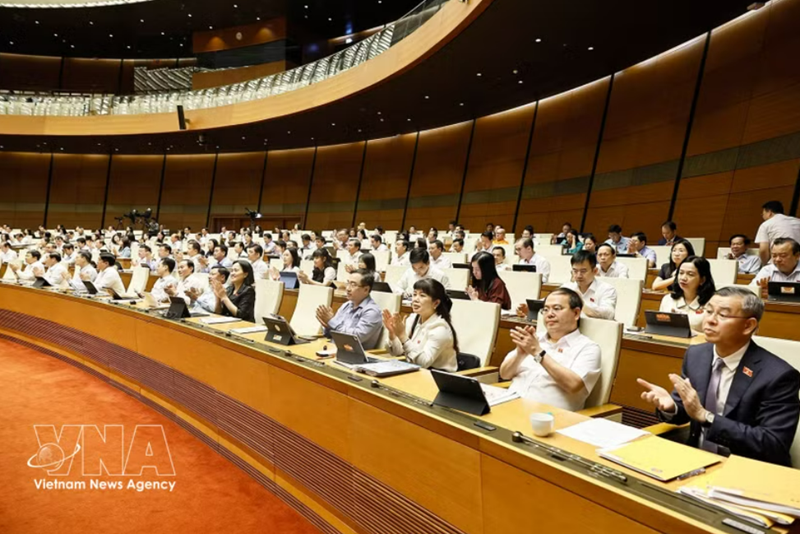
National Assembly deputies vote to pass laws and resolutions. |
The amendments aim to institutionalize Party guidelines on improving institutions, cutting administrative procedures and business conditions, and promoting decentralization in line with the two-tier local administration model. They also seek to codify Government resolutions and prevent legal gaps after March 1, 2027.
The law is expected to help create a healthier and fairer business environment, promote innovation, improve State management and strengthen administrative governance.
Amendments to eight laws will cut 40 administrative procedures, simplify 12 others and remove 40 business conditions. Amendments to four others will decentralize 24 administrative procedures currently under the authority of the Ministry of Agriculture and Environment to provincial-level People's Committee chairpersons.
The law also revises related provisions to ensure consistency among the amended laws.
Deputy Prime Minister Ho Quoc Dung said the revisions would focus on codifying Government resolutions and address administrative procedures and business conditions without introducing new policies, in line with the conclusion of the N.A. Standing Committee.
He said the Government would direct relevant agencies to review implementation, assess impacts and consult stakeholders to propose comprehensive amendments to several laws in the future.
Regarding the removal of plant protection products from the list permitted for use in Vietnam, Dung said the Ministry of Agriculture and Environment had issued regulations allowing products to be removed when scientific evidence shows adverse impacts on human or animal health, ecosystems or the environment, or when they are subject to warnings from international organizations.
The ministry has already removed a number of non-compliant active ingredients and is reviewing others for possible removal, he said.
On proposals to abolish conditions for trading fertilizers and plant varieties, Dung said the Law on Crop Production would continue to prescribe the obligations of organizations and individuals involved in their production and trading.
Counterfeit products and those failing to meet technical standards would be strictly handled, while quality control of imported and marketed plant varieties and fertilizers would continue under relevant laws.
Source: VNA