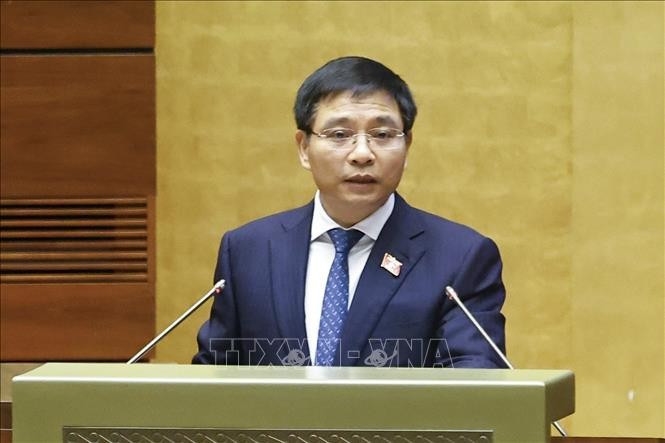
Presenting the report on the revised draft before the vote, Minister of Finance Nguyen Van Thang said the law represents a fundamental shift in investment procedures, with clearer definitions of which projects must undergo investment policy approval
    |
 |
|
Minister of Finance Nguyen Van Thang speaks at the N.A.'s 10th session |
Under the changes, only projects in important or sensitive sectors such as seaports, airports, telecommunications, publishing, journalism, or projects located in areas affecting national defense and security will require such approval.
A major highlight of the revised law is the comprehensive review of conditional business lines in accordance with the Politburo’s Resolutions No.68 and 198. Based on this review, the Government has cut 38 conditional business lines and adjusted the scope of 20 others.
The Government will issue two lists. One list includes sectors where a business license or certification remains necessary before conducting investment activities.
The other list names sectors where licensing requirements will be abolished and replaced with announced business conditions to be managed through post-inspection, shifting from pre-licensing control to a more modern regulatory approach.
For foreign investors, the amended law introduces a key reform that allows them to establish an enterprise before obtaining an investment registration certificate. This is regarded as a breakthrough in simplifying entry procedures and enhancing Vietnam’s competitiveness.
To ensure national defense and security, the Government will supplement regulations in the guiding decree, including reporting responsibilities during the period before project implementation and requirements to meet market-access conditions from the stage of establishing a business entity.
|
|
 |
|
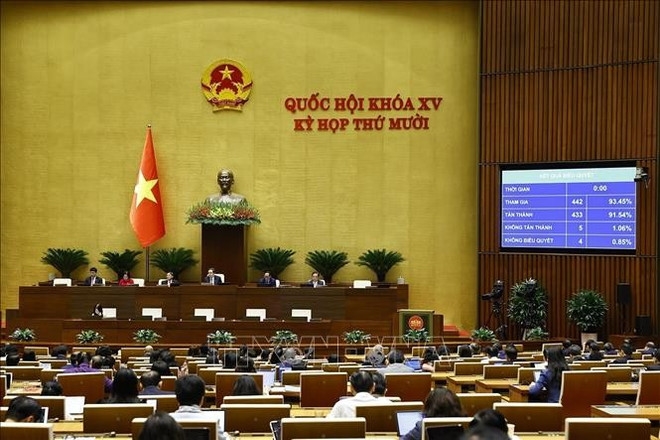
At the N.A.'s 10th session |
Regarding outbound investment, the amended law removes the requirement for investment policy approval for overseas projects and narrows the types of projects subject to outbound investment registration certification. Detailed government regulations will specify which projects are exempt from this procedure, while maintaining strict control over foreign exchange management to safeguard national economic and financial security.
Also on December 11, the N.A. adopted a resolution on mechanisms and policies for energy development for the 2026-2030 period. The resolution grants the Prime Minister authority to approve offshore wind power projects for the 2025-2030 period without requiring land-use auctions or investor bidding.
For the 2031-2035 period, the authority to approve investment policy for offshore wind projects will be decentralized to provincial People’s Committee chairpersons, enhancing local autonomy and expediting project implementation.
The resolution also expands participation in the Direct Power Purchase Agreement (DPPA) mechanism to electricity retailers, ensuring consistency with other laws under review.
Source: VNA