Speaking on the strategic direction set out at the 14th National Party Congress, experts from the Vietnam Union of Science and Technology Associations (VUSTA) highlighted the need to unlock new motivations for growth while balancing economic expansion with environmental protection and governance reform.
Breakthrough shift in environmental development mindset
Reviewing the country’s prominent achievements over four decades of the Doi moi (renewal) process, Dr. Tran Van Mieu, Vice President of VUSTA's Vietnam Association for Conservation of Nature and Environment (VACNE), said Vietnam has successfully transitioned to a socialist-oriented market economy, broken through embargoes and isolation, and steadily emerged as a regional growth bright spots while integrating more deeply into the regional and global economy, laying a solid foundation for a new stage of development.
    |
 |
|
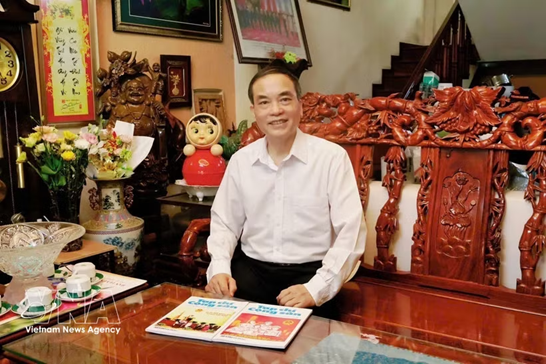
Assoc. Prof., Dr. Vu Van Phuc, Chairman of the Scientific Council of the Institute of Economics and International Law under VUSTA |
The country’s GDP now surpasses USD 514 billion, with per capita GDP exceeding USD 5,026 a year. Alongside economic gains, Vietnam has also made strides in infrastructure development, poverty reduction, human development and global integration.
According to Mieu, Vietnam has undergone a fundamental shift in its development philosophy, moving from exploiting natural resources for growth to pursuing sustainable development. Environmental protection, climate action and green transition have become central to national development strategies, reflected in the commitment to achieve net-zero emissions by 2050 and promote biodiversity conservation alongside benefit sharing.
The expert said despite its economic achievements, Vietnam's rapid industrialization has created growing environmental challenges. He noted that balancing growth with nature conservation requires stronger institutions and clearer responsibilities for authorities, businesses and citizens, wider adoption of green and circular economy models, greater public awareness, more sustainable business practices, science-based planning that respects environmental carrying capacity, and transparent environmental impact assessments.
Science, technology and digital transformation should play a greater role in environmental management, biodiversity conservation and early-risk forecasting through big data systems, he added.
To fulfil Vietnam’s climate commitments, Mieu proposed accelerating the transition to a circular economy, green infrastructure and digital transformation with ecosystems at the center of development. Priorities include advancing a low-carbon economy through eco-design and renewable energy, while strengthening ecosystem-based biodiversity conservation, particularly by restoring mangrove forests to enhance carbon absorption and improve resilience to natural disasters.
He stressed that people must remain at the center of sustainable development, with communities, businesses, schools and social organizations all sharing responsibility for the green transition.
Vietnam should introduce green finance mechanisms to attract sustainable FDI, issue green bonds and develop the carbon credit market, he said, noting that lasting environmental protection depends on putting people at the center of sustainable development by engaging individuals, communities, schools, religious organizations and businesses in the country's green transition process.
Institutional and economic reforms
Sharing Mieu’s opinion, Assoc. Prof., Dr. Vu Van Phuc, Chairman of the Scientific Council of the Institute of Economics and International Law under VUSTA and former Editor-in-Chief of the Communist Review, said Vietnam's national strength, international standing and development potential have reached unprecedented levels after nearly four decades of reform.
From a poor and isolated economy, Vietnam has become one of the world's fastest-growing exporters while making notable progress in social welfare, with the multidimensional poverty rate falling to 1.93%.
Vietnam has signed 17 free trade agreements (FTAs), established diplomatic relations with 194 countries, and set up comprehensive partnerships or higher with 42 countries, and comprehensive strategic partnerships with all five permanent members of the U.N. Security Council.
However, reaching the upper-middle-income status is only an initial step, Phuc said.
To achieve the goal of becoming a developed, high-income country, he proposed a comprehensive set of measures, calling for accelerating the transition to a new growth model driven by digital, data and green economy, with science, technology and innovation as the main engines of growth.
Vietnam should seize opportunities presented by the Fourth Industrial Revolution, particularly artificial intelligence (AI) and semiconductor technology, to boost total factor productivity (TFP), while further improving the socialist-oriented market economy to unlock resources, strengthen development of domestic enterprises and safeguard national interests, he said.
Phuc added that institutional reform should go hand in hand with modern governance, including streamlining the state apparatus and improving the effectiveness of the rule-of-law state.
The expert called for a people-centered governance model, further streamlining the state apparatus, ensuring that all laws and policies prioritize the people's safety, well-being and happiness, and promoting public participation in governance while aligning the Party's vision with the people's aspirations to achieve the country’s long-term development ambitions by 2045.
Source: VNA