Recently, the Prime Minister issued Directive No.18/CT-TTg on improving the quality of commune-level officials and civil servants to meet the requirements of the new situation.
The directive notes that the contingent of commune-level personnel has largely been consolidated and that working methods are gradually shifting towards better serving people and businesses. However, requirements of the new development phase are now significantly higher.
    |
 |
|
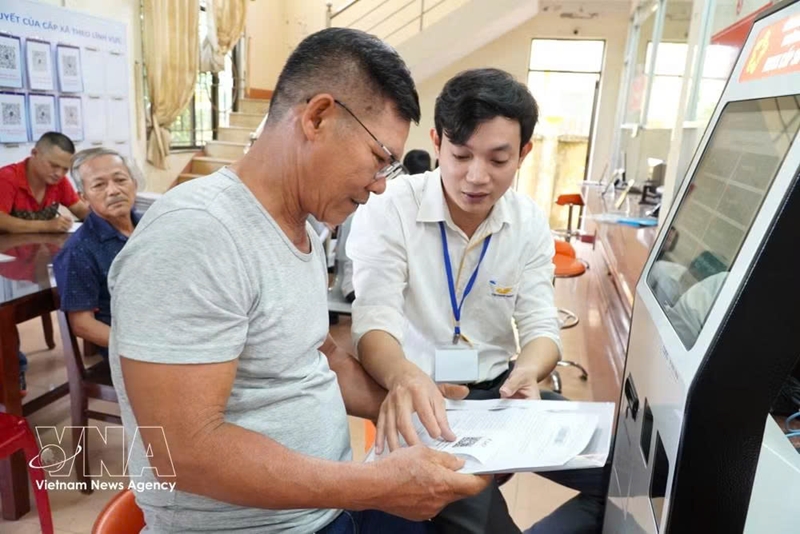
A civil servant guides citizens through administrative procedures in Quang Ngai province. |
As the functions and responsibilities of grassroots administrations continue to expand, and as the country pursues the ambitious double-digit growth target, commune-level authorities are no longer merely handling routine administrative tasks. Instead, they are expected to directly organize the implementation of development policies and address emerging issues right at the grassroots level.
Directive No.18 therefore calls for a comprehensive review of the quality of commune-level personnel, ensuring the right people are assigned to the right positions at the right time and in the right locations, while leveraging their practical capabilities, expertise and experience. It also requires decisive staff streamlining for those with weak capacity, a poor sense of responsibility or who fail to meet task requirements.
Priority is to be given to talented, capable and experienced individuals who can withstand pressure and possess in-depth expertise in complex areas such as land management, construction, and complaint and denunciation settlement. Notably, the evaluation of personnel must be directly linked to work processing progress as well as the satisfaction of citizens and businesses.
This spirit has also been reflected consistently in major directions from the central level. National Assembly Chairman Tran Thanh Man, while presiding over a session examining the legal normative document system, stressed that the process is a “comprehensive institutional review.” He demanded clear identification of regulations hindering development, overlapping provisions and outdated regulations, warning against superficial or vague reporting.
At the first regular meeting of the 16th-tenure Government, PM Le Minh Hung also requested stronger acceleration of decentralization and delegation of authority in tandem with strengthened inspection and supervision, while using reform outcomes as criteria for evaluating ministries, sectors and localities.
The Government has issued eight resolutions on cutting and simplifying administrative procedures and business conditions, abolishing 184 administrative procedures, delegating the handling of 134 procedures to local authorities and removing 890 business conditions.
These figures demonstrate that reforms are moving into practical implementation. However, the Government itself has acknowledged that the operation of the two-tier local administration model still faces shortcomings, including incomplete decentralization and delays in issuing some guiding documents.
Therefore, the resolution of the Government's April 2026 meeting asks for a preliminary review of the one-year implementation and calls for reducing administrative procedure processing times and compliance costs by 50% in 2026 compared to the 2024 levels.
The National Assembly has also urged the Government to tighten discipline and order, practice thrift rigorously and address wastefulness in public asset management, land use and delayed projects. At the same time, savings generated from apparatus streamlining are allowed to supplement salary reform resources.
Practical implementation nationwide has already shown significant changes under the new model.
Lam Dong province, merged with Binh Thuan and Dak Nong, has reduced 66.6% of Party units and 61.9% of administration units while deploying more than 730 personnel to support grassroots authorities.
Thai Nguyen province, has accelerated digital transformation after the administrative merger with Bac Kan, with Phan Dinh Phung ward processing nearly 25,000 administrative dossiers online since July 2025 and achieving a 97.2% resolution rate with support from an AI-powered virtual assistant system.
However, challenges remain. Some localities still face difficulties in operating the new model, including personnel imbalances, uneven digital capabilities and slow adaptation among some civil servants.
Da Nang city has acknowledged that some personnel continue to work according to outdated methods and stressed that weak or irresponsible ones must be replaced and not be allowed to hinder development.
Authorities at both central and local levels have emphasized that further institutional reform, stronger discipline, enhanced digital transformation and effective personnel arrangements will be essential to ensuring the two-tier local administration model becomes a true driver of fast and sustainable national development.
Source: VNA