Major overhaul of judicial apparatus on large scale
The inspection team found that the court’s Party Committee had strictly followed Party resolutions and carried out a drastic, large-scale restructuring that compresses the court system from four tiers to three. The reform reorganized 693 district-level people’s courts into 355 regional people’s courts, while 63 provincial-level courts were merged into 34 units. The team called it one of the largest-ever organizational reshuffles ever inside Vietnam’s judicial apparatus.
    |
 |
|
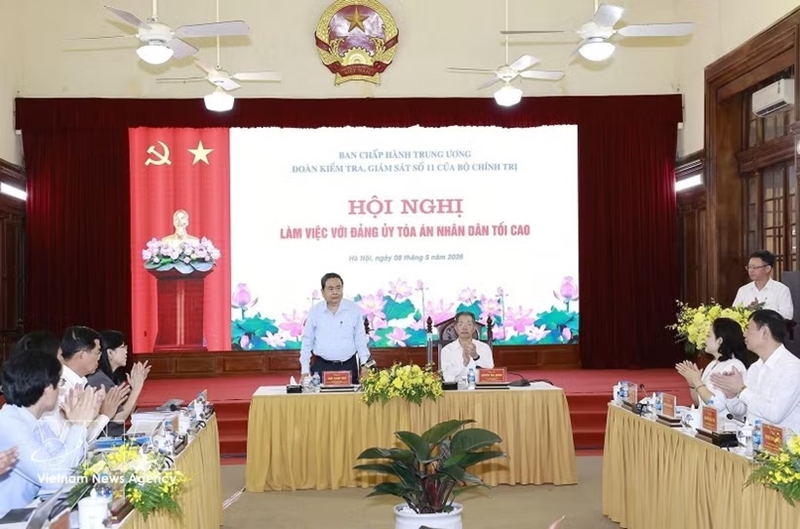
N.A. Chairman Tran Thanh Man speaks at the working session. |
At the same time, the court sector handled a heavy strategic advisory and institutional reform workload. It presented a major proposal to the Politburo to create a specialized court at the International Financial Center (IFC) and is advancing three central-level projects. Since July 1, 2025, the sector has been drafting five laws, nine decrees and 12 joint circulars.
The team said efforts to upgrade and standardize the legal framework have accelerated. Work is underway on 13 resolutions of the Council of Judges, 12 circulars from the Chief Justice, one lead joint circular and 11 coordinated joint circulars, aiming for consistent enforcement across the country’s entire legal system.
The court sector has also issued a series of directives on digital transformation covering e-courts, digital data strategies, digital signatures, case management software, data standardization, cybersecurity and online procedures, signaling the Supreme People’s Court’s determination to build a modern electronic judiciary.
A solid political and legal “fortress” to bolster public trust
Chairman Man urged the people’s court system to keep thoroughly grasping and effectively following the Party’s policies and guidelines on comprehensive national renewal and strategic breakthroughs for national development.
It was asked to strengthen strategic advisory role for the Party and State, and effectively follow policies on building a socialist rule-of-law state, advancing judicial reform and improving the legal framework for national development.
Courts at every level must fully enforce seven laws and two resolutions of the 15th N.A., along with five ordinances and nine resolutions from the N.A. Standing Committee. These include the amended Law on Organization of People’s Courts, the Law on amendments and supplements to several articles of the Civil Procedure Code, the Law on Administrative Proceedings, the Law on Juvenile Justice, the Bankruptcy Law, the Law on Mediation and Dialogue at Courts, the 2025 Law on Specialized Court at the IFC, and Resolution 33 dated November 12, 2021 on online court hearings.
Stressing that the country’s new development phase demands not only greater effort but measurable results, he pushed courts at all levels to raise the quality and efficiency of adjudication, calling it the core mission of both the judiciary and judicial reform.
He also called for a comprehensive review of the three-tier court model using concrete metrics such as case backlogs, overdue cases, trial quality, resolution time and public satisfaction. He stressed the need to quantify the judiciary’s contribution to economic development through the handling of commercial disputes, bankruptcy cases, property rights protection and improvements to the investment climate.
Digital transformation, he said, must be tied directly to judicial work, with the ultimate goal of cutting processing times, boosting transparency and lifting adjudication quality, not simply deploying software.
The court sector was also told to tighten performance evaluations for officials based on work outcomes, trial results and the accountability of both individuals and agency heads. He further highlighted the importance of international cooperation and learning from global judicial experience to reinforce the domestic court system, especially in cases involving foreign and international elements, and engage more actively in international justice mechanisms.
Chief Justice Nguyen Van Quang affirmed that the Supreme People’s Court’s Party Committee would continue directing the judiciary to effectively follow the 14th National Party Congress’s resolution and key Politburo and Secretariat conclusions. The sector, he said, would keep improving adjudication quality, safeguarding justice and human rights, advancing judicial reform and contributing more actively to national development in the new era.
Source: VNA