Expectations from veteran revolutionaries
Nguyen Dinh Ngo, 90, a former National Assembly deputy for three consecutive terms (7th, 8th and 9th tenures) representing the former Thua Thien Hue province (now Hue city), expressed pride and optimism ahead of the congress. He said the Party has consistently adhered to the revolutionary path charted by President Ho Chi Minh, with its correctness and superiority proven through historical challenges.
    |
 |
|
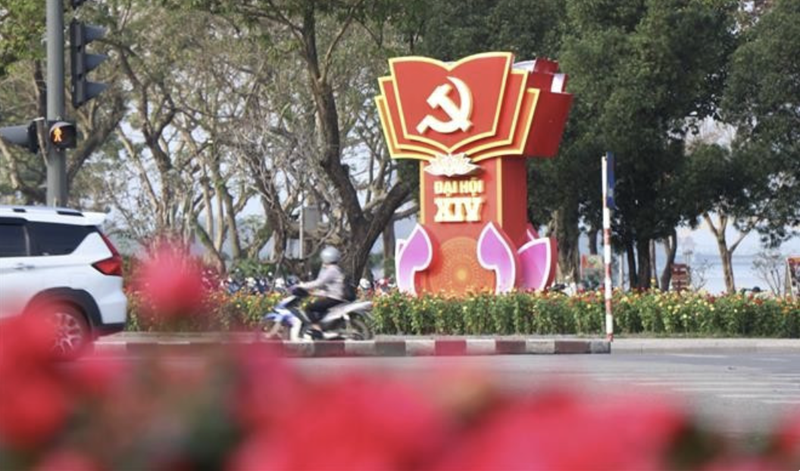
Streets in Hue city are decorated to welcome the 14th National Party Congress |
He noted that the Party has always placed the people at the center, regularly listening to public opinions, practicing democracy, and consulting the population on major issues to ensure policies align with people’s interests.
He particularly welcomed the Party’s resolute anti-corruption drive, carried out with determination, without forbidden zones or exceptions, as a clear demonstration of its commitment to organizational integrity.
Ngo also noted that the Party’s leadership has remained proactive in embracing global development trends, especially through the promotion of digital transformation and innovative policies, contributing to Vietnam’s growing international standing.
He voiced his confidence that the 14th National Party Congress will be a success and expressed a hope that future policies will continue to prioritize social welfare, with stronger investment in health care and education, moving gradually towards free medical services and education to ensure equitable access to development gains.
Calls for breakthroughs in education, science, technology, social welfare
Associate Professor Dr. Vo Thanh Tung, President of the University of Sciences under Hue University, said he firmly believed the congress would play a pivotal role in advancing renewal and modernization, guiding the country into a new development era. As both a Party member and an education administrator, he expressed strong expectations that education would be positioned as a central pillar, driving force and foundation for national development.
Dr. Tung highlighted recent landmark policies, including Politburo Resolution 71 on breakthroughs in education and training, and Resolution 57 on science, technology, innovation and national digital transformation, describing them as timely catalysts that have injected new momentum into education reform and scientific advancement.
He said hopes the congress will further institutionalize bold and decisive mechanisms, particularly in basic sciences, high technologies and advanced engineering.
As a research-oriented institution and one of the country’s three major centers for basic sciences, the University of Sciences pledges to strive for new achievements in celebration of the congress, contributing to national progress in the new era.
Meanwhile, Le Viet Hoan, Chief of the Office of the An Cuu ward Party Committee, noted that the congress is taking place at a special juncture, as Vietnam implements a two-tier local government model following administrative streamlining and restructuring. He described this as an important foundation for more effective governance aligned with public needs.
Representing younger generations, Nguyen Anh, a fourth-year student at the University of Sciences, expressed hope that the congress would adopt policies supporting post-graduation employment, encouraging innovative start-ups, reducing institutional bottlenecks, and creating conditions for young people to secure stable livelihoods and sustainable development.
Anh also voiced expectations for greater trust in youth by assigning them responsibilities in start-up projects, scientific research and digital transformation initiatives.
Source: VNA