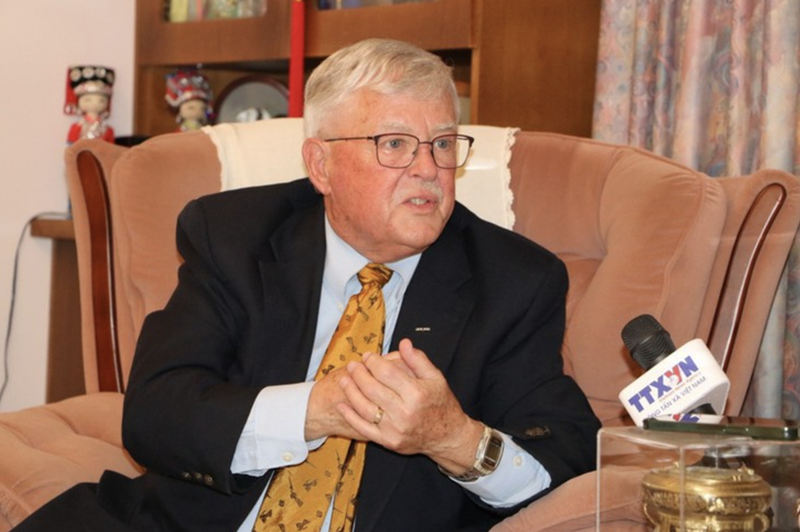
Speaking to Vietnam News Agency correspondents in Australia following the conclusion of the Congress, Thayer highlighted a notable shift from policy formulation to effective implementation and the pursuit of concrete outcomes, including enhancing national stature and raising living standards.
    |
 |
|
Emeritus Professor Carl Thayer of the Australian Defense Force Academy at the University of New South Wales |
He said the Congress was particularly significant in refining and completing strategic orientations that have been carefully prepared over time.
Despite rapid and unpredictable global changes, Vietnam’s development direction remains consistent, he noted, adding that the Congress once again demonstrated an orderly and stable generational transition in leadership.
Thayer praised the consolidation of the Political Report, the socio-economic report and the Party-building review report into a single, comprehensive Political Report, describing it as coherent, detailed and substantive.
While acknowledging periods of turbulence marked by the resignation and accountability of several senior officials, the scholar said these developments underscored Vietnam’s commitment to political stability and orderly power transition. The emergence of a younger leadership cohort, coupled with an extensive free trade agreement network, a growing role within ASEAN and ambitions to become a regional information technology hub, has reinforced international confidence in prospects of cooperation with Vietnam.
Against an increasingly complex global backdrop, Thayer cautioned that Vietnam must avoid being drawn into escalating conflicts. Being invited to participate in the Board of Peace for Gaza and the country's past service as a non-permanent member of the U.N. Security Council reflect the rising international credibility of Vietnam and expectations for a more active role in multilateral affairs, he said.
Looking ahead to the next five to ten years, the professor identified four major priorities: advancing sustainable development and improving quality of life; ensuring energy security amidst green transition and the expansion of energy-intensive sectors such as artificial intelligence and big data; completing and synchronizing infrastructure systems; and developing capital markets alongside attracting high-quality human resources.
He observed that Vietnam is adopting a more confident and proactive foreign policy, gradually positioning itself as a regional “middle power”. To fulfill this role, the country should continue helping with strengthening ASEAN, narrowing intra-bloc development gaps, supporting members facing challenges such as Myanmar, Cambodia, Laos and Timor-Leste, and contributing to regional peace and stability.
In the Indo-Pacific, Vietnam pursues comprehensive strategic partnerships without aligning with any side, prioritizing national and regional security while engaging in practical cooperation to address shared challenges. This approach, Thayer said, enables the country to maintain strategic flexibility and sustain a stable and predictable regional environment.
On the economic front, he stressed the need for Vietnam to fully leverage its network of 19 free trade agreements, including RCEP, CPTPP, the FTAs with the E.U. and the Eurasian Economic Union, while expanding into Middle Eastern and South American markets. Proactive and timely action by policymakers will be crucial to turning these opportunities into tangible gains.
Assessing Australia – Vietnam relations following their elevation to a Comprehensive Strategic Partnership, Thayer said bilateral cooperation rests on a solid foundation, with a focus on human resources development, digital transformation, climate change response and high-quality education. Emerging cooperation in minerals and energy was also highlighted as a promising area to boost value addition and enhance Vietnam’s economic competitiveness.
Source: VNA