An article in The New York Times described the 14th National Congress as the most consequential in decades, taking place at a time when Vietnam, an emerging middle power and one of Asia’s most dynamic countries, is facing its best and last chance to “get rich before getting old.”
According to the article, after 40 years of renewal and an extraordinary rise out of poverty, Vietnam is under growing pressure to pursue bolder reforms to catch up with regional peers. Beyond geopolitical challenges, the country’s main challenge is implementing policies that build openness, efficiency and competition, it wrote.
    |
 |
|
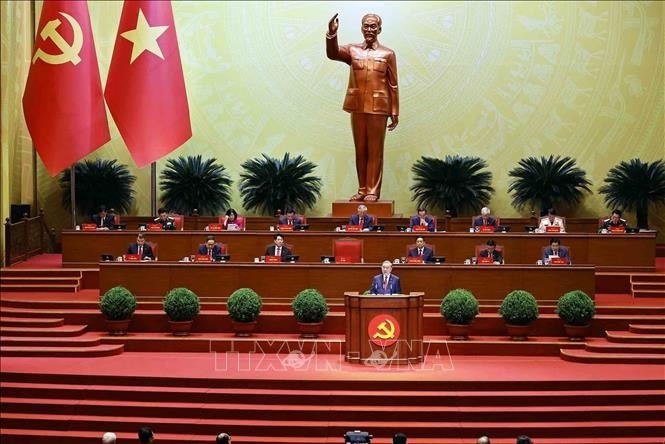
Party General Secretary To Lam delivers the 13th Party Central Committee's report on the documents submitted to the 14th National Party Congress on January 20 morning. |
Commenting on Vietnam’s agenda for the next five years, Modern Diplomacy noted that the draft Resolution of the CPV’s 14th National Congress reflects a stronger focus on security alongside ambitious economic growth targets. The Party has set a goal of achieving annual growth of at least 10% over the next five years - a significant leap compared to earlier targets. The article observed that, internationally, Vietnam’s political stability continues to provide reassurance for investors seeking predictability.
Meanwhile, an article on the Congress, published by China’s Shangguan News website, recalled the economic targets set at the 13th National Congress. These include transforming Vietnam by 2025 into a developing country with a modern-oriented industry and surpassing the lower-middle-income threshold. By 2030, the country would develop into an upper-middle-income nation with modern industry, and by 2045, into a high-income developed nation. Analysts noted that this will require Vietnam’s per-capita GDP to increase by around 70% by 2030 from its current level of approximately 5,000 USD. It is anticipated that the Vietnamese Government will focus on promoting private-sector development, the digital economy, and science and technology.
The article also revealed that despite facing an additional 20% tariff imposed by the US Government, Vietnam’s economy has demonstrated strong resilience, recording economic growth of over 8% last year. However, the country continues to face significant challenges, including meeting the expectations of its domestic youth workforce, balancing relations with China and the US, and addressing issues such as environmental pollution.
The Chinese news portal 163.com highlighted three strategic breakthroughs identified in the draft documents submitted for discussion at the 14th National Congress. They include developing institutions, economic restructuring, and improving the quality of human resources. Further breakthroughs include building socio-economic infrastructure, particularly in transport, technology and energy infrastructure.
In an article published on January 20, Bloomberg quoted analysts as saying that the 14th National Congress of the CPV represents the formalization and consolidation of measures that have shaped the country’s macroeconomic trajectory. As Vietnam seeks to move up the value chain and achieve high-income status by 2045, the Congress is aiming to promote the development of the private sector as one of the most important drivers of growth. Vietnam continues to position itself as an economy open to trade and investment, while seeking to reduce vulnerability to external shocks through diversification, strengthening internal capacity and enhancing institutions.
Source: VNA