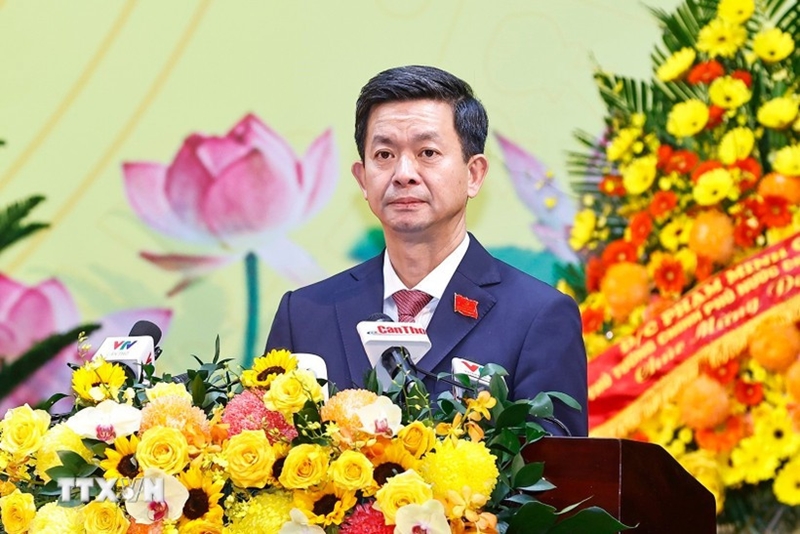
This is a very high target for Can Tho amid intertwined advantages and challenges, said Le Quang Tung, Secretary of the municipal Party Committee and head of the city’s delegation to the 14th National Party Congress, during an interview granted to the press on the sidelines of the event, a major political event charting Vietnam’s strategic development orientations for the new period.
Following the merger of Can Tho with Hau Giang and Soc Trang provinces on July 1, 2025, the city’s development space has expanded significantly, opening up new opportunities, potential, and comparative advantages.
    |
 |
|
Le Quang Tung, Secretary of the Party Committee of Can Tho city |
Alongside favourable conditions, the expanded Can Tho faces considerable challenges. After the merger, the city has yet to fully meet several criteria of a centrally governed municipality, including those related to urban development, average per capita income, and overall socio-economic performance. Agriculture still accounts for a relatively high proportion of the local economic structure.
The city must also address issues related to social security, poverty reduction, agriculture, rural areas, and farmers. Currently ranking second nationwide in food production as well as agricultural and fisheries output, Can Tho holds considerable potential, but to realise the high growth targets, it still needs to exert greater efforts in the time ahead, Tung admitted.
Overcoming challenges
To fulfil its role in leading the Mekong Delta's development, he stressed that Can Tho must prioritise economic development, ensuring an annual growth rate of 10–10.5% through 2030.
According to the provincial leader, improving people’s living standards, both materially and spiritually, is identified as a top priority. To consolidate its leading position, particularly in terms of the indicators pertaining to people’s happiness such as average income, environmental quality, education and health care, the city needs to pay special attention to disadvantaged areas.
Following the merger, Can Tho now has the highest proportion of ethnic minority residents nationwide, including the largest Khmer community, while many communes remain poor or extremely disadvantaged. These require sustained solutions to guarantee social security and improve the life quality for locals, which is essential for the city to play a genuine leading role in the region.
Another key task is strengthening Can Tho’s position as an education and training hub of the Mekong Delta, the official stated. By 2030, the city aims to become a centre for developing high-quality human resources for the region through increased investment, improved support policies and the attraction of new training institutions, thus encouraging learners to come to study, work and make contributions in the locality.
The city also looks to establish itself as a specialised healthcare centre for the Mekong Delta. Despite substantial investment in recent years, many patients still seek treatment in Ho Chi Minh City while local specialised services have yet to meet the requirements of a highest-level referral centre in the region. Developing advanced healthcare facilities and a medical training system will therefore be a priority, Tung said.
Culture is another area requiring stronger investment to affirm Can Tho’s status as the cultural centre of the Mekong Delta. The city aims to be home to distinctive cultural symbols of the southwestern region, take the lead in adopting regional cultural standards, and become a city of festivals showcasing the delta’s rich historical, revolutionary and ethnic heritage.
Science – technology and innovation are identified as a key development driver. Can Tho plans to strongly promote sci-tech application, digital transformation, and artificial intelligence in production and governance, while working towards establishing regional innovation and data centres to serve the Mekong Delta. Given this, it will step up attracting both investors and scientists to the city in the coming time.
In addition, tourism is also a sector with strong potential. From now until 2030, the city aims to develop tourism into a key economic pillar, enabling visitors to better experience the unique riverine culture of the Mekong Delta, the official said.
Source: VNA