Beyond Lunar New Year celebrations and major festivals, Vietnamese identity lives on in the language spoken at home, traditional meals, family ties and enduring affection for the homeland. Through these everyday practices, Vietnamese people abroad maintain a strong connection with their roots as they integrate into their host society.
For people living far from home, geographical distance is not always the greatest challenge. The bigger question is how to keep memories, customs and cultural values from fading. As daily life unfolds in a different social environment, with the host country's language dominating work and communication, familiar traditions from home can gradually lose their place.
    |
 |
|
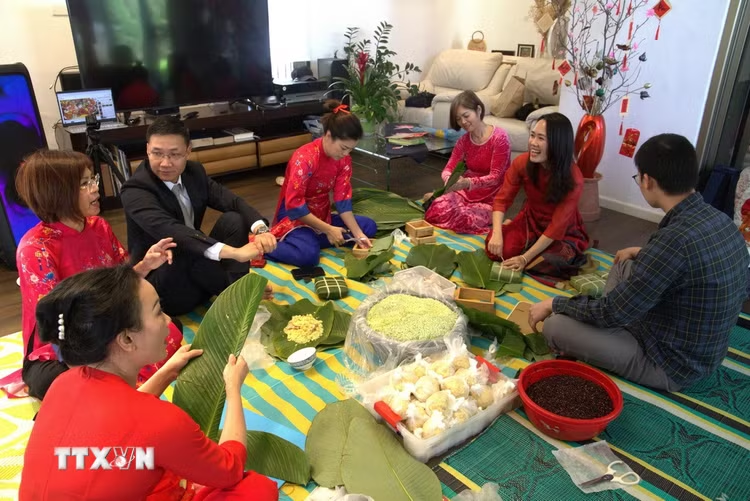
The Vietnamese community in Israel gathers to make "banh chung" (square sticky rice cake) for the Lunar New Year. |
This is a concern for the Vietnamese community in Israel, which numbers around 900 people, including long-term residents, Vietnamese-Israeli families, workers, agricultural trainees and students. Scattered across different localities and living in diverse circumstances, they have an even greater need for a shared cultural space.
Culture, therefore, is more than a series of festive activities. It is a way for the community to reaffirm its ties with Viet Nam. A conversation in Vietnamese, a traditional dish or a weekend gathering can all help keep those connections alive.
For Vietnamese people who have lived in Israel for decades, memories of home often survive through the simplest things, such as the names of familiar dishes, New Year greetings, incense offerings to honor ancestors and stories of their hometowns passed down to younger generations. These small gestures give cultural identity its lasting depth.
While the Lunar New Year brings together some of the most distinctive features of Vietnamese culture, its lasting vitality depends on everyday life.
In Israel, preparing Vietnamese dishes, maintaining family customs and gathering with fellow Vietnamese have become part of daily life for many. Banh chung and banh tet (traditional sticky rice cakes), nem ran (fried spring rolls) and home-style soups do more than satisfy culinary cravings as they evoke memories of family, home and past Tet celebrations.
Food also serves as a bridge between Vietnamese people and their host society. In Be'er Sheva, in the Negev Desert, a restaurant named “Hanoi, Vietnam” offers a taste of home, while “Nem Viet” in Haifa introduces local residents and international visitors to Vietnamese cuisine. These businesses not only ease homesickness but also open a window onto Vietnamese culture.
Community ties provide another vital source of strength. Since the Association of Vietnamese People in Israel was established in March 2025, it has organized gatherings, cultural exchanges and celebrations of the Lunar New Year, Mid-Autumn Festival and other traditional occasions, with active participation from community members. Such events create a shared space for Vietnamese people while giving younger generations, particularly children from multicultural families, opportunities to experience their cultural heritage.
Solidarity, however, goes beyond festive occasions. When someone falls ill, is hospitalized or faces financial hardship, fellow community members step in with visits, encouragement and practical assistance. During periods of heightened security tensions in Israel, sharing information and looking out for one another's safety have become especially important.
The community also remains deeply attached to Viet Nam. Whenever natural disasters or floods strike at home, many contribute to relief efforts for affected communities. Though individual donations may be modest, they reflect a strong sense of responsibility and affection for the homeland. Such acts keep alive traditional values of mutual support and compassion, binding Vietnamese people together thousands of kilometers from home.
The greatest challenge to preserving Vietnamese culture abroad may lie not with those who grew up in Viet Nam, but with young people born and raised in their host country.
For children in Vietnamese-Israeli families, Hebrew and English often dominate communication at school and in wider society. Without regular exposure, Vietnamese can gradually become a language used only when speaking to parents or grandparents. Traditional customs and stories about Viet Nam's history and culture may also become increasingly unfamiliar.
Preserving the Vietnamese language is therefore a priority. More than a means of communication, the mother tongue is a gateway to understanding the nation's culture, history and identity. Families can help by speaking Vietnamese at home, encouraging children to join community activities and exploring suitable ways for them to learn the language.
Passing on cultural identity must also go beyond asking young people to observe traditional customs. They need to understand the values behind them, including filial piety, respect for the elderly, solidarity and strong family bonds. When these values are understood and felt, the desire to preserve their heritage can grow naturally.
Preserving national identity does not mean turning away from the host society. Embracing its positive values, respecting cultural diversity and actively integrating into local life can help the Vietnamese community thrive while promoting the image of Viet Nam and its people.
Through their work, studies, businesses and everyday interactions, Vietnamese people can serve as cultural ambassadors in Israel. Their diligence, friendliness, resilience, compassion and strong family values all help build a positive image of the community.
Keeping Vietnamese identity alive abroad is not about clinging to the past. It is about carrying the nation's finest values into the present and passing them on to future generations. When children speak Vietnamese with their grandparents, families gather around traditional meals and people far from home continue to support one another, Vietnamese culture remains alive.
Distance may take people away from their homeland, but it need not separate them from their roots. National identity lives not only in symbols and rituals, but also in family life, everyday actions and the hearts of Vietnamese people.
Source: VNA