The agreement was reached during their talks in Hanoi within the framework of the EC President’s official visit to Vietnam on January 28 and 29.
    |
 |
|
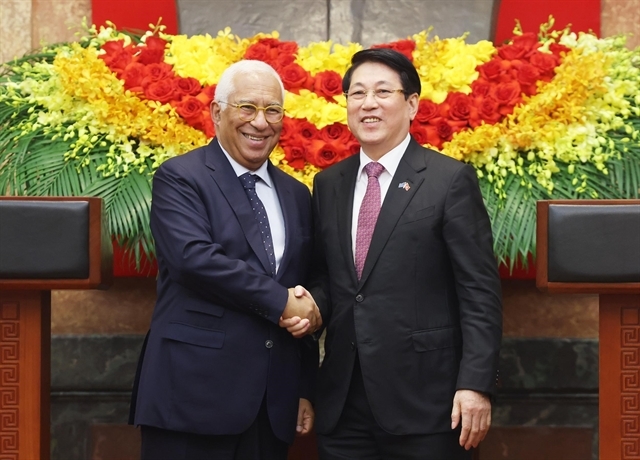
Vietnamese President Luong Cuong (right) and European Council President António Costa |
At the talks, President Luong Cuong highlighted the historic significance of the trip as the first visit to Vietnam by a President of the European Council since 2012, and the first by a European leader following the 14th National Congress of the Communist Party of Vietnam.
He affirmed that the visit opens a new chapter in Vietnam–E.U. relations, marked by the two sides’ decision to elevate bilateral ties to a Comprehensive Strategic Partnership.
Appreciating the European Union’s role and standing as a leading global center of politics, economy, science and technology, and culture, the State President affirmed that Vietnam consistently regards the E.U. as one of its most important partners in foreign policy. He underscored the country’s desire to develop relations with the E.U. in a deep, comprehensive manner, while continuously strengthening friendship and cooperation with E.U. member states.
He also highlighted the E.U.’s role in promoting multilateralism and upholding international law in pursuit of peace, stability and development in the regions and the world.
Briefing the guest on the key outcomes of the 14th National Party Congress, President Luong Cuong emphasized Vietnam’s two 100-year strategic goals: becoming a developing country with modern industry and upper-middle income by 2030, and a developed, high-income country by 2045. He stressed that building a new growth model based on science and technology, innovation, digital transformation and green transition is among Vietnam’s key priorities, and affirmed that it stands ready to continue working alongside the E.U. in a new era of development.
On this basis, President Luong Cuong proposed the two sides closely coordinate in implementing the substance of the Joint Statement on upgrading bilateral relations, with six key orientations. These include strengthening political trust through the exchange of high-level delegations and contacts; effectively implementing existing cooperation mechanisms while expanding new ones; identifying economic collaboration as a continued key driver of the bilateral ties; making science, technology and innovation a genuine pillar of cooperation; and promoting respect for international law and multilateralism.
He called on the E.U. to promote collaboration in marine economy, support Vietnam in building a sustainable fisheries sector, and soon lift the “yellow card” imposed on Vietnamese seafood. He affirmed that Vietnam supports stronger ASEAN–E.U. relations and stands ready to serve as a bridge to further deepen substantive cooperation between the two sides, toward the 50th founding anniversary of ASEAN–E.U. relations in 2027.
|
|
 |
|
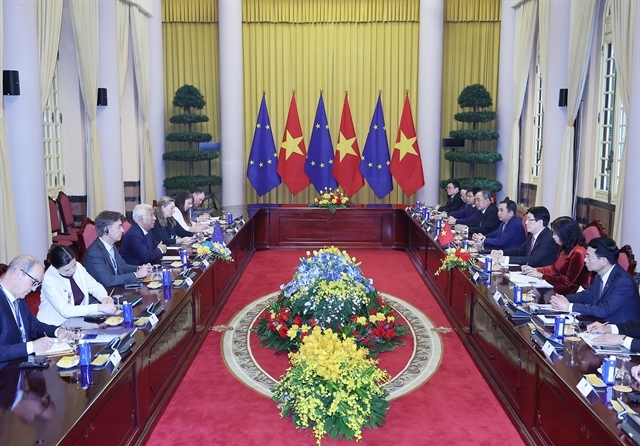
An overview of the talks between Vietnamese President Luong Cuong and European Council President António Costa |
Expressing his honor as the first European guest to visit Vietnam immediately after the 14th National Party Congress - a moment of great significance in shaping Vietnam’s future, EC President Costa thanked the Vietnamese State and President Luong Cuong for their warm and gracious reception. He congratulated the success of the 14th National Party Congress and expressed his deep admiration for Vietnam’s major, comprehensive socio-economic achievements over 40 years of Doi moi (Renewal).
Congratulating the country on its increasingly prominent role, standing and reputation in the international stage, EC President Costa affirmed that the E.U. regards Vietnam as an important partner within ASEAN and in its Indo-Pacific Strategy, as well as a partner sharing common values with the E.U., including respect for international law and support for free trade and freedom of navigation.
EC President Costa said his visit marked a historic moment, with the two sides upgrading their ties to a new level, making Vietnam the E.U.’s first comprehensive strategic partner in ASEAN. The move reflects not only the depth of the 35-year relationship but also the growing closeness and alignment of long-term visions amid an increasingly unpredictable global landscape, he said.
He noted the vast potential for cooperation across a wide range of fields, including trade, sustainable development, innovation, the maritime economy, governance, security and people-to-people exchanges. He expressed the E.U.’s desire to step up cooperation with Vietnam in traditional areas such as trade and investment, agriculture, sustainable development and climate change response, while expanding collaboration into new domains such as green transition, digital transformation, just energy transition, infrastructure and transport connectivity. Such cooperation, he stressed, should be commensurate with the level of the comprehensive strategic partnership and serve as a model for E.U. relations with a Southeast Asian country.
The two leaders officially announced the upgrade of Vietnam–E.U. relations to a Comprehensive Strategic Partnership after 35 years of establishing diplomatic ties, and agreed on orientations for developing an action plan to effectively implement the Joint Declaration on the Vietnam–E.U. Comprehensive Strategic Partnership in the coming period.
They agreed to promote cooperation in science, technology and innovation, elevating this area into a new pillar of bilateral relations, particularly in fields where Europe has strengths such as science, digital transformation and connectivity. Both sides committed to fully and effectively implementing the E.U.–Vietnam Free Trade Agreement (EVFTA) and to working towards the early completion of the ratification of the E.U.–Vietnam Investment Protection Agreement (EVIPA), with a view to delivering tangible benefits for businesses on both sides and encouraging high-quality E.U. investment flows into Vietnam. They also agreed to maintain the effectiveness of the Vietnam–E.U. Defense and Security Dialogue mechanism, enhance cooperation in UN peacekeeping operations, and expand collaboration in maritime security, cybersecurity and crisis management.
Both sides further consented to strengthen cooperation on environmental protection and climate change response, green economy, circular economy, marine economy and clean energy.
Exchanging views on regional and international issues of mutual concern, the two sides agreed to enhance coordination in addressing global challenges, promote multilateralism, uphold international law and resolve disputes peacefully in accordance with the U.N. Charter. They underlined the importance of maintaining peace, stability, freedom of navigation and overflight, and the rule of law in seas and oceans, including the East Sea (South China Sea), as well as in the Indo-Pacific and the Atlantic.
Source: VNA