Meeting with Japanese Minister of Education, Culture, Sports, Science and Technology Seki Yoshihiro on October 2, Quan proposed the Japanese side continue providing postgraduate scholarships, particularly at master's and doctoral levels in strategic technological sectors, facilitate exchanges among students and researchers, and maintain support for the Viet Nam Japan University (VJU).
    |
 |
|
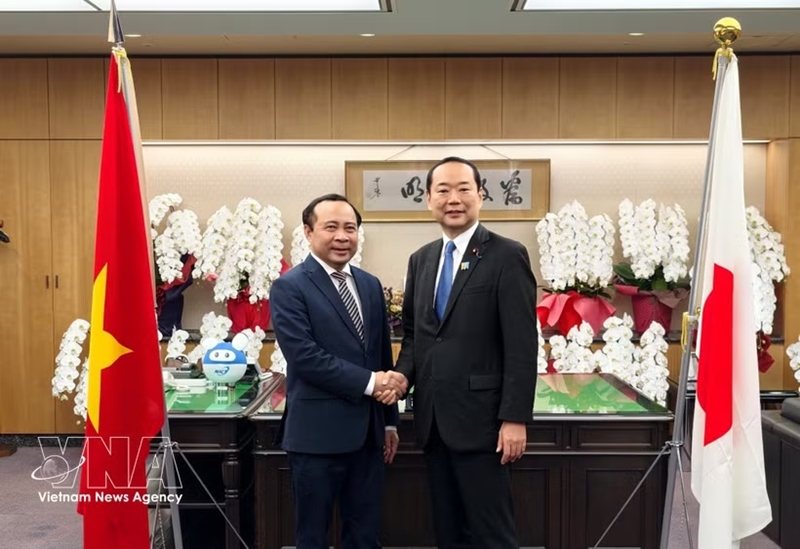
Minister of Science and Technology Vu Hai Quan (left) meets with Japanese Minister of Internal Affairs and Communications Fujii Hisayuki. |
The two sides discussed expanding training and research programmes for Vietnamese human resources, focusing on strengthening links among training, research and practical applications in semiconductors.
Viet Nam proposed studying the establishment of a Mini Fab Lab at VJU for training, research and small-scale experimental chip production, while Japan suggested relevant agencies continue discussions on the model, conditions and implementation plans.
The two ministers also discussed the Nexus program on semiconductor cooperation and high-tech human resources training, with Viet Nam proposing its expansion to AI, quantum technology and healthcare and stronger links with Japanese research institutions.
In healthcare, they discussed potential cooperation with the Japan Agency for Medical Research and Development (AMED).
The Japanese side said it will continue receiving Vietnamese students and researchers and promote exchanges between research institutions, while introducing programs of the Japan Society for the Promotion of Science (JSPS), including joint research and short-term programs for foreign researchers.
Seki affirmed that Viet Nam is an important partner of Japan and expressed his wish to expand scientific and technological cooperation.
The two sides agreed to assign relevant agencies to concretise cooperation in semiconductors, AI, quantum technology and healthcare.
At the working session with Japanese Minister of Internal Affairs and Communications Fujii Hisayuki, the two sides discussed AI, digital infrastructure, human resource training and policy coordination in the information and communications sector. The ministers agreed to continue the bilateral consultation mechanism launched in 2017, with the next joint working group meeting scheduled in Viet Nam in late October.
The Japanese official proposed stronger cooperation on AI safety, sector-specific AI models, Vietnamese-language data and human resources training. Meanwhile, the Vietnamese official suggested studying a cooperation program on AI human resources training with specific objectives and scale.
The two sides also discussed 5G, Open RAN and data centres.
Addressing the Viet Nam-Japan Digital Technology Forum 2026 in Tokyo on the same day, Quan outlined four cooperation orientations between the two nations: modernizing core technology systems, and jointly researching, designing and testing advanced technologies such as AI, robots and unmanned aerial vehicles. Training AI engineers based on businesses' needs, and bringing jointly developed products to global markets and supply chains round out the orientations.
A representative of the Japanese Ministry of Internal Affairs and Communications stressed the need to establish an appropriate testing environment and legal framework for businesses from the two countries to carry out joint research and development projects, particularly in AI and digital infrastructure.
The forum also featured an exhibition and business-matching activities, offering a good chance for Vietnamese technology companies to connect with Japanese partners and seek cooperation projects in high-tech fields.
During his stay, Quan also worked with the leadership of the University of Tokyo and visited FPT Japan to discuss technology development orientations.
Source: VNA