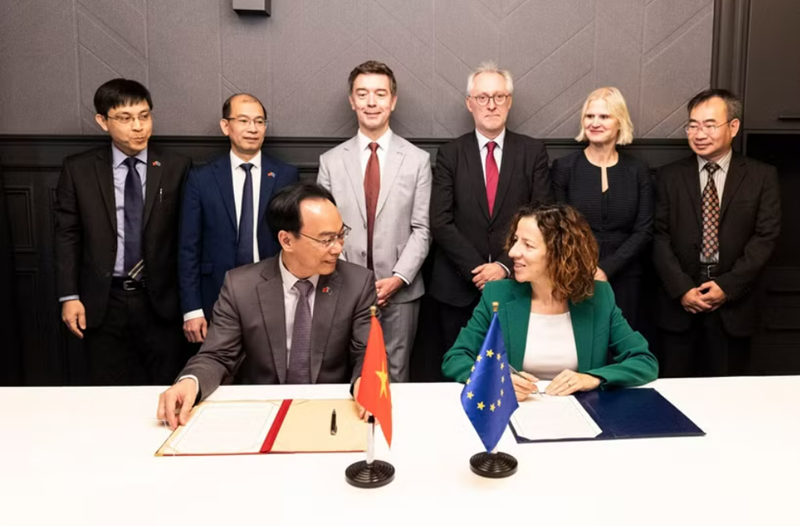
Minister of Education and Training Hoang Minh Son and European Commission Executive Vice-President Roxana Minzatu signed the document.
Since establishing diplomatic relations in 1990, Viet Nam and the European Union (E.U.) have maintained strong, important, and steadily growing ties.
    |
 |
|
Vietnamese Minister of Education and Training Hoang Minh Son (left) and E.C. Executive Vice-President for Social Rights and Skills, Quality Jobs and Preparedness Roxana Minzatu sign the Letter of Intent on Education and Training on October 22 in Brussels. |
Education and training are among the key areas of cooperation outlined in the E.U.-Viet Nam Framework Agreement on Comprehensive Partnership and Cooperation (PCA), signed in 2012 and entering into force in 2016. Under the agreement, both sides agreed to promote cooperation in education and training while respecting their respective diversity to enhance mutual understanding. They also agreed to raise awareness of educational opportunities in the E.U. and Viet Nam.
Building on their shared interests and common priorities, the two sides seek to deepen and expand cooperation in education and training. The Letter of Intent sets out a comprehensive roadmap for current and future cooperation, aiming to develop a substantive, equal, and mutually beneficial partnership.
Areas of cooperation include information exchange; networking under the Erasmus+ program; collaboration through the Global Partnership for Education (GPE) and other educational programs at various levels. The two sides also aim to support Erasmus+ national contact points in carrying out their assigned roles; build the capacity of individuals and academic institutions; promote mobility for learners and academic staff; exchange experience and best practices; and facilitate joint education and research programs.
According to Minister of Education and Training Hoang Minh Son, the signing of the Letter of Intent opens a new chapter in education cooperation between Viet Nam and the E.U. The two sides have previously implemented various education and training support programs, while direct partnerships between universities and colleges have been maintained for many years. Through this letter, they seek to pursue more comprehensive cooperation, spanning general education, vocational education and training, and higher education.
|
|
 |
|
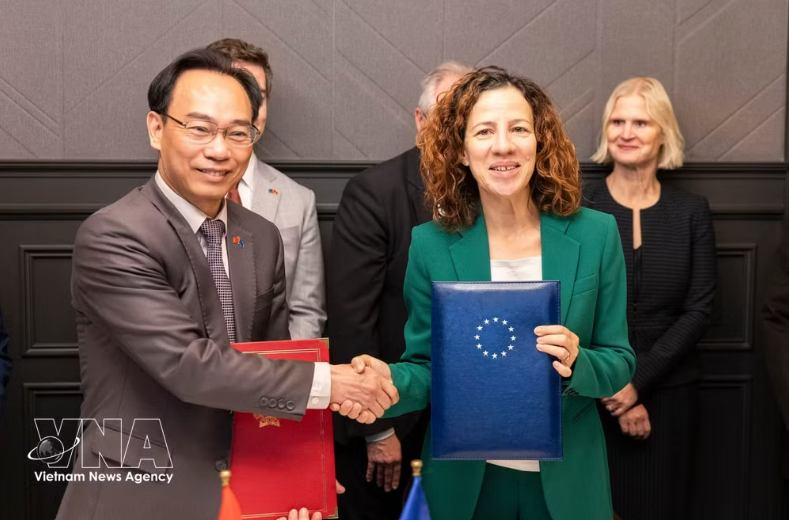
Vietnamese Minister of Education and Training Hoang Minh Son (left) and E.C. Executive Vice-President for Social Rights and Skills, Quality Jobs and Preparedness Roxana Minzatu exchange the Letter of Intent on Education and Training on October 22 in Brussels. |
The minister highlighted several priorities, including the recognition of qualifications, skills, and diplomas; the development of specific cooperation roadmaps covering general education, vocational education and training, and higher education; capacity building for universities and colleges; and the promotion of student and faculty exchanges and broader partnerships among educational institutions.
Minister Hoang Minh Son said that the agreement presents an important opportunity for Viet Nam to develop a highly skilled workforce, renew its growth model, and meet the needs of foreign businesses, particularly those operating in high-tech industries. This will help Viet Nam gradually shift toward an economic development model driven by highly skilled human resources, technology, and innovation.
Following the signing, the minister said the two sides would establish a working group to develop a roadmap and implement specific programs and projects. Cooperation will be reviewed annually to enable timely improvements and adjustments, with the aim of building an equal and comprehensive partnership.
Referring to the significance of presenting the Letter of Intent at a high-level business forum witnessed by General Secretary and State President To Lam, Minister Hoang Minh Son said the event also conveyed Viet Nam's commitment to aligning education and training with business needs. European companies, including Belgian firms, are looking to expand investment in Viet Nam in sectors requiring highly skilled workers, such as high technology, logistics, healthcare, and medical services.
Therefore, education and training must not only meet current workforce needs but also anticipate future demand. A highly skilled workforce will become a competitive advantage for Viet Nam in attracting foreign investment, particularly from high-tech companies.
Regarding Belgium specifically, the minister noted that the Belgian government had supported Viet Nam through numerous training and research projects. Within the broader framework of cooperation with the E.U., the Ministry of Education and Training will continue promoting specific projects and programs with individual member states, including Belgium.
Source: VNA