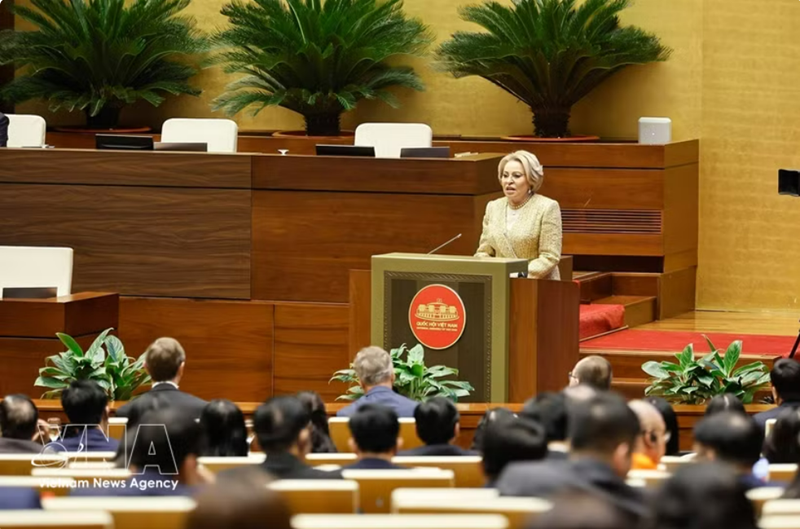
Addressing a plenary session of the Vietnamese National Assembly (N.A.) in Ha Noi during her official visit to Viet Nam, Matviyenko underscored the historical ties between the two nations, describing their friendship as one built on shared traditions and decades of solidarity. She credited President Ho Chi Minh with laying the groundwork for the enduring relationship and recalled that a monument dedicated to the Vietnamese leader was unveiled in Saint Petersburg, her hometown, in 2023.
Tracing the milestones in bilateral relations, Matviyenko pointed to Russian President Vladimir Putin's first official visit to Viet Nam in 2001, which resulted in the signing of a Joint Declaration on Strategic Partnership. The relationship was subsequently upgraded to a Comprehensive Strategic Partnership in 2012, paving the way for sustained high-level political engagement between the two countries.
    |
 |
|
Chairwoman of the Federation Council of the Federal Assembly of Russian Valentina Matviyenko delivers a speech at a plenary session of the Vietnamese National Assembly in Ha Noi on November 13. |
She described the state visit to Russia by General Secretary of the Communist Party of Viet Nam Central Committee and State President To Lam in September 2026 as a major development in bilateral ties this year. The visit saw the signing of several cooperation agreements covering energy, education and science.
Parliamentary ties have also developed steadily over the decades. Matviyenko noted that the first delegation of Vietnamese National Assembly deputies visited the Soviet Union 70 years ago. Building on that foundation, the two countries have stepped up exchanges and expanded institutional cooperation. A new agreement between the Federation Council and Viet Nam's National Assembly was signed following Matviyenko's meeting with N.A. President Tran Thanh Man in Moscow in 2024.
She also welcomed Viet Nam's admission as a BRICS partner country in 2025, highlighting the country's contributions to ASEAN and its role in promoting dialogue between Russia and the regional bloc.
Economic and trade relations featured prominently in her address. Matviyenko voiced optimism about bilateral trade growth in 2026, identifying the free trade agreement between the Eurasian Economic Union (EAEU) and Viet Nam as an important catalyst. The agreement, which took effect in 2016, was the EAEU's first such arrangement with a country outside the bloc.
Investment cooperation is yielding results in several sectors, particularly oil and gas and agriculture, she said. Among the examples cited were dairy production projects in Russia's Kaluga Region involving Vietnamese enterprises and oil extraction operations run by the Rusvietpetro joint venture in the Nenets Autonomous Okrug.
Energy cooperation is another key area of the bilateral partnership. Matviyenko highlighted the agreement signed by the two countries' prime ministers in March 2026 on developing the Ninh Thuan 1 nuclear power plant based on Russian designs. She also described the Nuclear Science and Technology Research Center, now under construction in Viet Nam, as a significant undertaking in the peaceful use of nuclear energy.
Education and cultural exchanges have provided another important dimension to bilateral ties. According to Matviyenko, tens of thousands of Vietnamese citizens have pursued their education at Russian institutions, with many going on to occupy senior positions in Viet Nam. More than 3,000 Vietnamese students and postgraduate researchers are currently enrolled in educational institutions in Russia. In addition, over 500 cooperation agreements between scientific and educational institutions in the two countries remain active.
Cooperation also extends to public health and biological safety. The two countries' leaders have inaugurated a laboratory in Ha Noi specializing in research into and the prevention of infectious diseases. On the cultural front, Viet Nam is preparing to host the Russian Seasons program next year, bringing another major cultural exchange initiative to the country.
Tourism has emerged as a growing area of people-to-people exchange. Nearly 700,000 Russian tourists visited Viet Nam in 2025, and arrivals surpassed 800,000 in the first six months of 2026. Matviyenko attributed the continued growth in travel partly to the expansion of direct air connections and more convenient visa arrangements.
She further highlighted a decree signed by the Russian President granting Vietnamese citizens visa-free entry to Russia for a one-year period ending October 15, 2027. Under the policy, Vietnamese visitors may stay in Russia for up to 30 days. Matviyenko said the arrangement would create favorable conditions for cultural exchanges and closer ties between the two peoples.
Beyond cooperation at the national level, exchanges between local governments remain an important pillar of the relationship. Matviyenko cited the cooperation councils established between Moscow and Ha Noi, as well as between Saint Petersburg and Ho Chi Minh City, as examples of efforts to strengthen ties at the local level.
Concluding her address, Matviyenko expressed confidence that the longstanding friendship between Russia and Viet Nam would continue to deepen and contribute to the prosperity of both nations. Citing the Vietnamese proverb, "A journey of a thousand miles broadens one's knowledge," she voiced her belief that the two countries would continue moving forward together and achieve further milestones in their cooperation.
Translated by Chung Anh