In an interview with the Viet Nam News Agency (VNA) correspondents in China, Wang, who is also a commentator for China Global Television Network (CGTN), said integrating embodied intelligence and humanoid robots into future industries could create new growth drivers, transform manufacturing through AI and advanced technologies, and help address population aging and labor market changes.
Wang highlighted complementary strengths of the two countries to boost cooperation, saying that China has advantages in robotics research, manufacturing and supporting industries, while Viet Nam has a rapidly growing manufacturing sector, an increasingly skilled technology workforce and strong links to global supply chains.
He proposed bilateral cooperation in joint research and testing, component manufacturing, robot assembly and system integration, saying that Viet Nam could also pilot humanoid robots in electronics, auto component and logistics facilities, while universities, research institutes and businesses strengthen joint research, engineering training and personnel exchanges.
    |
 |
|
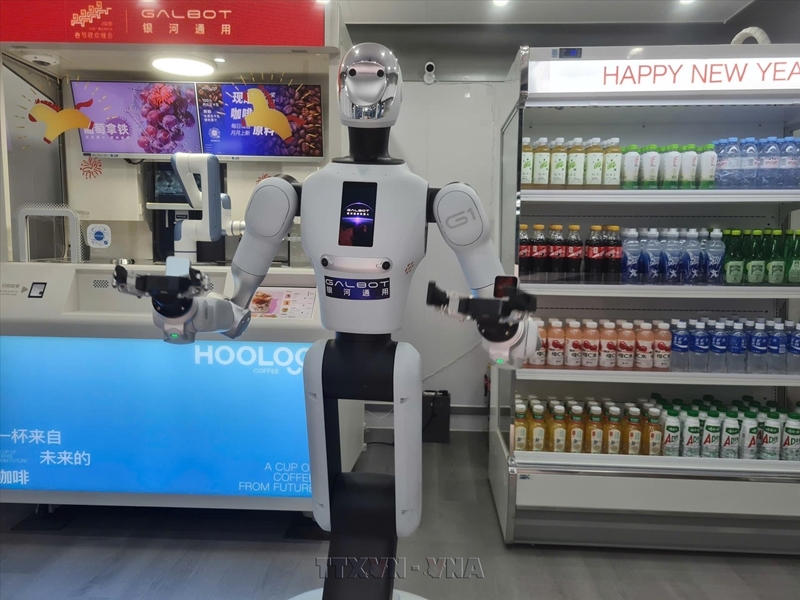
Robots manufactured in China are beginning to be deployed in automated retail. |
For Viet Nam, Wang Xinsong proposed leveraging its manufacturing and processing base to promote AI applications in industry and gradually master system integration, industrial software and smart control technologies. He also stressed the need to capitalize on international cooperation to strengthen independent research and development capabilities, support science and technology enterprises, and gradually build an embodied intelligence ecosystem suited to the country’s strengths.
As humanoid robotics remains at an early stage globally, cooperation in research, manufacturing, application and training could open up opportunities for new industries and promote the transformation of manufacturing sectors towards greater intelligence and higher added value in both nations, and the wider region, he said.
According to the expert, China has gradually developed policies to support the sector. In 2023, its Ministry of Industry and Information Technology issued guidelines targeting a secure and controllable industrial and supply chain by 2027. The country’s 15th Five-Year Plan in 2026-2030 also identifies embodied intelligence as a priority future industry.
China had more than 140 humanoid robot manufacturers offering over 330 products in 2025. Data from the International Data Corporation (IDC) shows that more than 19,000 humanoid robots were shipped in China in the first half of 2026, accounting for about 78% of global shipments.
Wang attributed China's advantages to its manufacturing capacity and experience in robotics, automobiles, electronics and new energy, as well as relatively comprehensive supply chains for key components such as motors, reducers, sensors and batteries.
However, the expert said large-scale commercialization remains challenging. Most humanoid robots are still used in research, education, demonstrations and data collection. Stable long-term operation and the ability to perform complex tasks at competitive costs remain major hurdles. He noted that further progress will depend on advances in embodied intelligence and robots' ability to operate in real-world environments. Over the next three to five years, the industry is expected to focus more on robots' ability to perform tasks autonomously and make independent decisions. Commercial applications will initially expand in automobile manufacturing, electronics assembly and logistics, while competition will increasingly extend to technology ecosystems, including components, software, training data and technical standards, he went on.
Source: VNA