In her interview granted to the Viet Nam News Agency (VNA) ahead of the visit, the ambassador said the visit reflects the special importance the Lao Party, State, and N.A. attach to the consolidation and development of the great friendship, special solidarity, comprehensive cooperation, and strategic cohesion between Laos and Viet Nam.
Sonexay Siphandone was elected President of the 10th-tenure N.A. of Laos on October 5, 2026, making the visit particularly important to strengthening ties between the two legislatures in the new period, implementing the existing cooperation agreements, and exploring new areas of collaboration.
The visit will also enable the two parliamentary leaders to review cooperation achievements and discuss measures to improve the effectiveness of legislative activities, coordination in lawmaking, supreme supervision and decision-making on major national issues, she said.
Against the backdrop of rapid and complex regional and international developments, closer exchanges and coordination to improve legal systems are essential to creating a sound political, legal, and institutional environment for each country's socio-economic development, Khamphao added.
Cooperation between the two legislative bodies is not only meaningful for their respective operations but also contributes directly to the reinforcement of political trust, the bonds between the two peoples, and a comprehensive partnership between the two nations, she affirmed.
    |
 |
|
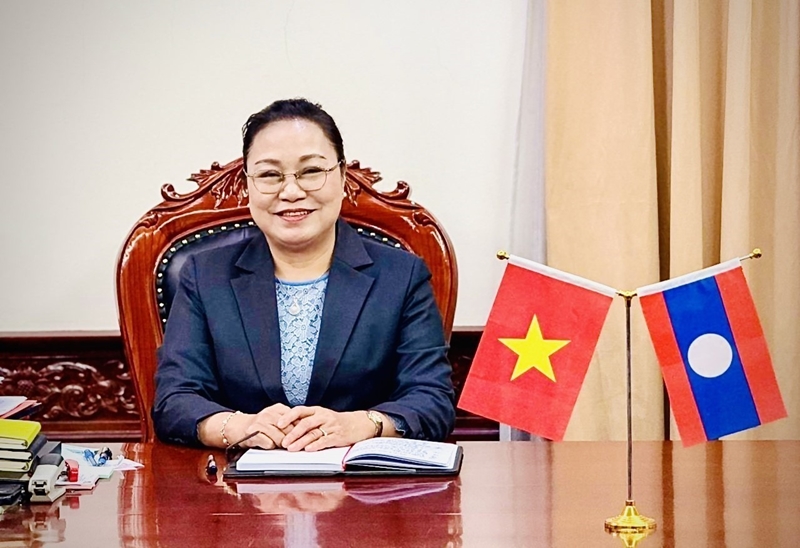
Lao Ambassador to Viet Nam Khamphao Ernthavanh |
The ambassador outlined five key areas to prioritize to enhance bilateral parliamentary cooperation.
First, the two sides should further step up cooperation mechanisms and delegation exchanges to share experience in organizing parliamentary sessions, legislative procedures, reviewing draft laws, conducting question-and-answer sessions and thematic supervision, meeting voters, handling citizens' complaints and petitions, and improving the quality of legislators.
She praised the strong collaboration between the Offices of the Vietnamese and Lao N.A.s, noting that annual seminars and exchange programs have offered practical opportunities for their officials and civil servants to share professional expertise, enhance advisory skills, and strengthen support for parliamentary activities.
Second, the two legislatures should intensify cooperation in lawmaking and supervision over the implementation of high-level agreements. They should keep sharing experience in drafting, amending and improving legal systems while ensuring consistency between domestic regulations and the policies, guidelines and cooperation agreements reached by the two countries.
Parliamentary supervision should be fostered to monitor and assess the implementation of agreements signed by the two countries' Governments, ministries, sectors and localities, helping identify and promptly address obstacles related to mechanisms, policies and legal regulations.
The Lao diplomat stressed that cooperation should move beyond policy exchanges and commitments towards closer monitoring of implementation, clear assignment of responsibilities and assessment of actual results. This will help translate the two countries' political trust and commitments into tangible benefits for their people and businesses.
Third, bilateral parliamentary cooperation should be closely linked with coordination at multilateral forums, particularly the Inter-Parliamentary Union (IPU), the ASEAN Inter-Parliamentary Assembly (AIPA) and the Asia-Pacific Parliamentary Forum (APPF).
Such coordination will help enhance the two countries' voices and standing while actively contributing to ASEAN centrality and the promotion of a peaceful, stable and cooperative regional environment, she noted.
Fourth, the two sides should expand experience-sharing and improve the capacity of parliamentary personnel, a long-term strategic priority requiring sustained investment.
Cooperation could include professional exchanges, thematic seminars, training courses and expert programs focusing on legislative skills, policy analysis, budget oversight, supervision of public investment projects, voter engagement and research support for N.A. deputies. Particular attention should be paid to training young officials, female personnel and specialists to develop a qualified workforce capable of meeting the demands of modern parliamentary operations, according to the ambassador.
Fifth, digital transformation and the development of digital parliaments should become a new strategic area of cooperation.
She noted that digital transformation involves more than introducing computers and software into administrative work, requiring fundamental changes in organization, management, information processing, policy research and the exercise of legislative, supervisory and decision-making functions.
Viet Nam's N.A. has gained considerable experience in applying information technology, developing databases, digitizing documents, managing official records, and assisting with legislators' activities, providing valuable lessons for Laos to study and adapt.
The two sides could step up cooperation in developing digital parliamentary libraries, digitizing legal documents and session records, establishing electronic document management systems, and applying technology to discussions, voting and oversight activities. They could also explore the use of artificial intelligence (AI) in legal document searches, summarizing voter feedback and analyzing data for policy research and supervision.
However, technological applications should go hand in hand with information safety, cybersecurity, data protection, and information accuracy and transparency.
Under the cooperation framework between the two parliamentary offices, they have exchanged experience in developing digital libraries, establishing N.A. television channels and applying information technology to advisory work, personnel training and facility management.
Khamphao expressed her hope that the two N.A.s will develop more extensive digital transformation programs through expert exchanges, training and technical cooperation, helping Lao officials access modern governance models and gradually build a digital parliament suited to the country's conditions.
Such cooperation will improve parliamentary operations and contribute to digital government, digital society and digital economy development in both countries, she added.
Source: VNA