The upgrade caps more than five decades of cooperation and signals both nations' intent to deepen investment in a shared future.
Upgrading Viet Nam-Canada ties to a Strategic Partnership
Viet Nam and Canada, which established diplomatic ties in 1973, have steadily built a relationship marked by growing openness, trust and closeness.
Arriving as the relationship stood poised for a broader and more substantive phase, the visit converted years of accumulated potential into concrete plans designed to deliver tangible gains for both countries.
    |
 |
|
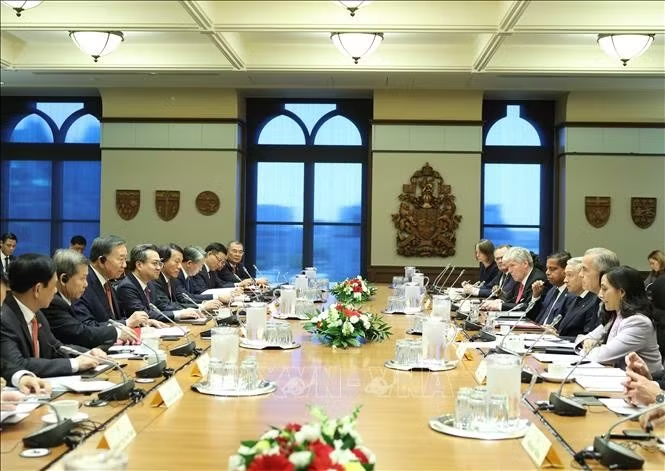
General Secretary and President To Lam holds talks with Canadian Prime Minister Mark Carney. |
At their talks, General Secretary and President To Lam and Canadian Prime Minister Mark Carney agreed to issue a Joint Statement elevating ties to a Strategic Partnership built on eight pillars: bilateral, regional and multilateral cooperation; trade, investment, finance and economy; transport, supply chains and infrastructure; digital transformation, AI and innovation; energy security, environment and sustainable growth; food security and agriculture; national defense, security and law enforcement; and education, culture and people-to-people exchanges.
The two countries also share common views on international law, free trade and regional stability, with complementary strengths in play: Viet Nam is leaning on science, technology and global integration to hit development targets for 2030 and 2045, while Canada is diversifying its markets and expanding its footprint in the Indo-Pacific.
Both sides committed to deepening university and research institute links, joint research and technology transfer, and innovation ecosystems; expanding energy cooperation spanning clean power, liquefied natural gas, renewables and nuclear energy for peaceful purposes; and broadening ties in healthcare, environment, agriculture, education and culture, while building sustainable supply chains around their complementary strengths in agriculture and food production.
Arbour said she hopes the two nations will seize the moment together to build a more peaceful, prosperous and resilient future.
A policy speech to the Canadian Parliament, titled "Viet Nam-Canada Strategic Partnership in a Changing World", stood out as a top highlight of the trip, with the top leader laying out Viet Nam's foreign policy and development vision before lawmakers and senior officials.
Underscoring growing legislative ties, he met separately with Speaker of the Senate Raymonde Gagné and Speaker of the House of Commons Francis Scarpaleggia, who both pointed to parliamentary cooperation as a pillar that will underpin future government agreements.
Prof. Vu Viet Hung from the Royal Military College of Canada, who chairs the Canadian Vietnamese Scientists and Experts Association (CVSEA), called the upgrade a milestone set to open doors for scientific collaboration. His network counts more than 150 scientists and experts, many holding senior posts at Canadian and North American universities, research institutes and tech firms.
Building a bridge of Viet Nam-Canada friendship
Canada is home to nearly 300,000 Vietnamese, a community described as well-integrated and well-regarded, with younger generations active in technology, education, research and entrepreneurship while working to preserve Vietnamese language and culture.
Senior Canadian officials praised the community's contribution to Canada's cultural fabric, casting it as a “living bridge” fostering economic, scientific and art exchanges between the two nations.
At a meeting with the Canada-Viet Nam Parliamentary Friendship Group, lawmakers, including Vietnamese-Canadian Chi Nguyen, welcomed the progress in ties. The Vietnamese legislature's founding of a counterpart friendship group in June 2026, alongside the Canadian group's 25 senators and members of the House of Commons, underscores lawmakers' strong interest in closer bilateral bonds.
Prof. Nguyen Dai Trang, who chairs the Canada-Viet Nam Trade Council and York University's Canada-ASEAN Initiatives, said the council will focus on people-to-people exchange and youth engagement going forward.
The council also plans to push economic and tech cooperation in clean technology, smart agriculture, new materials, AI, cybersecurity and digital transformation, while building out a network of Vietnamese experts.
It will further ramp up cultural programming and Vietnamese language education, showcase Viet Nam's global image and push for tighter coordination between domestic and overseas agencies in overseas Vietnamese affairs, Trang said.
Source: VNA