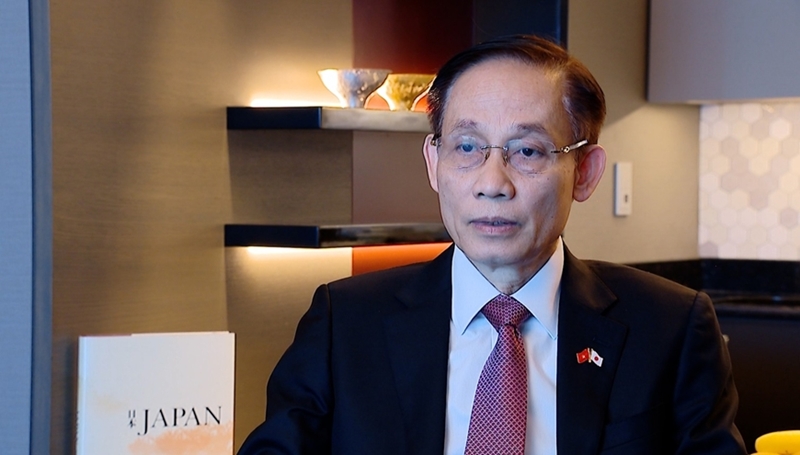
Speaking to the People’s Army Newspaper about the outcomes of the visit, Minister of Foreign Affairs Le Hoai Trung highlighted its significance amid a new phase of development in bilateral ties and rapid, complex developments in the international and regional situation.
    |
 |
|
Minister of Foreign Affairs Le Hoai Trung |
This was the first visit to Japan by General Secretary and State President To Lam in his current capacity, and the first visit to the country by a General Secretary of the Communist Party of Viet Nam in 11 years. The Japanese Imperial Family, Government, and National Diet accorded the Vietnamese leader, his spouse, and the high-level delegation a warm welcome, including special courtesies that reflected Japan’s high regard for Viet Nam’s position and role, as well as bilateral relations.
During the visit, General Secretary and State President To Lam held high-level meetings with Japan’s top leaders, leaders of political parties, and prominent Japanese politicians. He also met with business leaders, research institutes, universities, and representatives of Japanese friendship and people-to-people organizations.
The meetings and working sessions resulted in a high degree of consensus on many important issues, reflected in the Viet Nam-Japan Joint Vision Statement for the coming period. A key outcome was the shared commitment to ushering in a new phase of bilateral relations, with the two countries becoming partners working together and co-creating for mutual benefit, toward high-quality growth, strategic autonomy, and resilience.
According to Minister Le Hoai Trung, this new approach is consistent with the development strategies and requirements of both countries.
The Joint Vision Statement identifies key cooperation frameworks and interconnected priority areas, including science, technology and innovation; education, training and human resource development; production and supply chain connectivity; finance, investment and development assistance.
Cooperation in energy, digital transformation, semiconductors, and other fields has also been further specified to meet the development needs of both countries in the coming period. During the visit, the two sides signed 11 agreements involving ministries, sectors, and localities, as well as approximately 60 cooperation agreements between businesses. These agreements provide important foundations for cooperation in areas where both sides have strengths and needs.
The minister noted that the visit helped strengthen mutual understanding and expand cooperation across multiple fields through both bilateral and multilateral channels. The outcomes serve the interests of the two peoples and contribute positively to peace, stability, cooperation, and development in the region and the world.
The visit also helped advance cooperation through Party, State, parliamentary, and people-to-people channels, while representing a proactive and effective step in implementing the foreign policy outlined at the 14th National Party Congress, contributing to creating a favorable external environment through high-level exchanges and engagements between Viet Nam and international partners.
Regarding the implementation of commitments and agreements reached during the visit, Minister Le Hoai Trung stressed that the foremost priority is to fully grasp the new cooperation orientations set out in the Joint Vision Statement, particularly the positioning of Viet Nam and Japan as partners working together and co-creating.
He highlighted a shift toward deeper cooperation in production and supply chains. Rather than simply manufacturing certain products for export, the two countries are expected to strengthen joint research and development, production, and sourcing, enabling them to participate more deeply in regional and global supply chains.
He also emphasized the need to effectively promote cooperation through all channels, including the Party, State, National Assembly, and people-to-people exchanges, thereby consolidating political trust and mutual understanding and making bilateral relations deeper, more substantive, and more effective.
To translate the outcomes of the visit into concrete results, ministries, sectors, localities, agencies, and businesses of both countries need to coordinate closely in developing specific programs, plans, and projects with clear objectives, roadmaps, and responsibilities. Relevant agencies should also conduct regular reviews, monitor implementation, and address arising difficulties.
In addition, Viet Nam and Japan should strengthen coordination at international and regional forums, particularly the United Nations, APEC, ASEAN, the Mekong subregion, and other multilateral forums in which both countries participate. Such efforts will contribute to promoting multilateralism, dialogue, confidence-building, and respect for international law, while advancing peace, stability, cooperation, and development.
Translated by Quynh Oanh