During the meeting, Quang said he believes that Wagner's visit will help strengthen mutual understanding and trust, while providing fresh impetus for more substantive and effective cooperation between the Supreme People's Court of Viet Nam and the Supreme Court of Canada.
The visit comes as Viet Nam and Canada upgraded their bilateral ties to a Strategic Partnership in September 2026, opening new avenues for the two countries to deepen cooperation across a range of areas, including legal and judicial affairs.
    |
 |
|
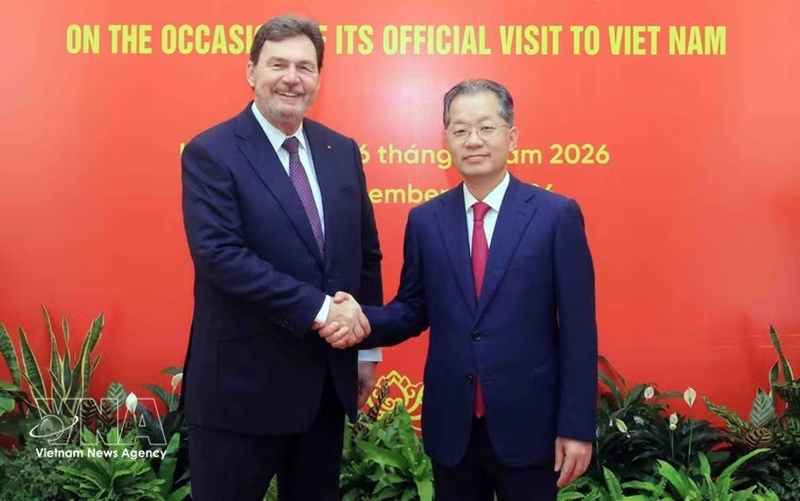
Chief Justice of the Supreme People's Court of Viet Nam Nguyen Van Quang (right) hosts a reception in Ha Noi on November 16 for visiting Chief Justice of Canada Richard Wagner. |
Notably, the joint statement on the Strategic Partnership welcomed the continued implementation of the Viet Nam-Canada judicial capacity development project, which, Quang said reflects the attention and expectations of their high-ranking leaders regarding judicial cooperation. This also provides a favorable political basis for the two countries’ court systems to launch new cooperation initiatives and contribute to the implementation of commitments under the bilateral Strategic Partnership.
The host called for continued exchanges of delegations, high-level meetings and professional expertise between the two courts, as well as closer coordination in implementing the above-said project for 2025–2030, and sharing experience in establishing specialized courts.
He stressed that the project implementation should closely align with Viet Nam’s practical needs and judicial reform priorities to ensure quality, effectiveness and sustainability of cooperation activities.
He also proposed expanding exchanges of experience in applying international law, implementing international treaties and observing international judicial practices, particularly in handling civil and commercial cases involving foreign elements.
Regarding training, the Vietnamese chief justice suggested stronger cooperation between the Viet Nam Court Academy and the National Judicial Institute of Canada in training judges and other judicial officials.
He also expressed interest in learning from Canada’s experience in legal improvement, enhancing adjudication quality, digital transformation, judicial modernization, as well as settling commercial and investment disputes involving foreign elements.
For his part, Wagner expressed his hope that the two countries’ courts will continue to promote cooperation and share experience to strengthen judges’ professional capacity and expertise, meeting judicial reform requirements amid digital transformation and rapid advances in science and technology.
He noted that these developments posed common challenges to judicial systems worldwide, requiring them to adapt proactively, renew their operating methods and improve adjudication efficiency.
He also suggested enhancing coordination in preventing and combating violations of the law involving cyberspace, and strengthening international cooperation in investigating and handling transnational crimes, thereby contributing to the development of the judicial systems of each country.
Source: VNA