The September 20-25 trip marked the top leader's first outing to the United Nations (U.N.), with his attendance at the high-level General Debate of the U.N. General Assembly’s 81st session, and his debut visits to the U.S. and Canada since Viet Nam wrapped up its 14th National Party Congress and elected deputies to the 16th National Assembly and People’s Councils at all levels for the 2026-2031 term.
His state visit to Canada at the invitation of Governor General Louise Arbour was the first by a Vietnamese Party and State leader since the two nations began diplomatic ties 50 years ago, arriving amid an increasingly complex global landscape, with geopolitical, economic and technological shifts.
    |
 |
|
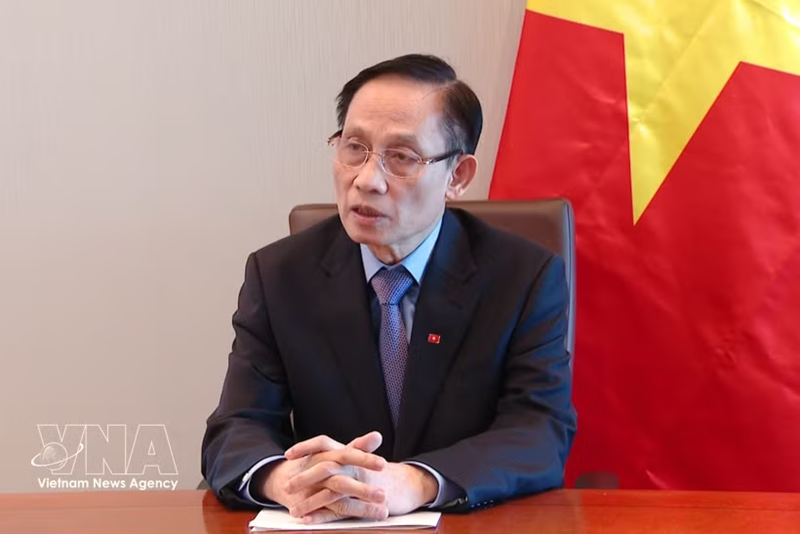
Minister of Foreign Affairs Le Hoai Trung |
At the highest levels, the leader pressed Viet Nam's case for its economic renewal and laid out the country's development goals and foreign policy direction for a new era, Trung said.
He used the occasion to position Viet Nam as a responsible player in the international community that proactively and actively contributes to settling global challenges.
His address at the high-level General Debate won praise for urging U.N. to elevate its role and shore up multilateral institutions at a moment when the organization is facing numerous challenges.
On this occasion, he also met with U.N. funds, development agencies and specialized bodies to offer Viet Nam's cooperation, with officials citing the country as a model for how developing nations can partner with the U.N.
Another highlight was his string of meetings with government and legislative leaders, business executives, scholars, friends and Vietnamese communities across the U.S. and Canada. The U.S. meetings and working sessions built momentum in bilateral ties and showed Viet Nam’s goodwill on issues of mutual concern, including trade. In Canada, the two countries agreed to upgrade ties to a Strategic Partnership, backed by an action plan spanning a wide range of areas.
Beyond the General Secretary and President's own schedule, other senior Vietnamese officials met separately with partners, businesses and research institutes. Vietnamese companies struck a series of agreements with U.S. and Canadian counterparts on trade, investment, technology, education, energy and transport cooperation tailored to both sides' priorities.
Overall, Trung said the mix of bilateral and multilateral engagement opened doors for concrete cooperation while advancing shared goals with the U.N., U.S. and Canada - all of which, he said, want Viet Nam to take a bigger hand in global and regional affairs.
According to him, U.N. officials and member states value Viet Nam's views on global affairs, its policy proposals and track record, including regional peacekeeping contributions, and want the country's role to keep growing.
Trung called on Vietnamese agencies to work with U.N. bodies not just for funding, as in the past, but to tap the organization’s expertise for the country's next growth phase, including drawing on international norms for intellectual property, information technology and AI governance.
On the U.S. and Canada fronts, ministries, agencies, and localities must now turn commitments into action with firm timelines and accountability, spanning political ties, people-to-people exchange, science - technology, economy-trade - investment, national defense - security, energy, and education - training, particularly quality workforce, he said.
Trung also urged fast-tracking capacity building in emerging sectors, singling out nuclear energy cooperation as a new frontier where both the U.S. and Canada bring ample expertise.
Source: VNA