Speaking at the seminar, Prof., Dr. Le Van Loi, President of the Vietnam Academy of Social Sciences (VASS), underlined that more than half a century since the establishment of diplomatic relations, Vietnam and Argentina have recorded important progress across politics, diplomacy, trade, culture, education and people-to-people exchanges.
However, he noted that cooperation has yet to match the potential, particularly in trade, science and technology, innovation, and academic linkages.
    |
 |
|
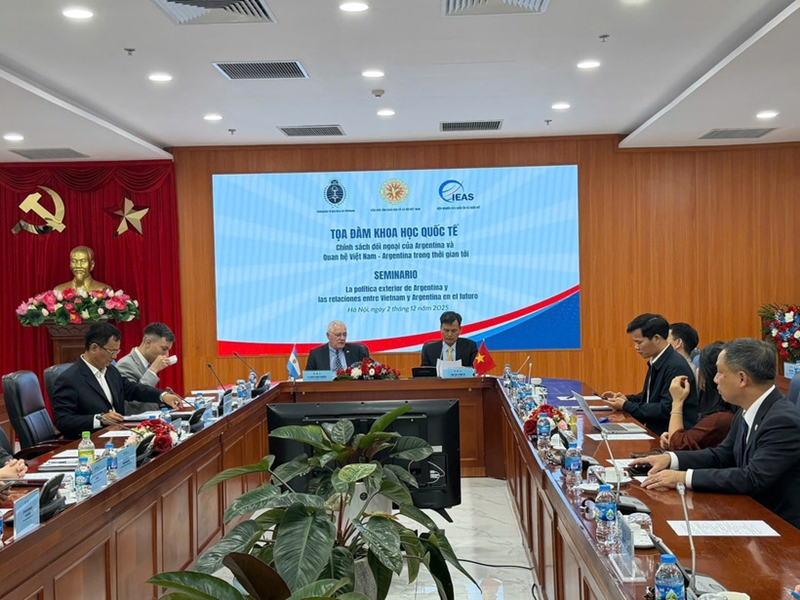
The international seminar on Argentina’s foreign policy and the future trajectory of Vietnam - Argentina relations is held in Hanoi on December 2, 2025. |
Loi stressed the need to bridge geographical distance, overcome cultural differences, strengthen expert connectivity, and make full use of the two economies’ complementary strengths. This, he said, requires both sides to step up joint research, strategic information sharing, digital transformation, and innovation, and to create favorable conditions for businesses to participate more deeply in shared value chains.
He affirmed that VASS stands ready to serve as a focal point connecting Argentine ministries, agencies, research institutes, universities and organizations with their Vietnamese counterparts, thereby deepening bilateral ties and opening new approaches suited to current development conditions.
Argentine Ambassador to Vietnam Marcos Antonio Bednarski said Argentina’s foreign policy is increasingly oriented towards enhancing cooperation with Asia, with Vietnam regarded as an important partner in Southeast Asia. Argentina is taking various measures to stabilize its macroeconomy, improve its investment climate, boost trade openness, attract large-scale projects, and facilitate bilateral cooperation in promising sectors.
He highlighted Argentina’s major advantages, including its leading global position in agriculture, alongside strong processing, energy and mineral industries, which open up significant cooperation opportunities with Vietnam. Beyond trade, both countries can expand collaboration in the fields of technique, innovation, education, and research.
Bednarski noted that bilateral ties have achieved many positive outcomes but still hold considerable room to grow further, especially in trade and science - technology. He expressed his country’s desire to continue strengthening business connectivity, expanding sectoral cooperation, and deepening bilateral relations in the years ahead.
Dr. Loc Thi Thuy of the Institute for European and American Studies pointed out the need to identify priority areas for Vietnam - Argentina relations, as well as for Vietnam’s ties with Latin American countries, boost substantive cooperation mechanisms, and increase policy information sharing. With 33 countries, over 600 million people, abundant natural resources and several similarities in economic structure with Vietnam, Latin America remains a region with significant room for Vietnam to expand cooperation with, particularly in agriculture, industry, information technology, tourism, and cultural exchange.
She emphasized that Argentina is a partner of special interest in Vietnam's foreign policy of diversification and multilateralization of external relations. However, trade cooperation and academic connectivity remain below potential. She called for more high-level mutual visits, strengthened bilateral negotiations, and the leveraging of Argentina’s role as a gateway to the Mercosur market, comprising Argentina, Brazil, Uruguay, and Paraguay, which pursues trade liberalization and a common economic space.
Thuy also highlighted the role of research institutes in organizing conferences, promoting economic ties, and stepping up people-to-people exchanges to generate new momentum for the bilateral partnership.
Participants discussed major orientations for boosting relations between Vietnam and Argentina, as well as Vietnam’s engagement with Latin America. Several opinions stressed the need to boost high-level visits, utilize existing bilateral mechanisms more effectively, and expand cooperation in areas of complementary strength such as agriculture, processing, energy, information technology, tourism and cultural exchange.
Many also recommended accelerating negotiations on a bilateral free trade agreement, describing it as critical for Vietnam to gain deeper access to the Mercosur market. Strengthening cooperation among research institutes and universities, through academic exchanges, policy dialogue, and information sharing, was also considered as essential to underpin mutual understanding, reduce geographical distance, and broaden practical cooperation opportunities between the two countries.
Source: VNA