The Joint Statement on the Viet Nam-Chile Strategic Partnership was adopted during an official visit to Viet Nam by Chilean President José Antonio Kast and his spouse on November 15-17.
It said the visit coincided with the 55th anniversary of diplomatic relations between the two countries (March 25, 1971 – 2026), marking a historic milestone in the longstanding traditional friendship between the two peoples.
    |
 |
|
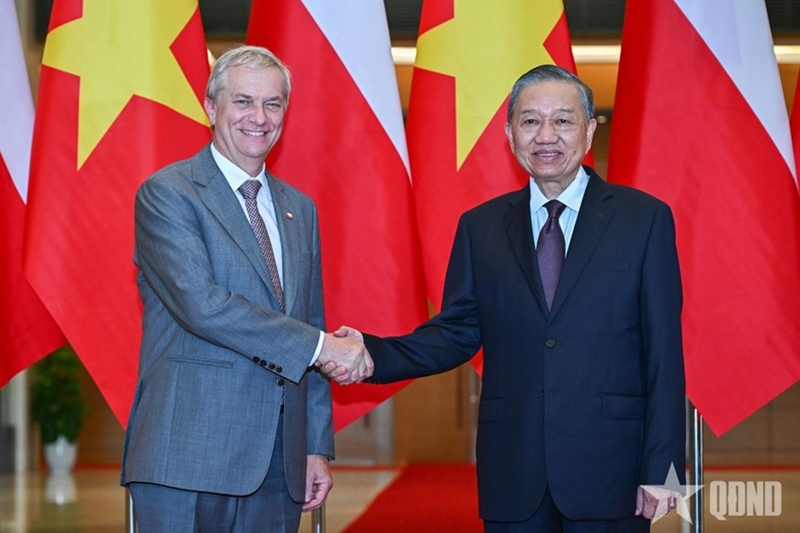
General Secretary of the Communist Party of Viet Nam Central Committee and State President To Lam and Chilean President José Antonio Kast |
During the visit, President José Antonio Kast paid tribute to President Ho Chi Minh at his Mausoleum and laid a wreath at the Monument to the Heroes and Martyrs in Ha Noi.
At their cordial and candid talks, General Secretary of the Communist Party of Viet Nam Central Committee and President To Lam and Chilean President José Antonio Kast reviewed key milestones in bilateral relations, which laid the foundation for the establishment of diplomatic ties in 1971.
President Kast's visit demonstrated the strong commitment of both countries' leaders to ushering bilateral relations into a new era of deeper, more substantive, effective and sustainable cooperation.
During the visit, the leaders of the two countries agreed to upgrade Viet Nam-Chile relations to a Strategic Partnership based on six pillars of cooperation: politics and diplomacy; economy and trade; agriculture; science and technology; education and culture; and national defense and security.
Regarding political and diplomatic cooperation, the leaders of the two countries acknowledged the importance of maintaining dialogue and high-level exchanges through State, Government and parliamentary channels, enhancing the effectiveness of existing bilateral mechanisms and working towards their upgrading, while establishing new sectoral dialogue mechanisms to strengthen the political foundation, facilitate cooperation on shared priorities, and effectively manage emerging challenges and opportunities.
They underscored the importance of multilateralism and international law, and of strengthening regional and multilateral cooperation through forums such as the United Nations, the World Trade Organization (WTO), the Asia-Pacific Economic Cooperation (APEC), the Forum for East Asia-Latin America Cooperation (FEALAC), international parliamentary forums like the Inter-Parliamentary Union (IPU) and the Asia-Pacific Parliamentary Forum (APPF), ASEAN-led mechanisms, as well as the framework of the Comprehensive and Progressive Agreement for Trans-Pacific Partnership (CPTPP).
Both sides reaffirmed their support for ASEAN's central role and commitment to deepening cooperation under the ASEAN-Chile Development Partnership, including in areas of shared interest such as sustainable trade, clean energy, food security, sustainable mining and the digital economy.
Viet Nam reaffirmed its welcome and readiness to actively support Chile's accession to the Regional Comprehensive Economic Partnership (RCEP). Viet Nam also expressed support for initiatives by Chile and other member countries to develop the Pacific Alliance into a platform for political cooperation and economic and trade integration with the wider world, aimed at improving people's well-being and promoting their social inclusion.
For its part, Chile strongly supported Viet Nam's efforts, together with other member states, to build a resilient, dynamic, innovative and people-centered ASEAN Community, thereby making positive contributions to maintaining peace, stability and shared prosperity in the region and the world.
Chile affirmed its readiness to serve as a bridge to promote substantive cooperation between Viet Nam and ASEAN and the Pacific Alliance, which Chile will chair on a rotating basis in 2028, as well as with the Latin American region.
Chile recognized Viet Nam's leadership as Chair of the CPTPP Council in 2026, as well as its efforts to further promote cooperation under the CPTPP-EU and CPTPP-ASEAN Trade and Investment Dialogues and prepare for APEC Year 2027. It affirmed its readiness to cooperate and actively contribute to APEC Year 2027 in Viet Nam to help ensure the event's success.
Both sides committed to continuing coordination in addressing regional and global challenges and advancing shared interests to strengthen peace, stability and respect for international law.
The two leaders affirmed that the 1982 United Nations Convention on the Law of the Sea (UNCLOS 1982) provides the legal framework governing all activities in the seas and oceans, as well as maritime cooperation at the national, regional and global levels.
Both sides underscored the need to uphold the universality and integrity of UNCLOS 1982 and emphasized the importance of settling maritime disputes through peaceful means in accordance with international law, particularly the United Nations Charter, as well as the importance of conserving and sustainably using the oceans and marine resources.
The two sides agreed that economic and trade cooperation is a central pillar of Viet Nam-Chile relations, driven by the synergies between the Viet Nam-Chile Free Trade Agreement (VCFTA), which took effect in 2014, and the CPTPP.
The leaders agreed to maximize the effectiveness of the Viet Nam-Chile Free Trade Council in guiding and supporting businesses from both countries in capitalizing on tariff preferences under the VCFTA and the CPTPP, while deepening cooperation in services, finance, investment protection and e-commerce. They also reaffirmed their support for the substantive implementation, modernization and expansion of the CPTPP.
Both sides welcomed efforts to increase two-way foreign direct investment in Viet Nam and Chile, and affirmed their readiness to facilitate a stable, long-term environment for each other's businesses to invest and operate.
The leaders reaffirmed the importance of resilient, diversified and reliable trans-Pacific supply chains and maritime and air transport networks. They agreed to coordinate efforts to address logistical bottlenecks, facilitate trade growth and ensure supply chain continuity between Southeast Asia and Latin America.
Both sides agreed to promote bilateral maritime transport cooperation and encourage connectivity between Viet Nam's major deep-water seaports, including those in Ho Chi Minh City, Hai Phong, Da Nang and Cai Mep - Thi Vai, and Chile's gateway ports of Valparaíso and San Antonio. They also encouraged shipping and airline operators from both countries to explore the establishment of joint venture cooperation agreements.
Regarding agricultural cooperation, the leaders emphasized the pivotal role of agricultural and agri-food cooperation in ensuring stable food supplies, promoting sustainable development and fostering innovation across the entire food value chain.
They welcomed stronger cooperation on sanitary and phytosanitary (SPS) measures between Viet Nam's Ministry of Agriculture and Environment and Chile's Agricultural and Livestock Service (SAG) and National Fisheries and Aquaculture Service (Sernapesca).
They acknowledged progress in deepening cooperation on food safety and animal and plant health, facilitating trade and modernizing certification procedures, including electronic phytosanitary certification (e-Cert). Both sides reaffirmed their commitment to promoting safe, seamless and mutually beneficial trade.
The two leaders welcomed the completion by Viet Nam's Ministry of Agriculture and Environment of quarantine and food safety procedures for imports of beef, pork and chicken products from Chilean suppliers, as well as the approval of several Chilean beef-exporting facilities during the visit.
They also welcomed the Chilean Ministry of Agriculture's decision to open its market to Vietnamese passion fruit, longan and lychee on this occasion, as well as the willingness of both ministries to work together to accelerate market access procedures for other agricultural, forestry and fishery products from both countries.
Both sides agreed to promote technical cooperation initiatives and the transfer of advanced agricultural technologies (AgriTech), focusing on water resource management, smart water-saving irrigation systems in arid areas, post-harvest preservation technologies, cold chain management, sustainable marine aquaculture technologies, and the breeding of crop varieties and livestock adapted to climate change.
The leaders affirmed that science and technology, innovation, digital transformation and green transition are important foundations for energy security, economic growth, modern industrial development and long-term prosperity.
Both sides pledged to strengthen cooperation in research, technology transfer and the sharing of management expertise in smart mining, environmentally friendly mineral processing, green hydrogen production and storage technologies, solar and wind power development, smart grid operations, carbon management and the development of carbon credit markets.
They also agreed to promote cooperation in the marine economy, marine biodiversity conservation, marine technology transfer, and green shipping and smart, zero-emission port initiatives across the Pacific region, while exploring opportunities to develop and apply low-carbon marine fuels.
The leaders reaffirmed their strong commitment to addressing climate change, protecting the environment and conserving biodiversity.
They agreed to promote expert exchanges, technology transfer and the application of Chile's advanced technical solutions in integrated water resource management, desalination technologies, and drought and saltwater intrusion prevention, supporting localities and key agricultural regions in Viet Nam that are severely affected by climate change.
The leaders welcomed initiatives to connect the innovation and startup ecosystems of universities, research institutes and businesses in both countries.
Regarding education and cultural cooperation, the leaders emphasized that the enduring friendship between Viet Nam and Chile is rooted in a deep legacy of historical solidarity, carefully nurtured by successive generations of leaders and people of both countries.
Building on this traditional friendship, both sides agreed to strengthen cultural exchanges, promote tourism cooperation and make effective use of the bilateral visa exemption regime. They also agreed to shift from friendly exchanges towards the development and implementation of concrete cooperation programs, creating long-term, mutually beneficial ties among organizations, localities, businesses and people of the two countries.
Both sides agreed to deepen cooperation in higher education, skills development, scientific research and academic exchanges; expand scholarship and student support programs; and facilitate opportunities for students, lecturers and researchers from both countries to study, teach Vietnamese and Spanish language and culture, and conduct academic activities at each other's higher education institutions.
The leaders welcomed and encouraged stronger direct cooperation between localities in the two countries, particularly through the establishment of partnerships and twinning arrangements between Vietnamese provinces and cities, including Ha Noi, Ho Chi Minh City, Nghe An, Hai Phong and Quang Ninh, and Chilean regions and municipal governments, such as the Santiago Metropolitan Region, Valparaíso, Antofagasta and Arica.
Such cooperation aims to leverage complementary strengths in port economies, mining, agriculture and fisheries, tourism, and smart and sustainable urban governance.
Regarding defense and security cooperation, recognizing that an increasingly complex and interconnected international security environment requires closer cooperation among trusted partners, the leaders reaffirmed their commitment to strengthening defense dialogue and cooperation through the effective implementation of the Memorandum of Understanding on Bilateral Defense Cooperation, signed in November 2024.
They also agreed to explore expanding cooperation in humanitarian assistance and disaster relief, search and rescue, maritime law enforcement capacity-building, and responses to non-traditional security challenges.
Both sides agreed to explore exchanges of experience among their respective military branches and services, and to tap the potential for cooperation in defense industry, science, technology and innovation in the defense sector, in line with each country's needs and capabilities.
They reaffirmed their commitment to promoting cooperation in United Nations peacekeeping operations and agreed to strengthen exchanges of expertise, instructors and training experience between the Viet Nam Department of Peacekeeping Operations and the Chilean Joint Peace Operations Center (CECOPAC).
The two leaders emphasized that security challenges posed by transnational organized crime, including cybercrime, high-tech online fraud, illicit financial flows, money laundering, terrorist financing, human trafficking and the illicit trafficking of drugs and precursor chemicals through international maritime routes, pose significant risks to economic security, public safety and regional stability.
They welcomed ongoing exchanges towards establishing a bilateral dialogue mechanism on security and law enforcement, as well as stronger operational information-sharing through bilateral channels and INTERPOL, to coordinate efforts to prevent and effectively combat threats posed by transnational organized crime.
The leaders recognized the importance of deepening cooperation and exchanges of delegations between the two countries' law enforcement and judicial agencies, and exploring negotiations on international agreements and bilateral treaties. These efforts would help improve the legal environment for trade and investment, facilitate the resolution of international commercial disputes and ensure the effective implementation of commitments under the CPTPP.
The Joint Statement on the Viet Nam-Chile Strategic Partnership took effect on November 16, 2026.
Translated by Song Anh