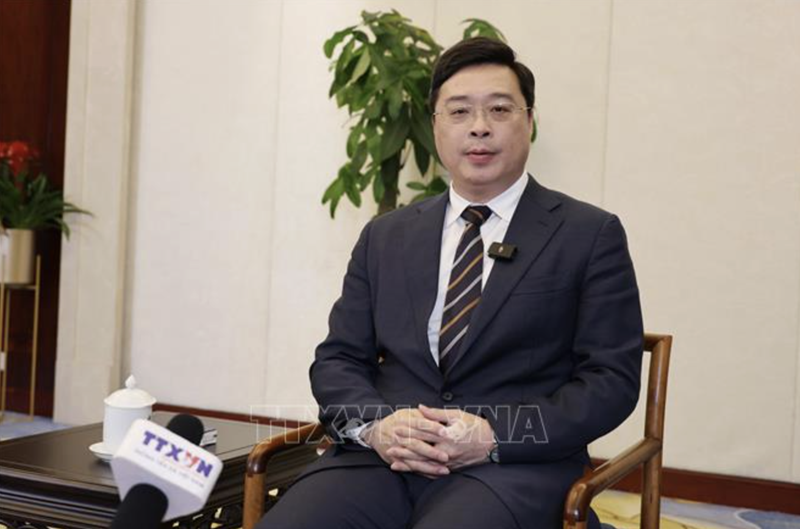
In an interview with Vietnam News Agency correspondents in China, Wei Tao, Deputy Secretary of the Party Committee and Chairman of the Guangxi Zhuang Autonomous Region, stressed that infrastructure connectivity forms the foundation of cooperation, enabling smoother flows of goods and people.
    |
 |
|
Wei Tao, Deputy Secretary of the Party Committee and Chairman of the Guangxi Zhuang Autonomous Region grants an interview to Vietnam News Agency correspondents in China. |
Bordering Vietnam along 696 km, Guangxi has three cities and eight districts adjacent to Vietnam. In recent years, the region has actively expanded cross-border infrastructure links. It now operates two railway lines connecting to the China–Vietnam border and has planned or built 13 expressways leading to border gates, with 10 already completed. Guangxi also has nine land border crossings with Vietnam, including Dongxing, the busiest in passenger traffic, and Youyiguan, the most advanced in infrastructure and technology.
The region is also promoting smart border gates to enable 24/7 and automated customs clearance. In maritime connectivity, the Beibu Gulf Port maintain 35 container shipping routes with Vietnam, linking with five Vietnamese ports, including Hai Phong and Ho Chi Minh City.
Following a visit to Vietnam in November 2025, Wei said Guangxi reached important agreements with relevant Vietnamese ministries and sectors on enhancing infrastructure links. The Vietnamese side said it is pushing the construction of two standard-gauge railway lines: Dong Dang–Hanoi and Mong Cai–Ha Long–Hai Phong, along with expressways and smart ports connecting to Guangxi, Wei said.
Wei expressed confidence that once these projects are implemented, connectivity between the two countries will be further enhanced, and bilateral trade and industrial cooperation will become more robust.
On “soft connectivity,” Guangxi holds a unique position as the only Chinese region bordering Vietnam both by land and sea. Trade and investment ties have expanded steadily in recent years. In 2025, trade turnover between Guangxi and Vietnam reached around 45 billion USD, up 5.4% year-on-year, accounting for about 38% of Guangxi’s total foreign trade.
Guangxi has become a key distribution hub for Vietnamese fruit exports to China, with the Youyiguan Border Gate serving as the country’s largest durian import gateway. Business cooperation is also intensifying, with major Guangxi firms such as Yuchai, Liugong and Meisida increasing investment in Vietnam. Partnerships like that between SAIC-GM-Wuling and Vietnam’s TMT Motors are also gaining momentum.
In the time to come, Wei said Guangxi plans to deepen cooperation in cross-border e-commerce, finance and logistics, while expanding collaboration in sectors such as automobiles, machinery, materials, electronics and light industry. The region is also working with Vietnam’s Quang Ninh province to explore pilot models for cross-border economic cooperation zones, and continue diversifying trade promotion activities, strengthening production–consumption linkages, and boosting trade.
Highlighting “people-to-people connectivity,” Wei noted that strong bilateral ties are rooted in close bonds between citizens. He stressed that Guangxi and Vietnam share geographic proximity and cultural similarities, with frequent exchanges at multiple levels.
Guangxi also holds historical significance as a place where President Ho Chi Minh once conducted revolutionary activities, symbolizing the long-standing friendship between the two nations, he said.
As of late 2025, more than 3,400 Vietnamese students were studying and living in Guangxi, making it one of the top Chinese destinations for Vietnamese students. These students, Wei said, serve as “ambassadors of friendship,” fostering mutual understanding between the two sides.
Guangxi will leverage historical and cultural resources to expand exchanges, including joint tourism projects such as the Detian (China) – Ban Gioc (Vietnam) cross-border waterfall tourism zone. It will also promote exchanges among youth, women’s and labor organizations, as well as twinning cities, through activities such as cultural festivals, sports events and community exchanges, the Chinese official went on.
Source: VNA