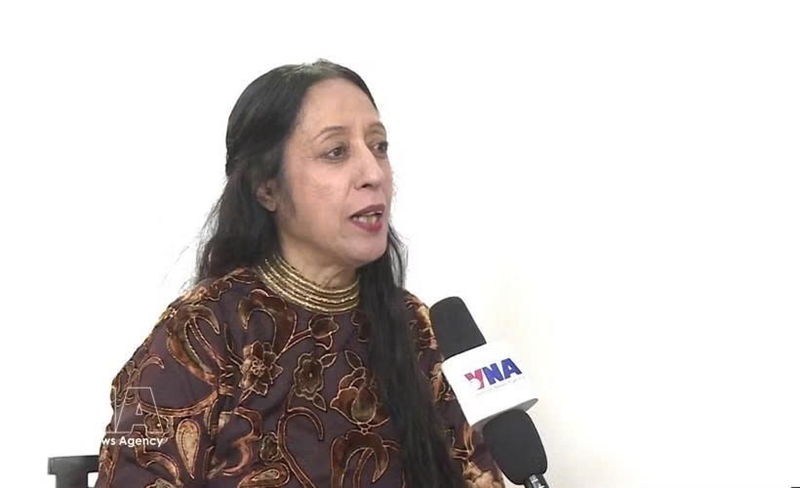
Professor Reena Marwah of the University of Delhi, who also serves as Secretary-General of the Association of Asian Scholars, said deep political trust built over generations of leadership has been the key factor underpinning the steady development of bilateral ties.
In a rapidly evolving regional and global landscape, both countries pursue strategic autonomy, uphold independence in foreign policy making, and support a rules-based international order – a foundation for sustainable growth in bilateral relations.
    |
 |
|
Professor Reena Marwah of the University of Delhi |
According to Professor Marwah, cooperation has expanded significantly over the past decade, from traditional areas such as defense, energy and people-to-people exchanges to new fields including digital transformation, green transition, logistics, seaport development, innovation and human resources development.
Defense cooperation remains a key strategic pillar, with potential for expansion into emerging areas such as unmanned aerial systems, missile technology, air defense systems and high-tech defense industries, she said.
On the economic front, she noted strong complementarity between the two economies. Vietnam’s strategic location, long coastline and growing role in global supply chains make it an attractive destination for foreign direct investment (FDI), while its experience in port and logistics development aligns with India’s infrastructure needs.
Meanwhile, India’s strengths in information technology, innovation, artificial intelligence (AI), digital services and high-quality human resources could complement Vietnam’s production capacity and integration capabilities, creating new growth drivers.
Professor Marwah also highlighted Vietnam’s policy orientation towards science and technology, innovation and digital transformation, as reflected in recent Party resolutions, as well as its push to develop the private sector. These moves signal a shift towards a knowledge- and technology-driven growth model, opening up significant cooperation opportunities in areas such as AI, semiconductors, software development, high-tech workforce training, and emerging sectors including rare earths, strategic minerals, batteries and Industry 4.0–5.0, she stated.
In terms of trade and investment, she said bilateral turnover remains below potential. Vietnam has strengths in textiles, footwear, electronics, manufactured goods, coffee and tea – products with strong prospects in India’s rapidly expanding middle-class market.
India, for its part, holds advantages in pharmaceuticals, renewable energy and heavy industry. Trade could be further boosted by reducing non-tariff barriers and expediting the review of the ASEAN–India Trade in Goods Agreement (AITIGA). Increasing business presence in each other’s markets, such as VinFast’s investment in India and Indian firms’ interest in Vietnam’s port and logistics sectors, are also positive signs, the scholar noted.
Beyond economics, people-to-people exchanges are emerging as an increasingly important pillar. With nearly 90 flights per week and a sharp rise in Indian tourist arrivals to Vietnam, connectivity demand is growing. Both sides could consider expanding direct air routes, improving tourism workforce training and attracting investment in hospitality and services to better tap this potential.
At the strategic and regional level, Professor Marwah noted that Vietnam and India share common interests in promoting peace, stability, freedom of navigation and respect for international law, particularly the United Nations Convention on the Law of the Sea (UNCLOS) 1982. With their rising roles in Asia and the Global South, both countries have the potential to become key partners in shaping a balanced, open and rules-based regional order.
“While the past decade has laid a solid foundation, the next step is to translate the partnership into more substantive outcomes in the next 10 years ahead,” she stressed.
Regarding the May 5–7 state visit of the top Vietnamese leader, Professor Marwah said its timing – shortly after Vietnam’s 14th National Party Congress and the consolidation of leadership under the 16th National Assembly – underscores the country’s determination to deepen bilateral ties and highlights India’s growing importance in realizing Vietnam’s foreign policy.
Beyond its symbolic significance, the visit is expected to inject fresh impetus into Vietnam–India relations, ushering in a more substantive, comprehensive and forward-looking phase of cooperation, the scholar underlined.
Source: VNA