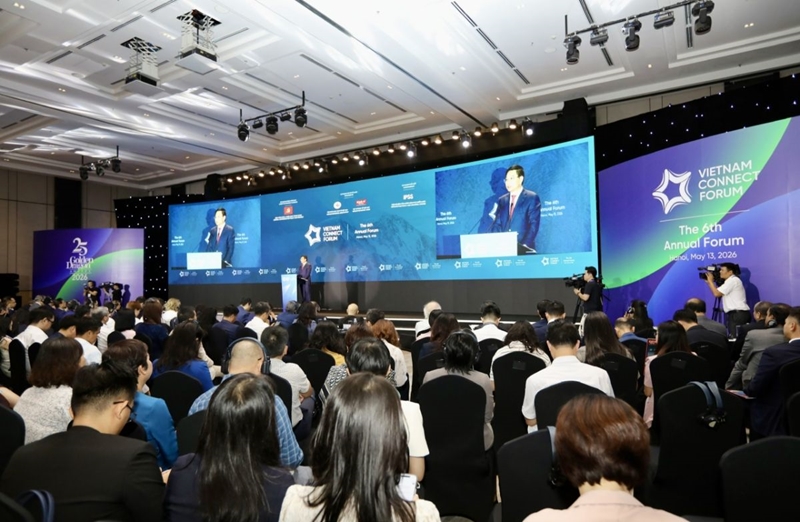
Jointly organized by the Institute for Policy and Strategy Studies (IPSS), the Vietnam Association of Small and Medium Enterprises, and the Association of Foreign Invested Enterprises, the event gathered over 300 policymakers, business leaders, investors and experts to discuss ways to enhance synergies between the FDI sector and the domestic private sector for sustainable growth.
    |
 |
|
The 6th Vietnam Development Bridge Forum 2026 (Vietnam Connect Forum 2026) with the theme "The foreign-invested economy and the domestic economy join forces to create sustainable growth momentum in the new period" (Photo: The organizing panel) |
Deputy PM Thang noted that the global landscape is undergoing profound and unpredictable changes, driven by strategic competition among major powers, supply chain restructuring, and rapid advances in digital transformation, green transition, artificial intelligence and semiconductor technologies. For Vietnam, this presents both challenges and opportunities to reposition itself in regional and global value chains, while renewing growth drivers based on innovation, science – technology, and private sector development.
He highlighted that the FDI sector remains a key pillar of Vietnam’s economy, with more than 46,500 valid projects and total registered capital exceeding 543 billion USD so far. Disbursed capital has reached around 357.6 billion USD. The FDI sector contributes over 20% of GDP, accounts for around 70% of total export turnover, and creates jobs for millions of workers. Vietnam continues to rank among ASEAN’s leading FDI destinations despite global investment slowdowns.
The trend reflects strong confidence of international investors in Vietnam’s stable environment, he said, noting that the country has increasingly attracted major corporations in electronics, semiconductors, high technology, energy, logistics, finance, innovation, and modern services, contributing to forming new production ecosystems and supply chains in Vietnam.
However, the Deputy PM pointed out persistent shortcomings, including weak linkages between FDI and domestic enterprises, low localization rates in some industries, and limited capacity of local firms to integrate into global supply chains.
|
|
 |
|
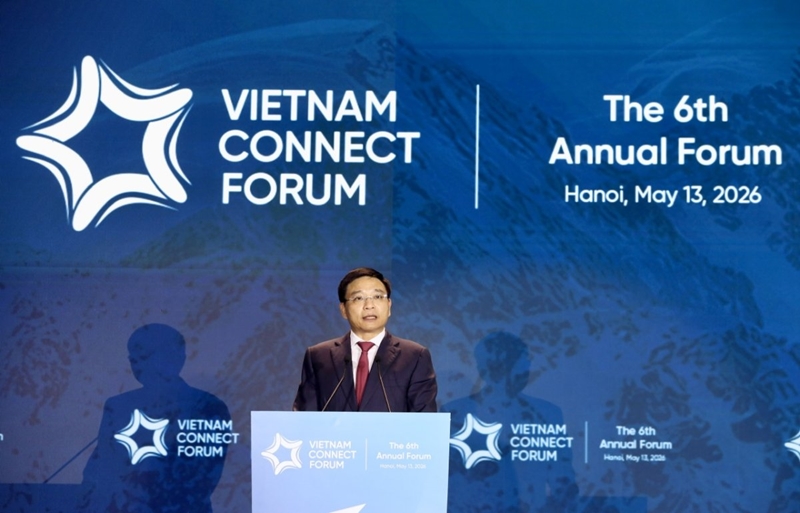
Member of the Party Central Committee, Deputy Prime Minister Nguyen Van Thang speaks at the forum. (Photo: The organizing panel) |
Against this backdrop, he stressed that Vietnam will prioritize improving the quality, spillover effects and connectivity of FDI with the domestic economy. The country consistently regards the foreign-invested sector as an integral part of the national economy, but will now adopt a more selective investment cooperation strategy focused on high technology, innovation, added value, efficient land use, environmental protection and stronger linkages with local businesses.
The Vietnamese Government will continue to refine institutions, improve the business climate, and shift from a management-oriented to a service-oriented approach. Attention will be also given to developing domestic enterprises and supporting industries, upgrading infrastructure, and training high-quality human resources to attract next-generation FDI.
At the same time, authorities will ensure effective state management for the FDI sector, maintain economic independence and security, and promote sustainable development, he stated, adding that while creating favorable conditions for investors to operate legally and efficiently, Vietnam will strictly address violations such as transfer pricing, trade fraud, environmental breaches and intellectual property infringements.
The Deputy PM reaffirmed Vietnam’s ambition to become a high-income developed country by 2045, which requires a new growth model driven by innovation, technology, high-quality workforce and stronger collaboration among economic sectors.
He called on foreign investors to view Vietnam not only as an investment destination but also as a strategic partner in global value chains, while urging domestic enterprises to enhance governance, technological capacity and cooperation to integrate more deeply into global production networks and supply chains.
The Government, he added, remains committed to building a transparent, stable and competitive business environment, fostering stronger synergy between the FDI and domestic sectors to generate new momentum for rapid and sustainable growth in the future.
Delegates discussed opportunities for attracting next-generation FDI and boosting its spillover to the domestic economy through technology transfer, higher localization, and greater participation of Vietnamese firms in global value chains.
Source: VNA