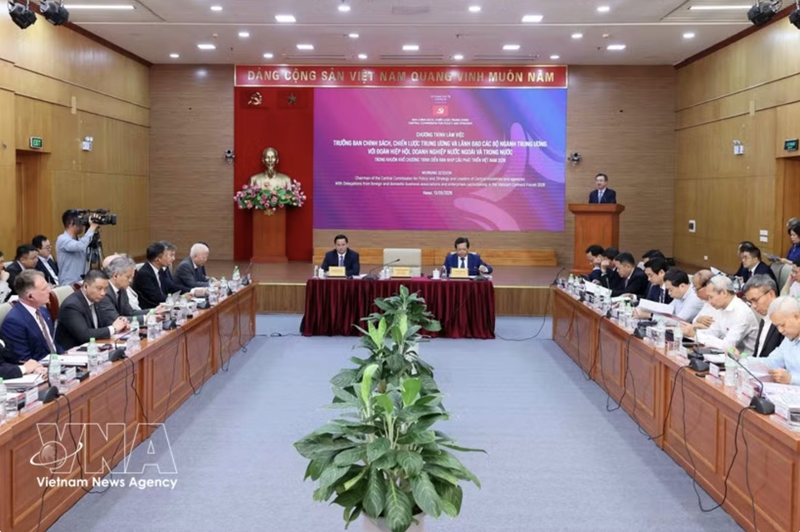
Addressing the meeting, Nguyen Thanh Nghi, Politburo member, Secretary of the Party Central Committee and Chairman of the commission, stated that after 40 years of Doi moi (Renewal), the foreign direct investment (FDI) sector had become an important part of Vietnam’s economy, making substantial contributions to growth, exports, economic restructuring, job creation and international integration.
He noted that the global landscape is changing rapidly amid intensifying strategic competition among major powers, the restructuring of global supply chains, and accelerating trends in digital transformation, green transition, artificial intelligence, semiconductors, data economy and innovation. These developments, he said, are creating significant opportunities while also placing new requirements on Vietnam’s strategy for foreign investment attraction and utilization in the years ahead.
    |
 |
|
Nguyen Thanh Nghi, Politburo member, Secretary of the Party Central Committee and Chairman of the its Commission for Policies and Strategies, speaks at the working session. |
Acknowledging the views raised during the session, Nghi affirmed that the Party and State consistently regard the foreign-invested sector, alongside the state and private sectors, as important components of the national economy, that maintains close interconnections and complements one another within Vietnam’s new growth model.
He said this orientation will continue to be clearly reflected in a forthcoming resolution on the foreign-invested sector; the driving roles of the state and private sectors have also been reaffirmed through major Politburo resolutions, including Resolution No.68-NQ/TW on the private economic sector development and Resolution No.79-NQ/TW on the state economic sector development.
In particular, Conclusion No.18-KL/TW, issued on April 2, 2026 by the 14th Party Central Committee, stated that to achieve double-digit economic growth, Vietnam must quickly unleash all available resources, including those from the FDI sector. The conclusion also highlighted the need to reform FDI policies by shifting away from a primary focus on tax incentives towards alternative forms of support, including performance-based incentives, while placing greater emphasis on technology transfer and stronger linkages between foreign-invested enterprises and domestic firms.
With this objective in mind, Nghi said Vietnam is encouraging foreign investors to continue expanding long-term investment, particularly in high-tech industries, innovation, research and development centers, workforce training, green technology and the digital economy. The country also seeks deeper cooperation between foreign investors and Vietnamese enterprises, enabling local companies to participate more substantially in global supply chains through technology transfer and human resources development.
He urged the Vietnamese business community to improve corporate governance, technological capacity, production standards, workforce quality and international connectivity to strengthen ties with the FDI sector.
The Party official also called on ministries, sectors and local authorities to fundamentally shift their management mindset from a model centered on “administration” towards one based on “support, facilitation and service”. He stressed that the effectiveness experienced by businesses and investors should serve as the yardstick for reform efforts, alongside a strong commitment to building a transparent, stable, competitive and predictable investment environment.
Earlier discussions within the session focused on the implementation of Vietnam’s newly introduced mechanisms and policies under the recent Party resolutions, as well as global trends in next-generation FDI and Vietnam’s opportunities to attract high-quality investment flows in sectors such as semiconductors, artificial intelligence, data centers, digital technology, green technology, renewable energy, smart logistics and international finance.
Representatives from the Ministry of Finance, Ministry of Industry and Trade, Ministry of Science and Technology, Ministry of Agriculture and Environment, Ministry of Foreign Affairs and the National Assembly’s Economic and Financial Committee also addressed a range of issues relating to improving the investment climate, refining institutional frameworks, strengthening linkages between the FDI and domestic sectors, developing high-quality human resources, promoting technology transfer and enhancing national competitiveness.
Several practical concerns raised by businesses were also discussed, including VAT refunds, investment certification, mergers and acquisitions, and foreign investor participation in the Vietnamese market.
Source: VNA