Speaking at a symposium themed “Intelligent Robotics & Automation” held on December 4 by the VinFuture Foundation as part of the VinFuture Science and Technology Week 2025, Dr. Nguyen Trung Quan of the University of Southern California and VinMotion said that Vietnam is emerging with strengths across all three pillars crucial to humanoid robot development: high-quality hardware manufacturing, strong software and AI capabilities, and a safe, reliable deployment environment. With these conditions, the country has the foundation to join the global competition in humanoid robotics, he said.
    |
 |
|
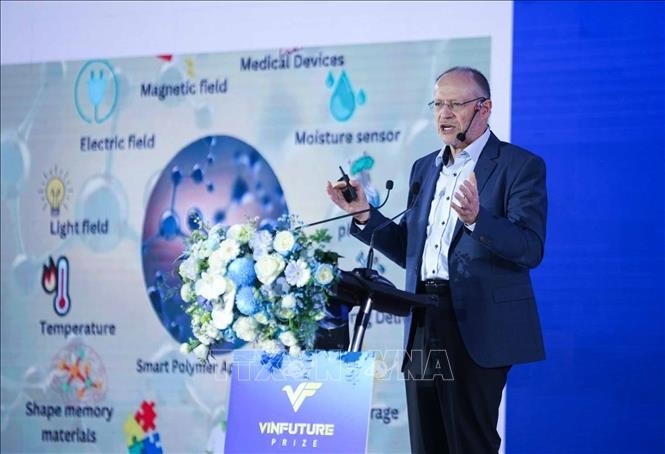
Professor Kurt Kremer, from the Max Planck Institute for Polymer Research in Germany, speaks at the event. |
The world is witnessing a rapid acceleration in robotics, automation and artificial intelligence (AI), underpinned by breakthroughs in advanced sensing and intelligent interactive systems. These technologies are not only reshaping industrial production, services and healthcare, but also improving productivity, enhancing quality of life and contributing to more sustainable development pathways.
At the symposium, international and Vietnamese experts also discussed the latest trends in robotics, from socially interactive humanoids and collaborative service robots to medical and rehabilitation systems, and examined major challenges surrounding AI safety and ethics to ensure that robotics evolves in a responsible, human-centered and sustainable manner.
Prof. Kurt Kremer of the Max Planck Institute for Polymer Research (Germany) outlined the transformative potential of soft materials, including advanced polymers, for next-generation robotics and electronics. Soft materials are abundant, lightweight, flexible, durable and inexpensive, and can be easily engineered into diverse shapes or combined with sensors, he explained.
Their rapid responsiveness, especially when integrated with gels or corrosive agents, allows robots to achieve high levels of adaptability and precision. Soft conductive polymers also hold promise for future electronics, being cheaper than silicon and not dependent on rare-earth supplies. Potential applications include solar cells, organic semiconductors, displays and neuromorphic computing systems that mimic the human brain.
However, he noted that improving mechanical strength, recyclability and biodegradability remains essential to unlocking their full potential.
Challenge of robotics in soft-material manipulation
Addressing the difficulties of robotic control, Prof. Ho-Young Kim of Seoul National University (Republic of Korea) highlighted that while industrial robots excel at handling rigid objects with fixed shapes, manipulating soft items such as fabric, plastic bags or clothing, remains one of the hardest problems in automation.
|
|
 |
|
Prof. Ho-Young Kim of Seoul National University speaks at the event. |
Tasks that seem simple to humans, like lifting a T-shirt or folding laundry, require advanced perception and dexterity. Robots must understand constantly changing shapes in real time, avoid deforming soft materials or reverse unwanted deformations. Success will require major improvements in hardware (grippers) and software (control algorithms, machine learning).
Toward a future of one billion robots
Prof. Tan Yap Peng, President of VinUni (Vietnam), predicted that by 2050 nearly one billion robots could coexist with humans. While millions of robots are already deployed, such as those used by Amazon in warehouses, the majority remain limited to simple, pre-programmed tasks.
He emphasized the need for robotics models with broader purpose and flexible intelligence. New foundation models such as large language models (LLMs), vision-language models (VLMs) and vision-language-action models (VLAs) allow robots to understand images, videos and natural language and convert that understanding into precise physical actions.
As these models mature, robots will evolve from single-purpose to multi-purpose systems, more dexterous, more autonomous, easier to maintain and capable of working seamlessly with humans. They will use energy more efficiently and operate safely in shared environments.
Humanoid robots and the rise of “physical AI”
Dr. Quan described “physical AI," the fusion of artificial intelligence with physical robotic systems, as one of the fastest-growing global industries, projected to reach 10 trillion USD within the next decade. Developing humanoid robots, however, requires vast quantities of high-quality real-world data. Yet robots cannot be deployed at scale for data collection until they are sufficiently safe and capable, a paradox the industry must overcome.
Vietnam, he stressed, has the rare ability to address this challenge thanks to its combined strengths in hardware production, algorithm development and safe operational environments, which together enable simultaneous progress across the entire robotics value chain.
Source: VNA