The meeting is the main high-level dialogue under the two countries’ Comprehensive Strategic Partnership. Its aim is to review progress made in the Viet Nam-Australia Enhanced Economic Engagement Strategy (EEES) through reports from the trade and investment working groups and the annual development dialogue, and set the next phase of substantive cooperation.
In his opening speech, Tuan said bilateral trade and investment have expanded sharply since the EEES was launched. Two-way trade hit 13.94 billion USD in the first 10 months of 2026, up 21.2% year on year. By the late October, Australia had 758 valid investment projects valued at over 1.9 billion USD in Viet Nam. Vietnamese firms, meanwhile, invested over 605 million USD in Australia, making Viet Nam the 12th largest among 87 foreign investors in the country.
    |
 |
|
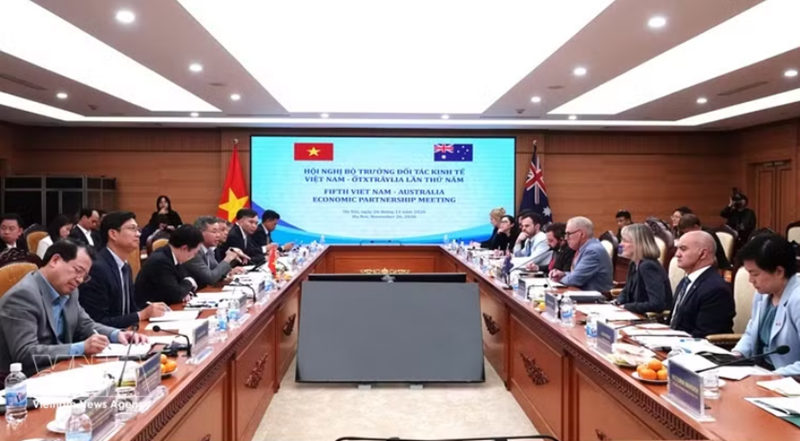
At the fifth Viet Nam-Australia Economic Partnership Meeting (Photo: mof.gov.vn) |
Citing positive results from the Trade Working Group, the Investment Working Group and the second annual Viet Nam-Australia Development Dialogue, he called for a concrete action plan to turn high-level commitments into deals. He outlined three pillars: a longer-term investment partnership tied to Viet Nam’s 2026–2030 priorities on science, technology, technology transfer and clean energy; broader two-way trade and investment in industry, agriculture, services, tourism, digital economy and green economy; and tighter coordination at regional and multilateral forums, including during 2026 and Viet Nam’s APEC Year 2027.
In the bilateral economic session, Tuan stated that Viet Nam pitched its long-term growth model under the 14th National Party Congress’s Resolution, targeting developed, high-income status by 2045. The country aims to sustain average GDP growth of at least 10% a year in 2026–2030 while keeping macro stability and inflation under control. Its GDP grew 9.01% in the first nine months of 2026, up from 8.02% year on year.
To pull in high-quality capital, Viet Nam is amending its Investment Law and Land Law to make rules more transparent and closer to international practices. It is also allocating resources to scientific research, innovation and digital transformation, and rolling out a direct investment support mechanism to balance State and investor interests amid the OECD global minimum tax.
Viet Nam is courting Australian investment funds, major financial institutions and companies in electronics, digital technology, semiconductors, artificial intelligence, clean energy and strategic infrastructure. It also wants Australian support for Vietnamese small and medium-sized enterprises to move deeper into global value chains.
It is also encouraging Australian financial institutions to invest in the newly approved international financial centers in Ho Chi Minh City and Da Nang as a channel for long-term international capital. It wants Australia to maintain ODA and non-refundable aid, at 98.3 million AUD in 2026-2027 fiscal year, for essential infrastructure, capacity building and climate change response in the Mekong Delta and northern mountainous regions.
On trade and green growth, a Vietnamese Ministry of Industry and Trade representative said both sides stressed the need for stable, long-term supply chains for essential minerals. They also agreed to push trade promotion, digital economic cooperation, digital transformation and cross-border e-commerce.
In agriculture and labor, Viet Nam wants Australia to widen market access for its key farm produce and make visas and labor movement easier. The two sides also discussed complementarity in agricultural trade, with Viet Nam importing some Australian materials and farm products for consumption, production and processing.
The Vietnamese side said it will review difficulties raised by Australian companies in Viet Nam and work with relevant agencies to settle them within its authority.
Farrell congratulated Viet Nam on its impressive growth and said Australia sees it as one of Southeast Asia’s most promising economic partners. He pointed to Export Finance Australia’s establishment of a dedicated investment promotion unit in Viet Nam as evidence of Canberra’s interest.
With geopolitical conflicts and rising trade protectionism clouding the global outlook, he said Australia maintains a firm advocate of free and fair trade. It wants to work with like-minded partners such as Viet Nam to make supply chains more resilient and double two-way investment within five years.
In agriculture and food, he noted that Australia is ready to send technical experts to help Viet Nam meet strict biosecurity standards, opening the way for more quality Vietnamese farm produce into Australia. Australia also wishes to expand exports of its own strong products to Viet Nam.
On energy, essential minerals and digital economy, Australia pledges to remain a reliable, stable and long-term supplier of coal, liquefied natural gas (LNG), critical minerals and rare earths for Viet Nam’s green transition. It is also ready to share experience in renewable energy such as wind and solar, regional grid connectivity, underground cable infrastructure, safe artificial intelligence and cross-border e-commerce.
On multilateral collaboration, Australia praises Viet Nam’s coordinating role in the Comprehensive and Progressive Agreement for Trans-Pacific Partnership (CPTPP) and backs its hosting of APEC Year 2027, including the APEC Finance Ministers’ Meeting in Ha Long and the APEC Economic Leaders’ Meeting in Phu Quoc. The two sides will coordinate in trade facilitation, SME support and regional cooperation initiatives.
In closing, Tuan and Farrell flagged three headline outcomes, including new momentum for the 2026–2030 long-term investment partnership in science, technology, strategic infrastructure and clean energy; market opening for agricultural and aquatic products plus broader digital and green economy cooperation; and stronger coordination at multilateral forums in 2026–2027.
The two ministers tasked the Trade Working Group, the Investment Working Group and the annual Development Dialogue mechanism with the agreed agenda, monitoring results and reporting back at the sixth Viet Nam-Australia Economic Partnership Meeting, expected in Australia in 2027.
Source: VNA