Promising results
During a visit to the farm of Duong Cong Quyen in Dich Tay village, Tien Phuoc commune, we were impressed by its well-planned layout and investment. Quyen said the farm covers approximately five hectares, with 500 mangosteen trees intercropped with around 1,000 cacao trees, alongside a herd of 50 goats.
To save electricity and water and reduce labor costs, his family has pro-actively applied science and technology to production. These measures include installing a solar power system to operate irrigation pumps and an automated irrigation network that delivers water directly to individual trees.
    |
 |
|
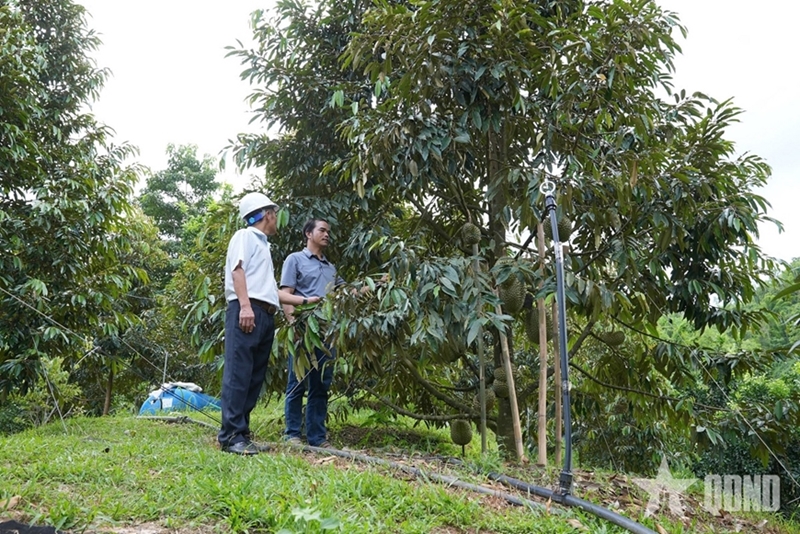
Durian cultivation is generating high economic returns for residents of Dong Giang commune. |
Notably, Quyen also records and manages detailed information about the farm, including planting areas, schedules for care and fertilization, pest and disease control, input consumption, water sources and irrigation, production costs, tree growth, and the number and condition of goats. This information is compiled into a digital database to support farm management.
Tien Phuoc is now one of Da Nang's key areas for developing garden-based and farm-based economies. The commune has more than 1,768 hectares of garden land, including 1,317 households with gardens measuring at least 1,000 square meters and 136 gardens meeting model-garden standards. Its key crops have established a local reputation, including mangosteen, bonbon, areca palm, green-skinned pomelo, durian, and pepper.
Average income from garden-based production in the commune is approximately VND 170 million per hectare, accounting for around 42 percent of its agricultural production value. Nguyen Hung Anh, Chairman of the Tien Phuoc commune People's Committee, said that targeted support mechanisms and policies introduced in recent years had encouraged residents to renovate less productive gardens, expand the cultivation of high-value crops, adopt technical advances, and develop more efficient production models.
Following the administrative merger, Da Nang has more than 150,000 gardens and farms, offering strong potential for agricultural and medicinal plant development. During the 2021-2025 period, nearly 1,900 gardens and 20 farms received local support, enabling investment in modern production models, including smartphone-controlled management systems. The city now has more than 220 gardens and farms suited to experiential tourism, while around 1,600 participate in value-chain production. Some have begun generating annual incomes of VND 30-100 million per garden and VND 200-300 million per farm, providing a foundation for further expansion.
|
|
 |
|
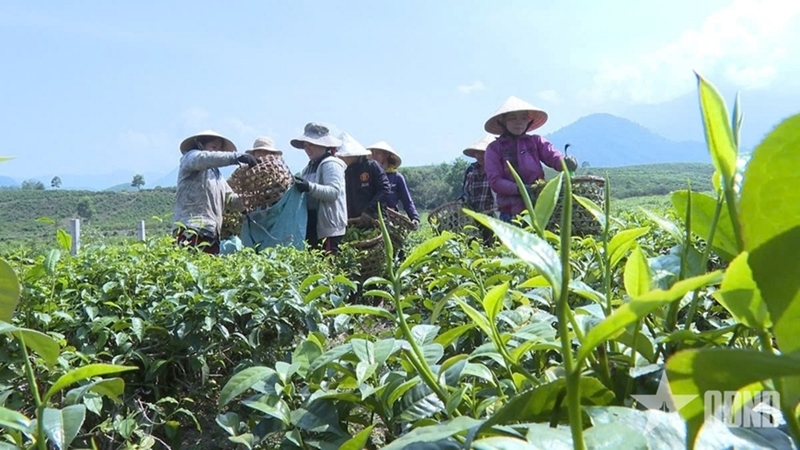
Residents of Song Vang commune harvest tea at a plantation. |
Coordinated measures for further development
Despite progress, Da Nang's garden- and farm-based economies still face challenges, including small-scale production, inadequate infrastructure, uneven adoption of technology, disconnected data, weak production links, and limited processing and stable market access.
Vu Thi Bich Hau, Deputy Director of the city's Department of Agriculture and Environment, said the priority was no longer expanding the number of production models but improving their quality through better production organization, higher product standards, increased processing, market expansion, and data-driven management.
At a recent workshop on digital transformation and double-digit growth in the sector, experts proposed reorganizing production based on local advantages and market demand, standardizing data, and evaluating digital farming models through measurable results rather than the number of devices or QR codes installed.
They also highlighted the potential to combine agricultural production with rural and community-based tourism. With its diverse resources, including orchards, vegetable farms, lotus fields, cinnamon, medicinal plants, and Ngoc Linh ginseng, Da Nang could develop experiential tourism linked to local livelihoods. Tran Quy Tan, Head of the Travel Management Division under the city's Department of Culture, Sports and Tourism, stressed the need to standardize gardens and farms as tourism products and digitize their offerings to make them easier for businesses and visitors to find and book.
Translated by Quynh Oanh