Speaking at the meeting with Deputy PMs and leaders of ministries and Government agencies, the PM asked the Ministry of Finance to refine the FTZ proposal for submission, ensuring feasibility and effectiveness to contribute to socio-economic development, especially the realization of the two strategic centenary goals.
    |
 |
|
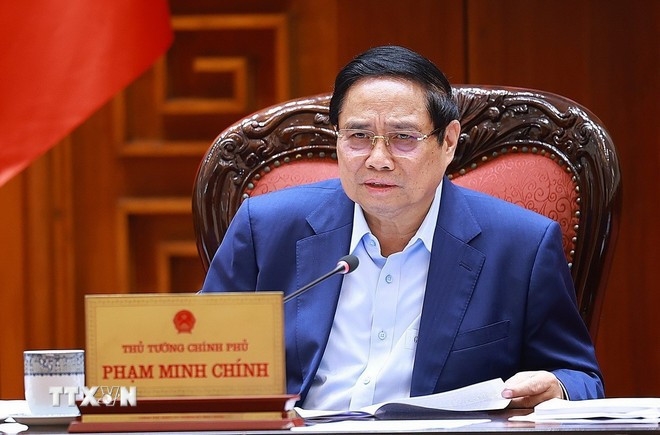
Prime Minister Pham Minh Chinh at the meeting |
PM Pham Minh Chinh explicitly requested clarifying the definition of an FTZ, its similarities with and differences from an international commercial center, as well as relevant mechanisms and policies. He urged agencies to study international experiences and base on Vietnam's conditions to formulate specific, suitable, competitive, and feasible mechanisms that do not negatively impact the general investment climate.
He emphasized that implementation requires integrated efforts across policy, planning, infrastructure, technology, and governance while addressing social security and environmental concerns, among others.
Internationally, over 7,000 special economic zones and FTZs are currently operational, holding growing importance to economic development strategies of developing and emerging countries. FTZs are increasingly adopting multi-functional models encompassing industry, urban development, services, finance, high technology, and innovation to attract maximum development resources.
In Vietnam, the current general legal system lacks specific FTZ provisions, making the immediate development of the proposal urgent. This move is expected to transform FTZs into new growth engines and testing grounds for economic policies aligned with international standards.
According to the proposal by the Ministry of Finance, pilot FTZs are expected to be established in Da Nang, Hai Phong, and Ho Chi Minh City in 2026. The goal is to establish 6-8 FTZs or similar models nationwide by 2030, and 8-10 international-standard FTZs by 2045, aiming to contribute 15% - 20% of the country's gross domestic product (GDP).
|
|
 |
|
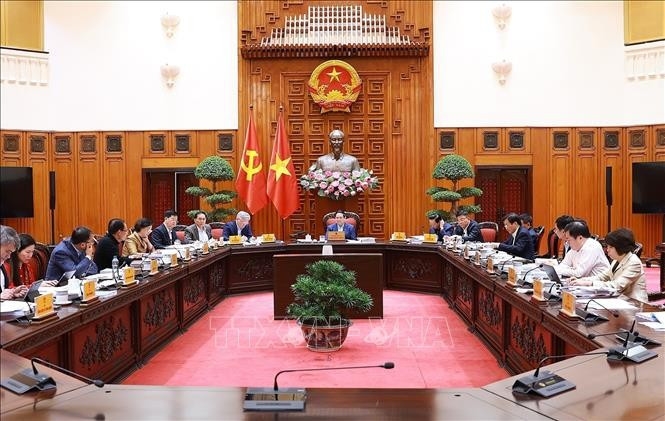
Prime Minister Pham Minh Chinh chairs the meeting with Deputy PMs and leaders of ministries and government agencies on December 5 to discuss the development of free trade zones in localities and a national oil refining, petrochemical, and energy center at the Dung Quat Economic Zone. |
Developing Dung Quat into national energy center
Later, PM Pham Minh Chinh chaired another meeting to discuss mechanisms and policies for developing a national oil refining, petrochemical, and energy center in the Dung Quat Economic Zone in the central province of Quang Ngai.
The Dung Quat Oil Refinery, the first of its kind in Vietnam, benefits from a strategic location and well-developed infrastructure. The Politburo’s Resolution No.26 stipulates the task of expanding and building the national oil refining, petrochemical, and energy center in the Dung Quat Economic Zone.
In his conclusion, PM Pham Minh Chinh noted that the Dung Quat refinery, invested and operated by Vietnam, is performing efficiently and already has its Phase 2 expansion approved.
The PM broadly supported the proposed policies but tasked ministries, the locality, and the Vietnam National Industry - Energy Group (Petrovietnam) with reviewing the existing regulatory framework and proposing even more specific, breakthrough, and robust policies for consideration by the National Assembly or the Government.
The PM stressed the need to draft a comprehensive, feasible, and effective master plan to develop the Dung Quat center. This initiative is crucial for bolstering local socio-economic development, securing national energy security and self-reliance, and contributing to the nation's two strategic centenary goals.
Source: VNA