Statistics showed that accounting for over 70% of Vietnam’s total export turnover, the foreign-invested (FDI) sector continues to expand its dominance, underscoring the need for stronger leadership from domestic economic groups to rebalance growth.
Dau Anh Tuan of the Vietnam Chamber of Commerce and Industry said the FDI share in exports has surpassed 70% with no sign of reversal. If this trend persists, Vietnam risks remaining a “processing hub” for multinational corporations.
    |
 |
|
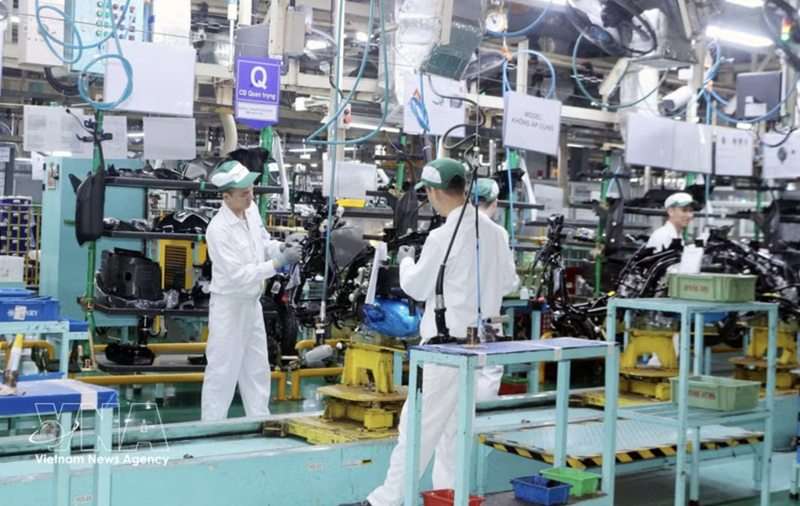
Workers at a factory in Ninh Binh province (Photo for illustration) |
Data from the Ministry of Finance’s Foreign Investment Agency showed that in the first quarter of 2026, FDI exports (including crude oil) exceeded 98.4 billion USD, up 33.3% year-on-year and accounting for around 80% of total exports.
According to Dr. Bui Thanh Minh, Vice Director of the Office of the Private Sector Development Research Board (Board IV), Vietnam has achieved high trade openness and export scale, but export capacity and trade surplus remain heavily concentrated in the FDI sector. In 2025, domestic firms contributed just 22.7% of total exports and recorded a trade deficit, while the FDI sector posted a large surplus.
This imbalance highlights that Vietnam’s export success does not fully reflect the strength of domestic enterprises. In many manufacturing industries, local firms remain concentrated in low value-added segments, while higher-value activities -such as design, branding, and distribution - are dominated by foreign companies.
Tuan noted that FDI firms control key links in major industrial value chains. In electronics, corporations like Samsung dominate production and exports; in textiles and footwear, Vietnamese firms largely remain subcontractors; and in sectors such as wood processing and seafood, FDI firms are expanding into areas once held by domestic businesses.
He added that while Vietnam enjoys large trade surpluses with major markets such as the US, EU, Japan, and the Republic of Korea, most exports to these markets are carried out by FDI enterprises.
By comparison, China reduced the FDI share in exports from 58% in 2005 to 27% in 2024, while domestic private firms rose to 65%. Vietnam, however, continues to see FDI dominance increase.
Experts say this poses a major challenge for domestic enterprises, which remain constrained in scale, capital, technology, and market access. In line with the Politburo’s Resolution 68-NQ/TW, which identifies the private sector as a key growth driver, Vietnam aims to build a strong domestic business base capable of leading industrialization and global integration.
Notably, by 2045, the private sector is targeted to develop rapidly, robustly and sustainably, taking a proactive role in global production and supply chains while achieving strong regional and international competitiveness. The goal is to have at least three million enterprises operating in the economy, contributing over 60% of GDP.
To achieve this, Tuan stressed the need to develop a new generation of private enterprises with technological capacity and leadership in regional and global value chains.
Assoc. Prof., Dr. Pham Manh Hung from the Banking Academy highlighted access to capital as a critical bottleneck, calling for a comprehensive approach combining financial market development, improved corporate capacity, and stronger state coordination.
Meanwhile, Minh emphasized institutional reform as a breakthrough solution. A transparent, stable, and predictable legal framework, ensuring property rights, reducing administrative barriers, and lowering compliance costs, is essential for nurturing large domestic conglomerates.
He added that policies should facilitate market-based capital accumulation and resource concentration, enabling the emergence of enterprises with sufficient scale to compete in high-tech, capital-intensive industries.
Only with such reforms, experts say, can Vietnam’s private sector move from supporting growth to truly leading economic transformation and enhancing the value of its exports.
Source: VNA