Ilyichev affirmed that regular state-level visits and exchanges of Government delegations between the two countries not only demonstrate a high level of political trust but also reflect substantial economic interests and cooperation potential.
    |
 |
|
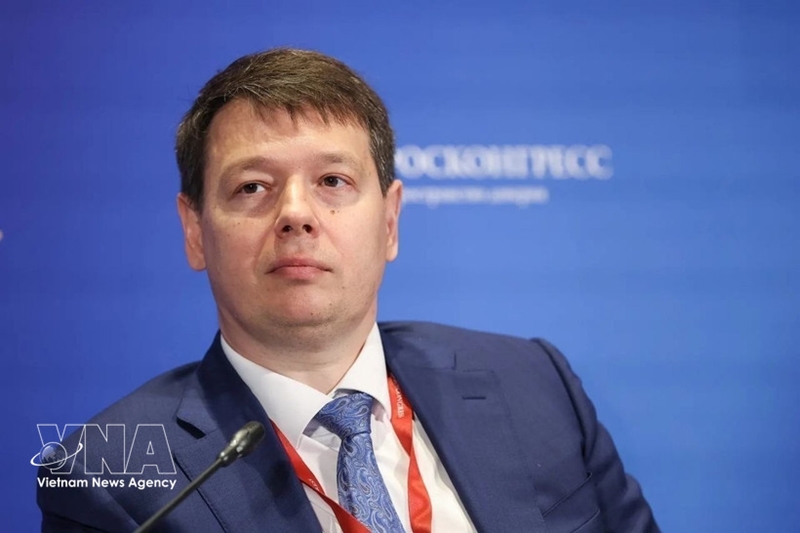
Russian Deputy Minister of Economic Development Vladimir Evgenievich Ilyichev |
Amid trade wars and disruptions to global supply chains, maintaining reliable economic ties untouched by constantly changing circumstances holds great importance, he said.
A prime example is the long-running Vietsovpetro joint venture in Vietnam, where Russian specialists and Vietnamese engineers trained in Russia have collaborated for decades. The project’s complexity and longevity illustrate the depth of technical competence on both sides, Ilyichev added.
According to him, the visit to Russia by General Secretary of the Central Committee of the Communist Party of Vietnam To Lam in May 2025 certainly injected additional momentum into bilateral ties. Overall, 2025 marked a highly successful year for cooperation on multiple fronts.
Specifically, bilateral trade rose by 6%. Russia’s fertilizer and pork exports to Vietnam hit record highs while Vietnam also began importing liquefied natural gas (LNG). Russian goods have become increasingly accessible to Vietnamese consumers through major retail chains such as WinMart.
At the same time, Russia is seeking to rebalance trade and expand both traditional and new products for Vietnam. Payment systems are being upgraded, with Russian banks rolling out QR-code services in Vietnam.
Supporting the trade surge, maritime and rail links have been expanded. The FESCO Transportation Group introduced a direct sea route from Saigon Port to St. Petersburg, complemented by new railway freight services from Vietnam to Russia. A suite of intergovernmental agreements was also signed to expand cooperation in oil and gas, industry and nuclear energy.
Recently, the Russian public's interest in Vietnamese culture and tourism has grown. The “Vietnam Days” festival in Moscow last August attracted around one million visitors, strongly driving two-way tourism flows. About 690,000 Russian tourists visited Vietnam in 2025, a 196.9% jump from 2024.
Last year, Russian airlines launched 31 additional flights across 15 new routes to Nha Trang, Hanoi, Ho Chi Minh City, and Phu Quoc Island. They now operate 50 flights per week while Vietnamese carriers run another 14.
Vietnamese arrivals in Russia rose 36%, aided by streamlined visa procedures, more flights and targeted promotion of Russia as an attractive destination, he said.
PM Pham Minh Chinh’s visit to Russia will deliver another boost to Russia – Vietnam trade and economic ties, Ilyichev stressed.
Among key cooperation areas, food and energy security tops the agenda. Russia stands ready to ramp up shipments of food and fertilizers, expand deliveries of coal, oil and LNG, and supply technology for sustainable energy projects amid the global energy crunch, he added.
Important outcomes of the visit include the signing of an intergovernmental pact for the Ninh Thuan-1 nuclear power plant in Vietnam and PAO NOVATEK’s LNG supply contract, which gains added significance given impacts of the Middle East tensions. The deputy minister perceived that this will help Vietnam secure strong energy infrastructure along with self-reliant and stable economic development.
Regarding prospects, Ilyichev noted that Russian logistics companies have set up regional centers in Vietnam to collect goods from most ASEAN countries. Memoranda of understanding on cooperation, including those among the FESCO Transportation Group, Delo Group, and the Vietnam Maritime Corporation, were signed at the Vietnam – Russia Business Forum on March 24.
In his view, cooperation in cloud technology, cybersecurity, artificial intelligence, digital public services, and smart and safe city solutions is becoming increasingly strategic in the current volatile landscape. Vietnam attaches great importance to technological sovereignty and is actively pursuing international partnerships in this field.
With backing from Russia’s Far Eastern Federal University, the Southeast Asia AI and Digital Technology Research and Development Centre has been launched in Vietnam. In November 2025, the Vietnam National University – Hanoi’s AI Institute joined the International AI Industry Alliance at a conference in Moscow. Besides, Russia's facial recognition technology is already in use on Vietnamese roads.
The creative economy, spanning high-value-added products, knowledge-based and innovation-driven industries ranging from information technology and cinema to fashion and design, represents a promising new frontier for bilateral ties, the official went on.
Education and training ties have also advanced, with more joint programs, academic exchanges and flexible interactive formats.
This year, 2026, has been designated the Russia – Vietnam Year of Science and Education. Ilyichev voiced confidence that collaboration in knowledge-intensive sectors will expand and deepen, especially in workforce training needed to support major infrastructure projects.
These positive developments point to brighter prospects for both countries, especially following substantive and trust-based high-level visits, he stressed.
Source: VNA