Speaking at the launch ceremony on November 1, Minister Thanh said the platform was designed to help residents and visitors easily search for cultural activities by location, time and theme, enabling them to choose suitable experiences with family and friends.
She expressed her hope that information available on the map would inspire more people to visit heritage sites, attract audiences to theaters, create opportunities to meet artisans and help cultural stories continue to be told along different journeys.
    |
 |
|
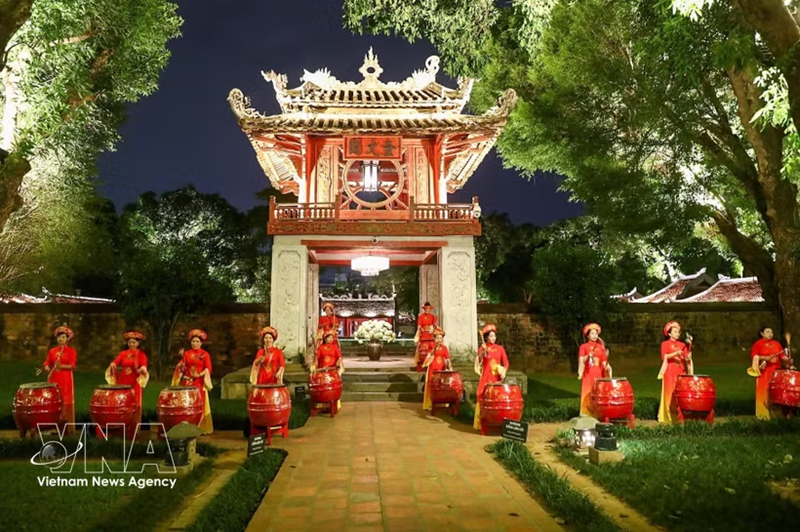
The digital art program “Tinh hoa dao hoc” (Essence of Education) at the Van Mieu – Quoc Tu Giam (Temple of Literature - National University) special national relic site in Hanoi on November 1 |
The minister called on the public, especially young people, to visit cmap.vn, select cultural activities to attend with family and friends, and share their experiences. She encouraged them to start with a nearby heritage site, traditional craft village or cultural event, becoming ambassadors for Vietnamese culture and helping turn each destination into a lively cultural encounter that would further nurture their love for the homeland and country.
The Ministry of Culture, Sports and Tourism organized the launch of the CMAP alongside the digital art program “Tinh hoa dao hoc” (Essence of Education) at the Van Mieu – Quoc Tu Giam (Temple of Literature - National University) special national relic site in Ha Noi, in response to the first Viet Nam Cultural Day on November 24, 2026, in conjunction with the 2026 Great National Unity Festival, marking a breakthrough in the cultural sector’s digital transformation.
Available at cmap.vn, the platform aims to digitize and connect cultural resources in a single system, allowing users to explore information about heritage sites, museums, events, festivals and cultural destinations across all 34 provinces and cities.
Beyond serving as a location-search tool, the CMAP is designed as a comprehensive digital information channel covering cultural, sports and tourism infrastructure. It enables real-time updates on arts and cultural events, traditional festivals, mass sports competitions and heritage tourism itineraries, bringing diverse cultural data together in an integrated ecosystem.
Local residents and visitors can use the platform to find cultural and sports activities near their location, learn about destinations and select suitable sightseeing and experiential itineraries. Localities and organizations can also use it as an official channel to introduce and promote cultural values and tourism products to the public.
For management agencies, geographically organized data will provide information on the current status, distribution and potential of cultural resources, supporting heritage preservation, activity coordination, management and policymaking. The platform will also offer businesses a useful reference for market research, investment opportunities and the development of cultural industry products and services.
The launch, together with the digital art program, took place ahead of the 950th anniversary of the establishment of Quoc Tu Giam, Viet Nam’s first national university (1076–2026), highlighting efforts to carry traditional knowledge, culture and heritage into the digital space.
The Van Mieu - Quoc Tu Giam, a symbol of the nation’s respect for learning and talent, has taken the lead in Ha Noi in applying technology to create innovative cultural products. These include the “Essence of Education” night tour and experiential activities linked to traditional craft villages and local cuisine.
The digital art performance “Essence of Education” demonstrated how performance technology can be integrated with digital cultural data infrastructure. Such initiatives help enhance the appeal of heritage, promote Ha Noi’s tourism economy and provide practical models for other localities to consult in developing their cultural industries.
The platform’s operation also realizes the direction given by General Secretary of the Central Committee of the Communist Party of Viet Nam and President To Lam, requesting the establishment of an interconnected, verifiable and sustainable national digital cultural database, alongside breakthrough mechanisms and policies to develop data and artificial intelligence applications in heritage preservation and turn cultural values into economic value to develop cultural industries.
The initiative also contributes to implementing the Political Bureau’s Resolution No.57-NQ/TW on breakthroughs in science and technology development, innovation and national digital transformation, and Resolution No.80-NQ/TW on Vietnamese cultural development in the new period, which stresses the application of modern technologies in the cultural sector.
The platform will continue to be upgraded and connected with the national electronic identification system VNeID and other relevant digital platforms, gradually incorporating data on tangible and intangible cultural heritage, museums, libraries, theaters, creative spaces, sports facilities and tourism destinations nationwide.
According to the ministry, as of November 1, the CMAP had listed 391 events taking place across all 34 provinces and cities. Cultural institutions under the ministry had also announced 33 events in response to the Viet Nam Cultural Day in conjunction with the 2026 Great National Unity Festival.
Source: VNA