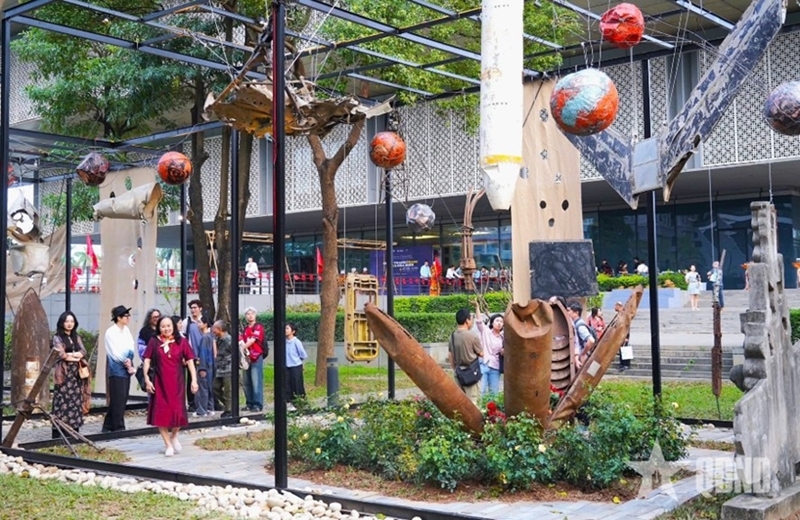
In the museum’s courtyard, aircraft wreckage fragments once archived are now suspended in natural light, facing the capital’s peaceful sky. Artists have integrated these historical artifacts into a new structure, retaining their rugged texture while inviting deeper contemplation.
    |
 |
|
Visitors explore the contemporary installation space “War and Peace.” |
The installation features two main steel frames connected by a narrow passageway. Stepping inside, visitors cross a symbolic boundary of war’s devastation. Suspended at eye level, the wreckage allows a direct confrontation with the nation's shared memory.
Interspersed among cold metal fragments are colorful, lacquer-coated geometric forms. This combination creates a striking contrast between hardness and softness, reflecting a painful past alongside aspirations for healing.
A relief sculpture of Senator John McCain, depicting his 1967 downing over Truc Bach Lake, serves as a focal point. Within this context, the image symbolizes closing a painful past to move toward reconciliation and development, offering an open, multidimensional perspective on history.
The experience culminates at the end of the passageway, where the space opens to a trellis of flowers and swaying ribbons. This transition from cold bomb shells to vibrant foliage guides viewers from destruction to renewal.
Artist Thu Tran explained, “The greatest challenge was preserving respect for the original nature of the artifacts. I did not alter them but simply placed softer materials beside them to evoke a sense of compassion.”
The exhibition marks a shift for the Hanoi Museum. By applying contemporary art language and moving artifacts out of glass cases, the museum creates an immersive experience.
Pham Tuan Long, Director of the Hanoi Department of Culture and Sports, noted that such events allow artists to realize creative ideas and help develop the museum into a prominent cultural destination.
Translated by Tran Hoai