In a land known for buckwheat flowers in season, old rammed earthen houses, and silver-grey stone fences, a special class is quietly helping preserve the cultural legacy of the H'mong ethnic community. The training course on the "khen" playing and dancing, organized by the Tuyen Quang center for culture and cinematography, aims to pass on traditional heritage to younger generations.
Bringing heritage into schools
In the Dong Van Karst Plateau Geopark, the sound of the "khen" has long been more than festive music. For the H'mong people, the instrument represents the voice of the soul, reflects the rhythm of life, and carries memories of spring fairs, harvest celebrations, and gatherings along rocky mountain slopes.
    |
 |
|
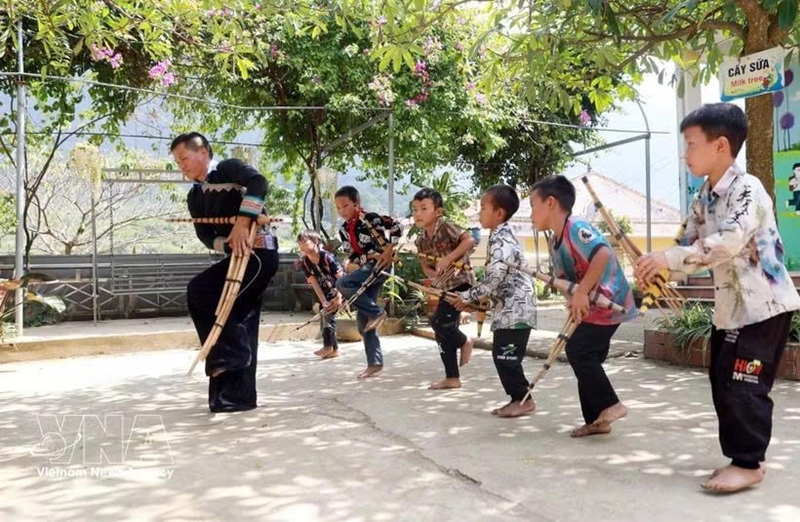
Students are taught how to perform the "khen." (Photo for illustration) |
Introducing the "khen" performance into schools, therefore, is not simply about teaching a performing art. It’s also a way to uphold the community’s cultural identity for future generations.
Tai Dinh Tinh, Director of the center, said the art of the "khen" playing and dancing is one of the most distinctive cultural traditions of the H'mong ethnic group in the Dong Van Karst Plateau.
Over time, many traditional cultural values risk fading away if they are not passed down, he noted, adding that as long as children still love the sound of "khen" and want to learn and preserve it, the heritage will continue to live on.
Beyond learning performance skills, students are also introduced to the deeper cultural significance of the instrument in the H'mong community life. Through stories shared by artisans, many children are discovering for the first time that the "khen" is closely tied to the history, customs, and spiritual life of their ethnic group.
Nurturing young guardians of heritage
In previous years, many mountainous communities worried that younger generations were gradually losing familiarity with traditional music, folk songs, and even their native language amid the pressures of modernization. Bringing cultural heritage into schools is therefore seen as a way to “plant the seeds” of cultural identity among local youth.
|
|
 |
|
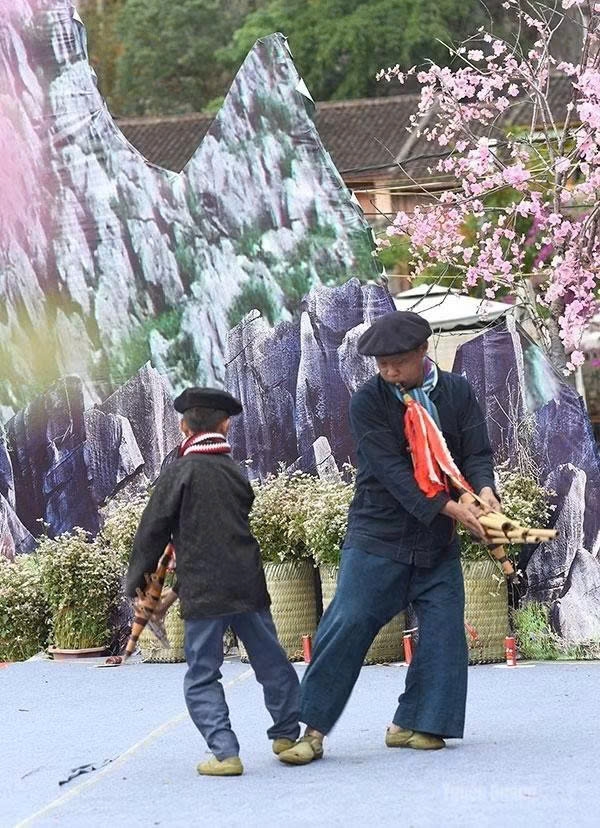
The sound of the "khen" echoes across the mountainous area, reflecting the traditional cultural identity of the H'mong ethnic people. (Photo for illustration: baotuyenquang.com.vn) |
Ly Ngoc Long, Vice Chairman of the Sa Phin commune People’s Committee, shared that local authorities consistently prioritize preserving and promoting the H'mong cultural identity in tandem with developing community-based tourism.
Cultural heritage can only truly survive when it is preserved and continued by the community that possesses it. Seeing students enthusiastically learn to play and dance with the panpipe is an encouraging sign for cultural preservation efforts in the locality, he added.
In recent years, many localities across the Dong Van Karst Plateau have strengthened efforts to integrate traditional culture preservation into schools. The "khen" performances, linen weaving, folk songs and traditional games are gradually becoming more familiar once again to younger generations.
Source: VNA