The official made the statement in an article written on the occasion of the 59th founding anniversary of the Association of Southeast Asian Nations (ASEAN) (August 8, 1967–2026) and the 31st anniversary of Vietnam's accession to the bloc (July 28, 1995–2026).
In the writing, he noted that on August 8, 1967, ASEAN was established, laying the groundwork for regional cooperation in Southeast Asia founded on the core principles of dialogue, trust, and friendship.
    |
 |
|
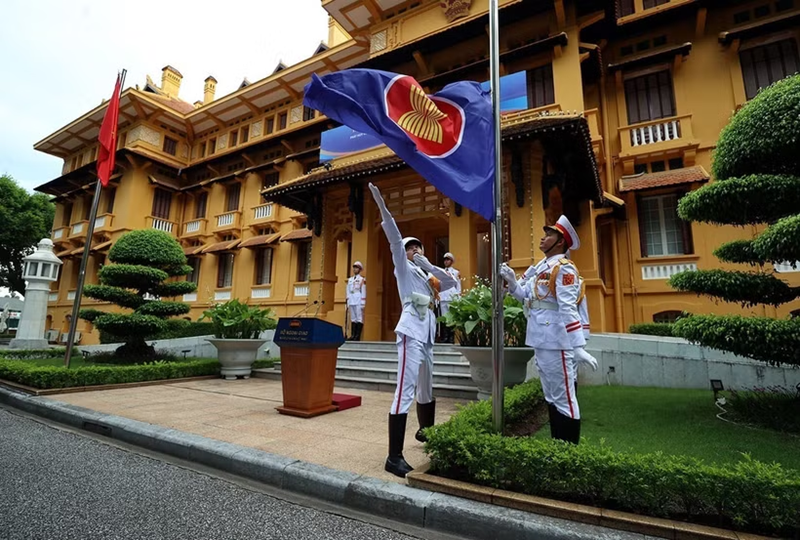
The ASEAN flag hoisting ceremony held in Hanoi on July 31, 2026 to mark the 59th founding anniversary of ASEAN and the 31st anniversary of Vietnam's accession to the bloc. |
Nearly six decades later, the bloc has evolved into one of the world's most successful models of regional cooperation. From a deeply divided region, ASEAN has forged a peaceful and stable regional environment, an epicenter of economic growth, and a cohesive common home where member states are jointly making strong strides forward.
The year 2026 marks a new development phase for ASEAN, starting the implementation of the targets under the ASEAN Community Vision 2045. The bloc possesses crucial foundations to realize this vision: a spirit of solidarity and unified political will among member states; institutional framework and regional integration built over decades; a dynamic market of nearly 700 million people with a young population; and a strong demand for deep cooperation to collectively address shared challenges.
However, the evolving landscape presents new imperatives. ASEAN can no longer merely adapt or react passively to shifts in the strategic environment; it must proactively help shape the rules of the game and lead regional development trends. This demands that ASEAN continue to boldly innovate its mindset and cooperation methodology toward a more proactive, effective, and substantive approach, thus delivering tangible benefits to its citizens and member countries, according to Trung.
Over three decades of journeying with ASEAN have affirmed the correct strategic decisions of the Vietnamese Party and State regarding foreign affairs and international integration. Today, ASEAN has become a vital strategic space closely intertwined with Vietnam’s security interests, development, and international standing, he noted.
As an active, proactive, and responsible member, Vietnam remains steadfast in upholding ASEAN's foundational principles and values. It has actively contributed to maintaining ASEAN solidarity and centrality, promoting international law and a rules-based regional architecture, and fostering a "culture of implementation "—measuring the success of cooperation through substantive outcomes and tangible benefits for the people.
Vietnam’s enduring contribution to ASEAN throughout this journey reflect a consistent conviction: ASEAN’s success is inextricably linked to the success of each member state, and ASEAN’s collective strength is forged through shared responsibility, mutual interest, and a unified strategic vision.
Guided by this spirit and built upon the nation's posture, potential, and standing after 40 years of Doi Moi (Renewal), Vietnam will continue to serve as a positive factor in helping shape major strategic shifts and the future development of ASEAN, the minister added.
Entering a new era of national development with the aspiration of building a strong and prosperous country, the mindset of "growing alongside ASEAN" will guide Vietnam’s more proactive, positive, and substantive contribution to the ASEAN Community and the co-creation of the region’s shared future.
Adhering consistently to the foreign policy of independence, self-reliance, resilience, and multilateralization and diversification of external relations, and to the spirit of the Resolution of the 14th National Party Congress, Vietnam will strive to elevate its role, initiatives, and ideas to boost its contribution to ASEAN across six strategic priorities.
The first is proactively creating and maintaining a peaceful, secure, and stable regional environment, Trung noted, elaborating that Vietnam will persistently work with other ASEAN countries to consolidate ASEAN solidarity, uphold the bloc’s centrality, adhere to the principles and codes of conduct, and enhance ASEAN’s responsiveness to increasingly complex security challenges.
Vietnam will also make concerted efforts to promote dialogue, build trust, and uphold international law, including the United Nations Convention on the Law of the Sea (UNCLOS) 1982. It will further contribute to conflict prevention, the management of differences, and the harmonious resolution of regional issues based on shared interests and responsibilities.
The second is fostering resilience and the quality of regional economic integration. Vietnam will actively collaborate with other ASEAN members to deepen intra-bloc connectivity, diversify markets and supply chains, guarantee economic security, and strengthen resilience to shocks. It will join efforts to safeguard energy and food security, enhance the quality of infrastructure connectivity, and generate new growth drivers rooted in science, technology, and innovation, while advancing the digital economy, green economy, circular economy, and just energy transition.
The third is strengthening the "culture of implementation." The focus will be on translating agreements into tangible projects and initiatives into measurable outcomes. Priority will be given to supporting disadvantaged countries and sub-regions while leveraging the roles of enterprises, citizens, and regional institutions in narrowing development gaps.
The fourth is enhancing ASEAN’s external relations in a proactive, balanced, and substantive manner. Vietnam will join other member states in deepening and diversifying relations with external partners on the basis of mutual respect, equality, and mutual benefit, ensuring ASEAN centrality and alignment with ASEAN principles.
The fifth is elevating the country’s contribution—from active participation to proactive shaping. Vietnam will actively propose new initiatives and amplify ASEAN’s influence in areas where the country holds experience and strengths such as digital transformation, innovation, food security, water resource management, climate change response, sub-regional development, Mekong–ASEAN connectivity, and promoting the role of youth, women, and enterprises in the Community building process.
The sixth is reforming operational methods and improving the efficiency of ASEAN institutions. Vietnam and fellow member states aim to build a streamlined and flexible ASEAN equipped with superior forecasting and policy-planning capabilities to meet the requirements of the new development phase, Trung went on.
Against the backdrop of a rapidly changing, complex, and unpredictable world, Vietnam remains firmly convinced that its developmental path is inseparable from the growth of ASEAN. It will continue to accompany, contribute to, and co-create the successful implementation of the ASEAN Community Vision 2045, ensuring ASEAN not only adapts to the times, but also actively shapes and asserts its role, delivering practical benefits to its people and contributing to peace, stability, and shared prosperity in the region and the world, the minister affirmed.
Source: VNA