The project is undertaken by the VTS consortium, co-led by the Military Industry and Telecoms Group (Viettel) of Viet Nam and Singapore’s Singtel. It marks the first international submarine cable system initiated and controlled by a Vietnamese enterprise, with the largest capacity and highest transmission quality among submarine cable routes connecting Viet Nam with Singapore.
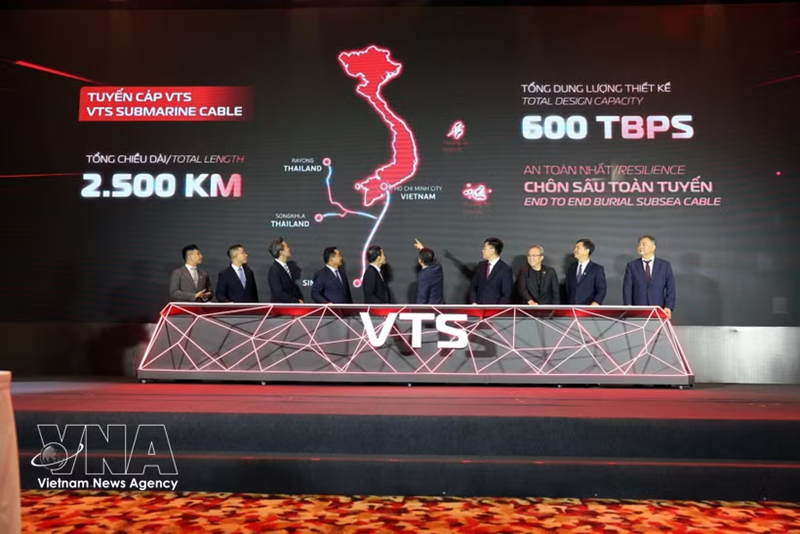
The VTS cable will stretch approximately 2,500 km, with a designed capacity of 600 Tbps. It is scheduled for completion and commercial operation in the fourth quarter of 2030. The direct Viet Nam-Singapore segment will measure around 1,200 km and have a capacity of 240 Tbps - approximately 2.5 times the combined capacity of all international submarine cables currently in operation in Viet Nam.
    |
 |
|
The launch ceremony of the Viet Nam–Thailand–Singapore submarine cable project on November 26, 2026 |
Designed with eight fiber pairs, the system will employ next-generation wavelength-division multiplexing (WDM) technology and an open-cable architecture. It is expected to deliver a round-trip data latency of just 12 milliseconds between Viet Nam and Singapore, about 50% lower than the current average.
The entire cable will be buried beneath the seabed, with the main section laid at a depth of up to three meters to minimize the risk of damage from fishing activities and ship anchoring. The project’s landing station will be located in Ho Chi Minh City.
Speaking at the launch ceremony, Lieutenant General Tao Duc Thang, Chairman and General Director of Viettel, said that this marks Viettel’s transition from participating in infrastructure investment to proactively developing connectivity infrastructure.
The initiative will help safeguard international connectivity infrastructure, he said, adding that by 2030, Viettel aims to put five additional international submarine cable systems into operation, take control of at least two of them and increase the total number of systems in which it participates to 10.
Deputy Minister of Science and Technology Pham Duc Long said Viet Nam’s demand for international bandwidth is growing by an average of 24% annually. Against this backdrop, Viettel’s initiative to develop a Vietnamese-controlled cable system is timely and necessary.
He highlighted three strategic benefits of the project, namely strengthening national autonomy in digital infrastructure, improving the security of international connectivity by adding a southern route, and developing the data economy while enhancing Viet Nam’s regional standing.
Truong Minh Huy Vu, Vice Chairman of the Ho Chi Minh City People’s Committee, stated that the landing station will provide the city with a new data gateway directly connecting it to Singapore, a leading regional telecommunications, data and financial hub. This will support the city’s ambitions to become an international financial center, data hub and digital economy center while strengthening its appeal to international investors.
The project also demonstrates Vietnamese enterprises' capacity to master strategic technologies, in line with the Politburo’s Resolution No.57-NQ/TW on breakthroughs in science - technology development, innovation and national digital transformation.
The VTS consortium brings together Viettel and Singtel as co-initiators, Thailand’s AIS, and Vietnamese technology companies VNPT, FPT Telecom and Viettel IDC. Japan’s NEC Corporation and Singapore’s ASEAN Cableship are the construction contractors.
Source: VNA