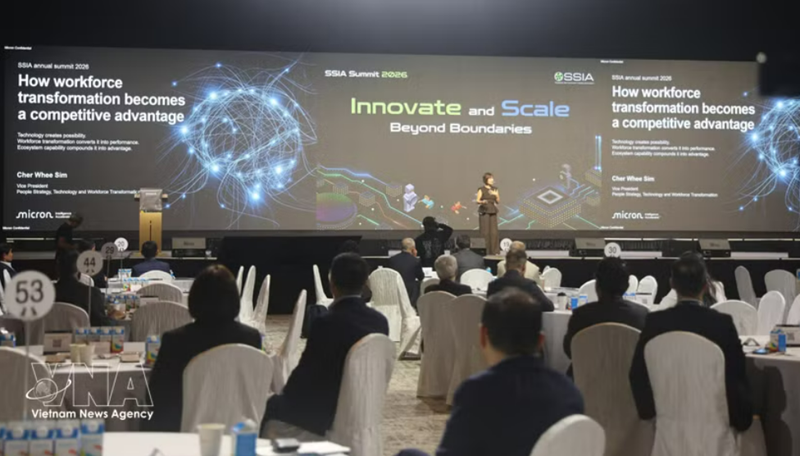
Bringing together more than 50 students and lecturers from Singapore, Viet Nam, India, Indonesia and Malaysia, along with representatives of semiconductor businesses worldwide, the event is an expansion activity of the SSIA Summit 2026 in Singapore.
    |
 |
|
A discussion at the first Regional Student Talent Exchange Program hosted by the Singapore Semiconductor Industry Association (SSIA) from September 23 to 25 |
According to SSIA, the global semiconductor industry is expected to need more than 1 million skilled workers by 2030, or over 100,000 annually. In Singapore, semiconductor engineers, instrumentation engineers and process engineers are among occupations facing manpower shortages, including positions in integrated circuit design and microchip engineering.
Talking to the Viet Nam News Agency, Cao Xuan Thang, head of the Viet Nam Trade Office in Singapore, said amid the global shortage of highly skilled semiconductor workers, cooperation with Singapore in training and employing engineers holds strategic and long-term significance to Viet Nam.
He noted that Singapore has developed a closely connected ecosystem linking training, research and businesses. Cooperation will help Viet Nam access modern training programs, improve the professional expertise, skills and thinking of engineers, and strengthen links among the State, universities and businesses.
Thang highlighted Singapore’s State – business – university model, under which training closely follows industry needs, with businesses participating in curriculum development, receiving interns and providing on-the-job training.
The Viet Nam Trade Office in Singapore has coordinated with SSIA to connect Vietnamese training institutions with the association’s member companies. The participation of Vietnamese lecturers and students in the exchange program is among the initial outcomes, he said.
SSIA Executive Director Ang Wee Seng said Viet Nam has emerged as an important semiconductor hub in ASEAN, with strengths in chip manufacturing and design and a large workforce. Singapore, meanwhile, has built its semiconductor industry over nearly six decades, developing a diverse ecosystem and skilled workforce.
The two countries can complement each other and work closely together to develop human resources, Ang said, stressing that the workforce must be able to adapt and reskill as technology evolves, particularly as advanced manufacturing moves towards AI-supported smart manufacturing.
He expressed confidence that Vietnamese universities and training institutions can adapt to this trend and prepare students for the evolving needs of the industry.
Dr. Nguyen Vu Anh Quang from the Viet Nam-Korea University of Information and Communication Technology (VKU) under the University of Da Nang pointed to gaps between semiconductor training in Viet Nam and the requirements of businesses, including the high cost of industry-standard design software, academically oriented curricula, and limited opportunities for lecturers to participate in businesses’ projects.
He proposed “Train the Trainer” programs, resource sharing, virtual laboratories and licensed software, as well as a “sandwich” training model allowing students to gain foundational knowledge in Viet Nam before undertaking graduation projects, internships or research in Singapore.
Nguyen Tien Anh, a student at Ho Chi Minh City University of Technology under Viet Nam National University-Ho Chi Minh City, said exchanges with engineers from semiconductor enterprises such as AMD and Infineon showed that young Vietnamese engineers need strong specialized foundations as well as English, communication and teamwork skills to join the global semiconductor value chain.
According to SSIA, the exchange program connects students with industry at an early stage and gives Vietnamese participants specializing in chip design and integrated circuits opportunities to engage directly with companies, engineers and industry leaders.
SSIA said no country can handle the entire chip-making process alone, nor can it develop the workforce independently. The program therefore opens avenues for Viet Nam–Singapore cooperation in semiconductor training, research and workforce development.
Source: VNA