The meeting was held ahead of the 12th Cambodia-Laos-Myanmar-Viet Nam Summit (CLMV 12) and the 11th Ayeyawady-Chao Phraya-Mekong Economic Cooperation Strategy Summit (ACMECS 11).
Welcoming the Cambodian Prime Minister back to Ha Noi for the two regional gatherings, PM Le Minh Hung said Hun Manet’s participation would contribute to their success and provide fresh impetus for cooperation across the Mekong subregion, particularly in promoting peace, stability and sustainable development.
    |
 |
|
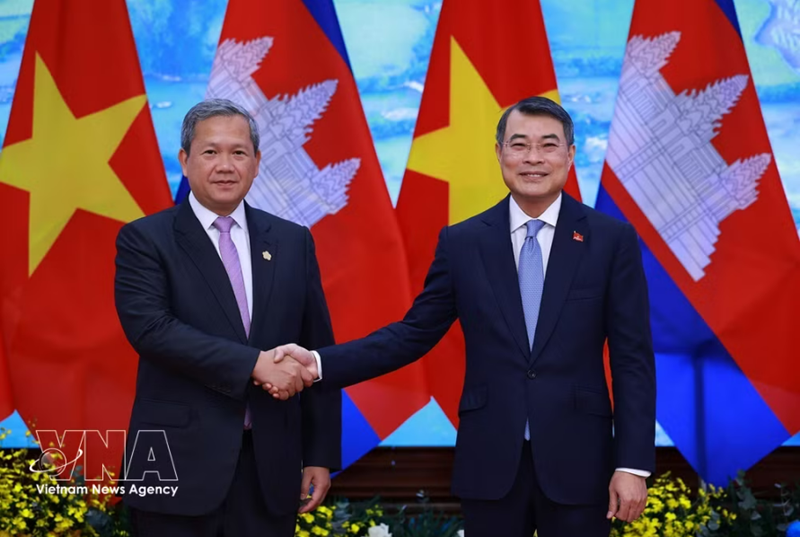
Prime Minister Le Minh Hung (right) meets with Cambodian Prime Minister Hun Manet in Ha Noi on November 28, 2026. |
He congratulated Cambodia on its recent achievements in national development and its successful hosting of numerous diplomatic events, which have further enhanced the country’s regional and international profile. PM Le Minh Hung expressed confidence that Cambodia would continue making progress in national construction and development and improving living standards for its people.
For his part, PM Hun Manet praised Viet Nam’s socio-economic progress and wished the country success in hosting the CLMV and ACMECS summits. He expressed confidence that Viet Nam would maintain strong economic growth, fulfill the development objectives set by the 14th National Congress of the Communist Party of Viet Nam and further strengthen its international standing.
The two leaders welcomed the steady progress in bilateral relations under the guiding principles of “good neighborliness, traditional friendship, comprehensive cooperation, and long-term sustainability.” Cooperation has expanded across a broad range of fields, supported by regular exchanges between senior leaders and delegations at all levels, which have helped consolidate political trust and solidarity.
Defense and security ties continue to serve as a cornerstone of bilateral relations, while economic, trade, investment and tourism cooperation has gained momentum. Collaboration in education, culture and people-to-people exchanges has also broadened, alongside stronger partnerships between localities in the two countries.
Against this backdrop, the Prime Ministers emphasized the importance of making better use of their respective strengths and complementary potential to generate additional resources for national development in the new period.
A key priority is to improve the performance of existing bilateral cooperation mechanisms. The two sides agreed to strengthen monitoring and review of the implementation of agreements and commitments reached by senior leaders, while encouraging ministries, sectors and local authorities to take greater responsibility for turning those commitments into practical outcomes.
Defense and security cooperation will continue to receive close attention. Both governments pledged to coordinate efforts to safeguard national security, maintain stability and ensure social order, reaffirming their commitment not to allow any hostile forces to use the territory of one country to undermine the other.
They also agreed to intensify joint action against cross-border criminal activities, particularly drug trafficking, human trafficking and online fraud. Cooperation in locating, recovering, repatriating and identifying the remains of Vietnamese volunteer soldiers and experts who died in Cambodia during wartime will also be maintained.
Economic connectivity featured prominently in the discussions, with both leaders calling for smoother cross-border trade, stronger investment links and more efficient circulation of goods. They agreed to make fuller use of market opportunities and each country’s comparative advantages, with a shared goal of bringing bilateral trade to 20 billion USD at an early date.
The two Governments will also work to improve the business environment and facilitate the expansion of enterprises from both countries, while advancing major cooperation projects capable of delivering tangible mutual benefits.
Improved transport links are another important part of the bilateral agenda. The two Prime Ministers called for stronger connections between major economic centers, more efficient border-gate operations and expanded logistics services. They also identified agriculture, energy, science and technology, and digital transformation as areas offering considerable potential for further cooperation.
In addition, the two countries will seek to improve the quality of cooperation in education, training and human resources development to better meet their respective development needs.
The leaders also highlighted the role of cultural, tourism and people-to-people exchanges in sustaining bilateral relations. They called for more activities involving younger generations and local communities to deepen mutual understanding, preserve traditional friendship and strengthen the social foundations of ties between the two countries.
Preparations for the Viet Nam-Cambodia Friendship Year 2027 will be stepped up ahead of the 60th anniversary of diplomatic relations, which falls on June 24, 1967–2027. The two Prime Ministers agreed to instruct ministries, sectors and local authorities to organize practical commemorative activities, helping younger generations better understand the history and significance of the two countries’ friendship.
On regional and international matters, the two leaders agreed to maintain close consultation and support each other at multilateral forums, particularly the United Nations, ASEAN and Mekong subregional cooperation mechanisms.
They also emphasized the need to reinforce ASEAN solidarity, unity and centrality, while upholding the fundamental principles enshrined in the U.N. Charter, the ASEAN Charter and international law.
Translated by Song Anh