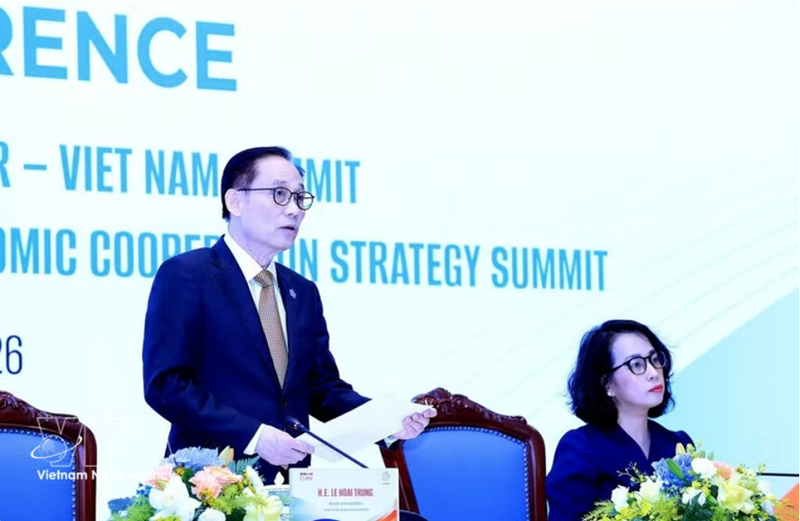
Vietnamese Minister of Foreign Affairs Le Hoai Trung announced the outcomes of the two meetings at a press conference in Hanoi on November 28 afternoon.
He said the two Mekong subregional cooperation summits, held earlier the same day, had concluded with resounding success.
Vietnamese Prime Minister Le Minh Hung chaired the 12th CLMV Summit. Viet Nam also co-organized the 11th ACMECS Summit alongside ACMECS Chair Myanmar.
    |
 |
|
Minister of Foreign Affairs Le Hoai Trung speaks at the November 28 press conference announcing the outcomes of the 12th CLMV Summit and the 11th ACMECS Summit. |
The gatherings drew the participation of Cambodian PM Hun Manet, Lao PM Saleumxay Kommasith, Thai PM Anutin Charnvirakul, and ASEAN Secretary-General Kao Kim Hourn.
For the first time, representatives from several regional partners and international organizations were invited to attend the CLMV Summit.
Trung noted that the leaders agreed to elevate the role of the CLMV and ACMECS in regional cooperation, bolster resilience, and deepen cohesion among member states, thus transforming the subregion into a shared development space. They held in-depth, substantive discussions on cooperation priorities and implementation methods to generate breakthroughs for subregional collaboration.
Promoting joint responses to common challenges, particularly climate change, environmental protection, and the management and sustainable use of Mekong River water resources, was also reaffirmed as a priority under both frameworks to ensure stable and sustainable livelihoods for people in the region.
At the 12th CLMV Summit, held under the theme "Connecting CLMV – Harnessing Potential – Building a Prosperous Future", the leaders agreed on some major orientations alongside broader subregional priorities, according to the minister.
First, the four nations identified connectivity as an overarching priority for the 2027–2028 period, with the linkage of economic corridors to be fostered to realize the goal of turning CLMV into a regional logistics hub.
The leaders tasked ministers with studying the feasibility of establishing a joint CLMV production base to contribute to a unified ASEAN market. They also directed authorities to resolve customs clearance bottlenecks, reduce logistics costs, and help enterprises across the four countries integrate more deeply into regional value chains.
Second, the leaders agreed to innovate areas of cooperation by focusing on new growth drivers and concrete initiatives. They pledged to advance digital connectivity, deploy smart border gates, develop cross-border economic cooperation zones, and explore a CLMV agricultural supply chain.
The summit endorsed two specific initiatives proposed by Viet Nam. They are the "CLMV smart dry port corridor", which will examine linking dry ports with border gates, airports, and seaports; and the "CLMV heritage journey", connecting iconic sites such as Bagan, Luang Prabang, Trang An, and Angkor into a single itinerary telling the story of Mekong River civilization.
Participants also welcomed Viet Nam’s CLMV Scholarship Program 2.0 for Cambodia, Laos, and Myanmar, which expands into English-taught programs, postgraduate studies, and vocational training.
Third, the leaders concurred in reforming resource mobilization and implementation methods. The four countries encouraged business participation right from the project design stage. Meanwhile, ministers and senior officials were instructed to coordinate with the ASEAN Secretariat in formulating programs and projects for the CLMV Action Plan 2027–2028.
The leaders adopted a joint statement along with two annexes covering the CLMV smart dry port corridor and CLMV heritage journey initiatives.
Closing the summit, Viet Nam officially handed over the CLMV Chairmanship to Cambodia, according to Trung.
Regarding the 11th ACMECS Summit, he noted that the leaders agreed to maintain ACMECS as an important subregional mechanism complementing the ASEAN Community-building process while aligning subregional development with broader regional integration.
Under Myanmar’s chairmanship theme, "Strengthening Socio-Economic Development Towards Smart and Sustainable ACMECS", the leaders reviewed past achievements and charted future directions for the grouping.
Discussions focused on advancing infrastructure, digital, and institutional connectivity, alongside environmental protection, water resources management, and air pollution control for sustainable development across ACMECS's three pillars.
The leaders adopted the Nay Pyi Taw Declaration and the terms of reference for the ad-hoc task force on the review of ACMECS priority projects. They welcomed ongoing efforts to draft the new-phase ACMECS master plan to address emerging challenges, while underscoring the importance of enhancing operational efficiency through the establishment of the ACMECS Development Fund (ACMDF).
Concluding the 11th summit, Myanmar handed over the rotating ACMECS Chairmanship to Thailand.
Trung stressed that for Viet Nam, successfully hosting the two summits marks a significant step in implementing the foreign policy set forth by the 14th National Congress of the Communist Party of Viet Nam, particularly in upholding the key and regular role of diplomacy and international integration, and actively contributing to economic integration and connectivity in the strategically important Mekong subregion.
The summits' outcomes also helped reinforce solidarity, friendship, cooperation and strategic cohesion between Viet Nam and its neighbors, expanding development space and supporting national development goals, he went on.
He affirmed that the immediate task following the summits is translating the leaders' commitments into concrete action while regularly reviewing implementation progress.
Viet Nam is committed to working alongside fellow nations to build a resilient, connected, and prosperous Mekong subregion, practically contributing to the realization of the ASEAN Community Vision 2045, the minister noted, adding that it will coordinate closely with Cambodia as the 2027 CLMV Chair, Thailand as the 2027 ACMECS Chair, and other member states to carry out cooperation priorities.
On behalf of the Government and people of Viet Nam, he thanked the Mekong countries, including Cambodia, Laos, Myanmar, and Thailand, as well as the ASEAN Secretariat, regional partners including China, Japan, the Republic Korea, Australia, and Singapore, international organizations, and the business community for their active contributions to the success of both summits.
Source: VNA