It was not just a routine transfer of power, but a strategic effort aimed at consolidating leadership, renewing a party’s vision, and positioning Vietnam for significant transformation by 2030, with the ultimate goal of becoming a high-income nation by 2045, the centenary of its independence, the article said.
    |
 |
|
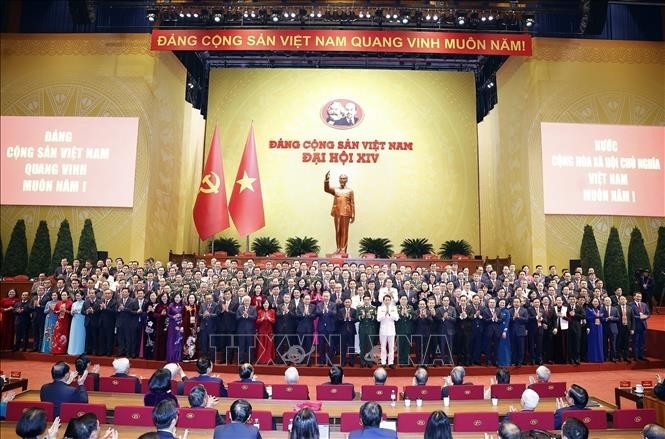
The 14th Party Central Committee makes debut at the 14th National Party Congress. |
The writing noted that convened at a moment of profound global uncertainty—characterized by geopolitical tensions, rapid technological disruption, climate stress, and shifting patterns of global growth, the 14th Congress delivered three powerful messages: the importance of stable leadership coupled with controlled renewal; the strategic clarity around a new development model; and heightened expectations for execution, state capacity, and international engagement.
Together, these elements indicate that Vietnam is entering a new phase of growth—one focused not merely on speed, but on achieving smarter, higher-quality, and more resilient transformation.
A notable outcome of the Congress was the formation of a renewed leadership cohort. The Congress elected 180 members to the Party Central Committee, including 71 newcomers, along with 20 young alternate members, ensuring a pipeline for leadership succession and longer-term generational renewal.
From this Central Committee, 19 members were elected to the Politburo, including nine new members, while General Secretary To Lam was re-elected with unanimous support, ensuring continuity at the top. The swift constitution of the Secretariat and the Central Inspection Commission further reinforced organizational discipline and unity, according to the article.
It stressed that beyond numbers, the new leadership reflects a qualitative shift towards greater emphasis on capability, professionalism, and execution capacity. Leaders with experience in economic management, science and technology, education, security, and governance in fast-growing provinces and cities are increasingly prominent.
Equally notable is the rising value placed on international exposure and structured policy learning. It reflects a recognition that governing in the current era demands strategic literacy, comparative insight, and systems thinking, not merely administrative seniority.
Substantively, the Congress reaffirmed Vietnam’s long-term national ambition: To become a modern industrial economy by 2030 and a high-income, developed nation by 2045. If successful, this will mark an extraordinary chapter in human history. In just a century (1945–2045), Vietnam would have navigated three significant phases of national survival and development: “rising up,” “awakening,” and now “ascending.”
The coming two decades are expected to define the third phase: ascending. This phase demands quantum leaps rarely achieved by nations, in productivity, innovation, governance quality, and global standing.
According to the article, what distinguishes the 14th Congress is not ambition alone, but the clarity of its development model, structured around eight mutually reinforcing pillars, including rule of law and institutions: institutions are treated as economic infrastructure, with execution discipline as the ultimate test; a new growth model: shifting to a knowledge-based, digital, green, and circular economy; science and technology: prioritizing innovation and digital transformation, especially AI and data platforms, to boost competitiveness; and human capital: breakthrough reform in education, skills, leadership, and values such as integrity and responsibility is tightly linked to economic transformation and social cohesion.
The other pillars are strategic security and diplomacy: Integrating defense, security, and foreign policy into development planning to safeguard national interests; Party building and State capacity: merit-based selection, accountability tied to outcomes, strict discipline, and protection for reform-minded officials; human security: a disciplined, safe, and civilized society places human security at the core of development—through anti-corruption, public trust, social safety nets, environmental protection, and disaster resilience; and national unity: democracy is paired with discipline, participation with responsibility, and equitable access to opportunity with fair sharing of development gains.
Together, these pillars form a coherent reform architecture, rather than a series of disconnected initiatives, the article continued.
It concluded that the 14th National Congress of the CPV represents a moment of strategic consolidation and elevation. The Congress's success will therefore be judged not by its resolutions alone, but by whether Vietnam can translate political alignment into sustained improvements in execution, productivity, innovation, and governance quality.
Vietnam’s success will hinge on its ability to respond effectively to challenges and seize opportunities. If Vietnam succeeds, the 14th Congress may well be remembered as the moment the country decisively repositioned itself for a new era of accelerated, high-quality growth, and for a confident ascent toward 2045.
If it achieves sustainable prosperity in the coming decades, its journey will serve as an inspiring example for many nations, demonstrating that peace, prosperity, and partnership are mutually reinforcing imperatives in the 21st century, the writing added.
Source: VNA