On weekends, the Vietnam National Village for Ethnic Culture and Tourism in Hanoi buzzes with visitors hunting for cultural immersion. Alongside traditional craft demos, festivals and folk shows, the food zone remains one of the biggest crowd-pullers. Many guests come back again and again to taste dishes that capture the distinct flavors of Vietnam’s mountains, deltas and river regions, while soaking up the customs, traditional know-how and cultural values baked into the cuisine of ethnic communities.
    |
 |
|
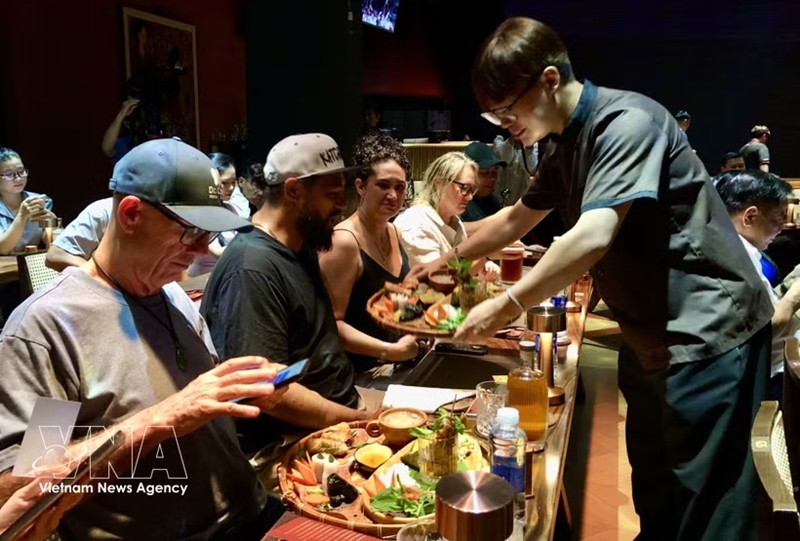
Foreigners taste unique Vietnamese cuisine. Photo: VNA |
Vietnam is sitting on a massive culinary heritage with thousands of signature dishes spanning 54 ethnic groups, many of which have earned international acclaim. More and more localities are positioning food not just as a service for tourists, but as a standalone attraction. Hue has jumped out ahead by putting culture squarely at the center of its culinary tourism strategy.
According to the Hue municipal Department of Tourism, the central city drew an estimated 4.3 million visitors in the first half, a 30% leap from the same period last year. Tourism revenue hit an estimated VND 10.3 trillion (USD 396 million), rocketing up 56.2%. Beyond the buzz of the Hue Festival and a packed calendar of cultural events, food has increasingly become a decisive magnet. Travelers now come to Hue not just to see heritage landmarks but to fully immerse themselves in the culinary culture of the former imperial capital.
Assoc. Prof., Dr. Nguyen Thi Thu Phuong, Director of the Vietnam Institute of Culture, Arts, Sports and Tourism (VICAST), said the pull of Hue’s food isn’t just about the more than 3,000 dishes on offer but the cultural depth tucked inside each one. From picking ingredients and cooking techniques to how food is presented and the rituals around eating, every detail reflects the Hue people’s philosophy of harmony, elegance and balance. That means each dish isn’t just a local specialty; it’s associated with a cultural space, a living community of practice and a body of traditional knowledge passed down over generations. And that, she noted, is exactly the direction many destinations around the world are chasing.
According to the World Food Travel Association, some 81% of travelers want to explore local cuisine during trips and are willing to allocate 25-35% of their travel budget on food experiences. Even with all its globally celebrated culinary diversity, Vietnam still hasn’t fully cashed in on its food assets for tourism. In many places, culinary tourism products still don’t go much further than introducing local specialties, while the surrounding cultural values, historical stories, traditional craft villages and local communities stay largely untapped in the visitor experience.
Nguyen Thi Hoa Mai, Deputy Director of the Vietnam National Authority of Tourism (VNAT), said the VNAT has advised the Ministry of Culture, Sports and Tourism to submit to the Government a project to spread Vietnamese tourism and cuisine overseas during the 2026-2030 period. The goal is to make food a core pillar of the national tourism brand and lift Vietnam’s competitiveness as a destination in Asia and beyond.
Nguyen Thi Lan Huong, a tourism researcher at the VICAST, said as global tourism keeps swinging hard toward authentic, personalized and culturally immersive experiences, destinations should move past simply "selling food" and start creating chances for visitors to co-create memorable moments.
Instead of just trying local dishes, tourists should be able to join the full culinary journey, from exploring growing areas, traditional markets and craft villages to preparing dishes themselves, meeting local artisans and learning the cultural stories behind every recipe. That kind of experience doesn’t just add value to tourism products, but also helps preserve food heritage, build sustainable livelihoods for local communities and sharpen a destination’s competitive edge, she said.
Le Thi Kim Phuong, Rector of Hoa Sua School of Economics and Tourism, made it clear that Vietnam’s culinary variety on its own won’t turn into a real competitive advantage without common service standards. She’s pushing for quick development of national criteria and standard operating procedures for food tourism products, standardized service, interpretation and experience design, plus a serious overhaul of training courses so they line up better with what enterprises really need and where international market trends are going.
She also stressed that tighter teamwork among regulators, companies, training establishments, artisans and local communities is a must. When every player delivers in the value chain, cuisine won’t just pull in bigger tourism revenue but also keep traditional crafts alive, protect indigenous knowledge and boost local livelihoods.
Source: VNA