Positive initial signals from Red River routes
Currently, Thang Long GTC Joint Stock Company is the pioneer operating nine river routes connecting Hanoi, Hung Yen, Bat Trang, and Bac Ninh. The launch of the Thang Long Victoria II cruise ship has boosted passenger numbers from 3,000 in 2023 to over 7,000 in 2024, generating revenue of 3 billion VND (over 113,600 USD), nearly double the previous year's figure.
The city’s Tourism Department has outlined four river tourism corridors, including the Red River, the Day River, the To Lich River, and the Cau-Ca Lo-Tich River systems. The Red River is identified as the key route with nearly 30 historical and cultural relic sites, numerous traditional craft villages, and distinctive landscapes along its banks.
    |
 |
|
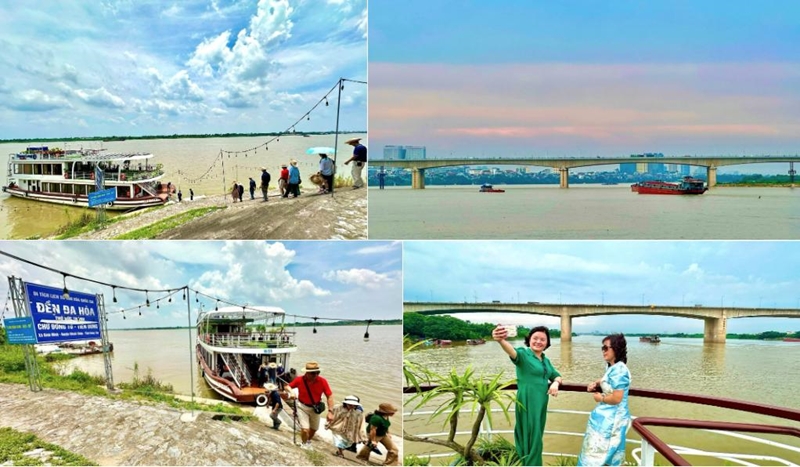
Tourists experience a river tour on the Red River in Hanoi. (Photo: Ha Noi Moi Newspaper) |
Although the initial results are still modest, the waterway routes have offered new experiences such as watching the Red River sunset, admiring the historic Long Bien Bridge, or exploring Bat Trang pottery village. Those experiences help to shape Hanoi’s cultural “soul” from the river.
Investment in waterway tourism infrastructure
The most significant constraint facing Hanoi’s water tourism currently is asynchronized infrastructure. Only the Chuong Duong Do Wharf meets the technical standards. The majority of the remaining ports are makeshift civilian wharves, lacking proper parking, service areas, and dedicated reception facilities for tourists.
According to Associate Professor, Dr. Pham Hong Long, for river tourism to develop commensurate with its potential, Hanoi needs a comprehensive master plan along the Red River, attracting investment into essential infrastructure and services. "With its advantageous scenery and culture, Hanoi can fully develop distinctive tourism products, much like Ninh Binh or Hue," he assessed.
Vu Van Tuyen, Vice Chairman of the Vietnam Community-based Tourism Association, proposed that the city promptly invest in modern terminals and safe piers, develop premium night cruises, and issue fixed sailing schedules for easy booking by tourists.
In response to this reality, Hanoi issued Plan 169/KH-UBND to implement Resolution 06-NQ/TU for the 2024-2025 period, focusing on developing the Chuong Duong Do-Bat Trang-Ninh So-Hung Yen route and expanding connections to Bac Ninh, Hai Phong, and Quang Ninh. The city also plans to dedicate land along the riverbanks for cultural and art spaces, green areas, and a synchronous connection between waterway and road transport.
Deputy Director of the Hanoi Tourism Department Tran Trung Hieu stated that the city has proposed mechanisms to encourage the socialization of investment, creating favorable conditions for businesses to participate in exploiting tourism ports such as Chuong Duong Do and Bat Trang.
"The goal is that by 2030, waterway tourism will become a signature product of the capital," he emphasized.
Expanding experiences, energizing Hanoi tourism
Beyond tapping its river advantages, Hanoi is vigorously diversifying its products to expand visitor experiences.
Night tourism products, cuisine tours, pedestrian streets, craft villages, and community-based tours are increasingly rich. Experiential tours like "Old Quarter - New City," "A day as an ancient Hanoian," and "Hanoi cuisine" attract large numbers of visitors.
The combination of pedestrian streets and culinary hubs with street art performances is transforming the capital into a "sleepless city," an inevitable direction in developing the night economy.
Not just the inner city, the outskirts of Hanoi are also becoming new destinations with craft villages like Bat Trang, Van Phuc, Son Dong, and Phu Vinh integrated into experiential tours, allowing visitors to mold pottery, weave silk, make lacquerware, or do paper; alongside agro-ecological tours, suburban cycling trips, and exploration of rural lanes, rivers, and lagoons.
In parallel, Hanoi is promoting regional linkages with Ninh Binh, Hoa Binh, and Bac Ninh to form inter-provincial tours such as "Hanoi-Tam Coc-Bai Dinh" or "Hanoi-Kim Boi Hot Springs," helping to distribute visitor flow and share economic benefits across the region.
Aiming to be a leading Asian experience destination
From the "new currents" on the Red River to its product diversification strategy, Hanoi is entering a strong transformation phase to become a leading experiential destination in Asia.
According to the plan, Hanoi aims to welcome 35.8 million visitors by 2026, including 8.6 million international arrivals. However, to achieve the stature of Bangkok or Hong Kong, which each attracts 30-40 million international visitors annually, Hanoi must shift its focus from increasing quantity to enhancing quality and spending value.
Experts suggest the capital should develop MICE, golf, and luxury tourism; invest in 24/7 entertainment, shopping, and dining systems to boost the night economy. Simultaneously, there is a need to increase direct flight routes to North America, Western Europe, and Australia, and complete the digital tourism ecosystem, including multilingual guides and cashless payment solutions.
When infrastructure, policies, and services are completed, Hanoi will not only be an administrative and cultural center but will also become a vibrant, friendly, and rich experiential destination, worthy of its position as "the heart of Vietnamese tourism."
Source: VNA