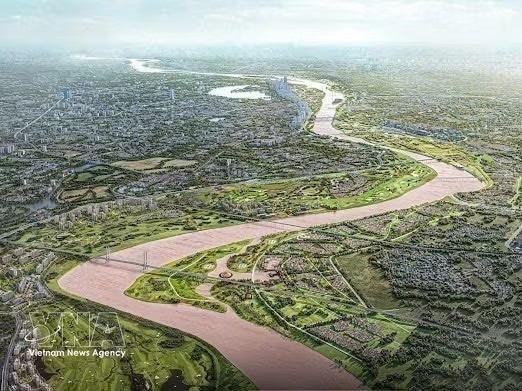
Covering more than 11,400 hectares and requiring an estimated 736.96 trillion VND (nearly 28 billion USD), the project is expected to reshape urban development along both banks of the Red River over the coming decades while improving transport connectivity and public spaces in the capital.
    |
 |
|
Work starts on Hanoi’s Red River Landscape Boulevard Axis project on December 19, 2025. |
Presenting the relevant proposal at the session, Standing Vice Chairman of the municipal People’s Committee Duong Duc Tuan said the project aims to complete Hanoi’s transport infrastructure network, expand urban space along the Red River corridor, and support sustainable urban development of the city.
The project also seeks to implement key orientations set out in the Politburo’s Resolution No. 15 on Hanoi’s development through 2030 with a vision to 2045 and Resolution No. 02 on the construction and development of Hanoi in the new era, as well as the city’s century-long master plan.
According to the proposal, the project will span multiple riverside wards and communes, including Hong Ha, Thuong Cat, Dong Ngac, Phu Thuong, Linh Nam, Thanh Tri, Nam Phu, Hong Van, Me Linh, Thien Loc, Vinh Thanh, Dong Anh, Bo De, Long Bien and Bat Trang. Major components include landscape boulevards, ecological parks, entertainment and recreation areas, urban development zones, technical infrastructure systems and water surfaces.
The transport component features two landscape boulevards running along both sides of the Red River, with a combined length of around 80 km.
The project will also include large-scale riverside parks in areas such as Trang Viet, Tam Xa, Ngoc Thuy, Long Bien–Cu Khoi, Xuan Quan–Phung Cong, O Dien and Lien Mac–Thuong Cat–Phu Thuong, covering thousands of ha in total.
Other components comprise embankments, riverbed and riverbank improvements, resettlement and urban redevelopment zones in Long Bien, Linh Nam and Bat Trang, as well as independent site-clearance projects. The implementation period is scheduled from 2026 to 2038.
In the 2026–2030 phase, Hanoi plans to prioritize the construction of the two main boulevard routes, embankment systems, major public parks, resettlement areas, and land-clearing work.
During their discussion, delegates stressed that the project will have far-reaching impacts not only on transport and urban planning but also on cultural heritage, livelihoods and community life along the Red River.
Director of the municipal Department of Culture Pham Tuan Long said the project passes through many traditional craft villages, ancient villages and historical-cultural relic sites that reflect the identity of the northern delta region.
He called for careful implementation to balance urban redevelopment with heritage preservation, warning that relocation of residents should not disrupt traditional communities or destroy local cultural spaces and livelihoods.
Long also suggested creating cultural, ecological, and community-based tourism routes along the river, boosting waterway tourism, setting up centers to display traditional crafts, and prioritizing on-site preservation for important heritage sites and relic clusters.
Delegates also emphasized the need to involve local communities, experts, artisans and social organizations in planning and landscape design to ensure social consensus and sustainable development.
Source: VNA