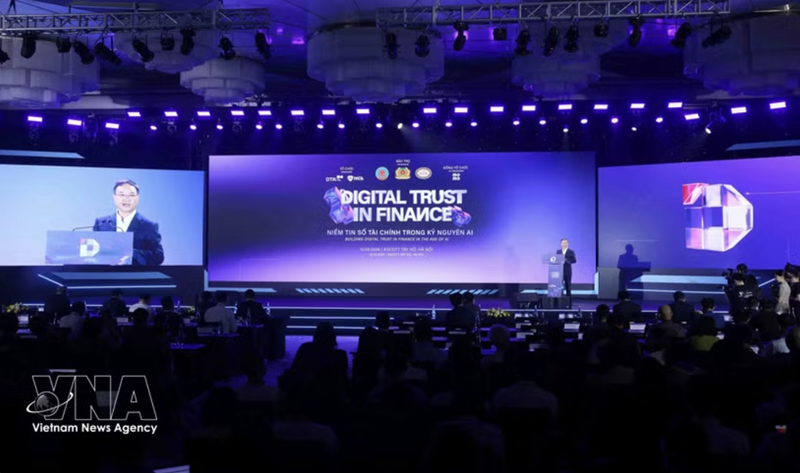
The event was co-hosted by the Digital Trust Alliance, the Department of Cybersecurity and High-Tech Crime Prevention under the Ministry of Public Security (MoPS), the National Cybersecurity Association and other partners, with backing from the MoPS, the State Bank of Vietnam (SBV) and the Ministry of Finance.
    |
 |
|
At the “Digital Trust in Finance 2026” forum |
Push for a safe, transparent, trustworthy digital financial ecosystem
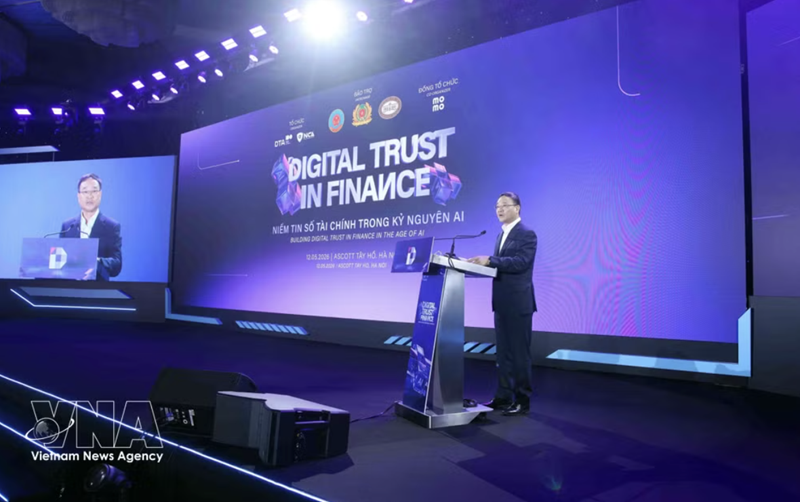
Deputy Minister of Public Security Sr. Lt. Gen. Pham The Tung told the forum that Vietnam’s financial and banking industry is racing through a digital overhaul, creating major opportunities as the country aims for double-digit growth in 2026 and beyond.
|
|
 |
|
Deputy Minister of Public Security Sr. Lt. Gen. Pham The Tung speaks at the forum. |
The AI era is igniting entirely new challenges, Tung warned. Risks that once concentrated on technology systems are now increasingly shifting toward the human factor, targeting users directly. Fraud and asset stripping schemes have grown more organized and sophisticated, while AI enables the creation of ultra-convincing fake identities and deceptive content that are difficult to detect.
That demands a fundamental pivot in digital financial security, from passive defense to proactive trust-building. A secure financial system, he said, isn’t simply free of risks, but where users are genuinely shielded, equipped to spot threats and promptly supported when incidents occur.
According to him, the MoPS has cast itself as a core force safeguarding national in cybersecurity, including digital financial security, with agencies proactively identifying and combating high-tech financial crimes while reinforcing international cooperation against borderless cybercrime.
But digital trust cannot be built by a single body, Tung stressed. It requires tight coordination among state regulators, financial institutions, technology firms and the entire society. More critically, public awareness and digital skills must be elevated, as people often act as both the weakest link and the first line of defense.
He called on agencies, organizations and businesses to jointly construct a safe, transparent and trustworthy digital financial ecosystem, laying a solid foundation for rapid and sustainable economic expansion in the country’s new growth phase.
Protecting digital trust becomes shared duty for sustainable financial growth
SBV Deputy Governor Pham Tien Dung said the AI era demands that trust no longer be viewed merely as customer perception, but as strategic infrastructure of the digital economy, built and protected through institutional frameworks, technology, risk governance and inter-sectoral coordination.
|
|
 |
|
SBV Deputy Governor Pham Tien Dung speaks at the event |
AI is unleashing enormous banking opportunities, helping boost efficiency, automate processes, personalize services, assess creditworthiness, deepen customer care, flag suspicious transactions, thwart fraud and combat money laundering, he said.
At the same time, AI is spawning a new threat landscape, including deepfakes, tailor-made scams, identity fraud, algorithmic bias, “black box” models, reliance on third parties and the danger of automated decision-making affecting customers with inadequate oversight.
In banking specifically, risks now extend far beyond technology systems into user behavior, personal data, transaction flows, interlinked platforms and criminals exploiting users’ trust to commit fraud.
This, Dung said, requires protecting not just systems but also users; forging a single shield for the entire ecosystem, rather than merely reinforcing defenses at individual organizations; and shifting from after-the-fact response toward early detection, warning, prevention and rapid coordinated action.
The plenary session zeroed in on digital trust’s role in sustainable financial growth as AI upends how markets function, how financial institutions make decisions and how users access financial services.
Source: VNA