Accordingly, they must review, update, and scale up courses in STEM, semiconductor microchips, information technology, artificial intelligence (AI), big data, cybersecurity, core and strategic technologies, and other hi-tech sectors.
    |
 |
|
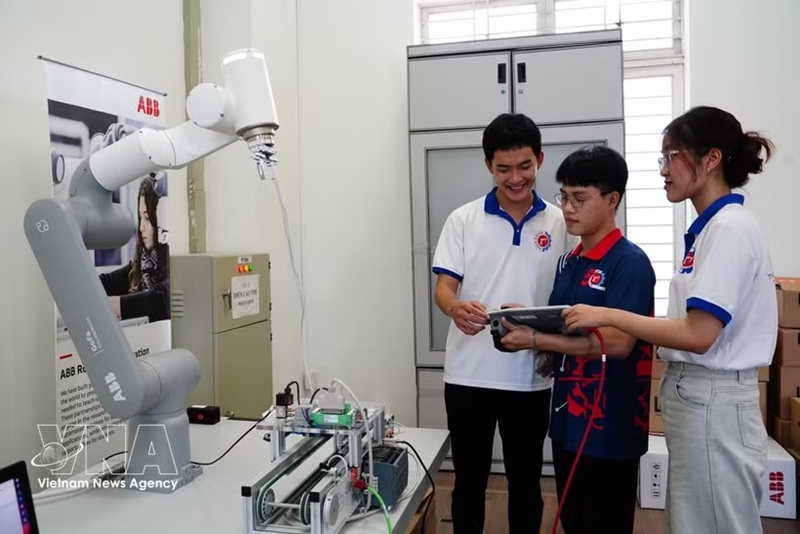
At national key laboratory of mechatronics and applications at Da Nang University of Science and Technology |
The ministry demanded a complete review of existing curricula, covering goals, learning outcomes, structure, content, teaching and assessment methods, and how emerging technologies like AI, semiconductors, automation, data science, and cybersecurity are embedded.
Curricula must be revised to boost interdisciplinary integration, add courses on new and core technologies, and expand practice sessions, projects, and industry-linked research. They should also involve major enterprises, foreign-invested firms, and tech companies in training and graduate assessment, and are encouraged to develop English-medium courses.
The ministry tasked them with creating new courses in semiconductor design and manufacturing, AI, data science, and cybersecurity, as well as in core technologies that support digital transformation and Industry 4.0. The list of priority fields extends to energy storage, space monitoring, marine technology, smart agriculture, next-generation communications, connected intelligent transport, digital creative industries, next-generation energy, green food, smart healthcare and home appliances, advanced materials, Earth system science, bio-responsive materials, and smart electric mobility.
They must also review and build up their faculty to meet quantity, structure, and qualification requirements, with priority to doctoral-level lecturers with research and international collaboration experience. They are encouraged to recruit experts from companies and research institutes and use incentive policies to draw domestic and foreign talent.
At the same time, they should review and invest in infrastructure, including laboratories, research centers, technology systems, digital learning resources, and equipment for hi-tech training.
On partnerships, the ministry ordered them to expand ties with tech enterprises, domestic and international corporations, research institutes, innovation centers, and key national technology projects.
Collaboration should take the form of co-developing and co-delivering courses, internships, commissioned training, jointly supervised research and product development, and the creation of leading expert groups and strong research teams that connect academia, industry, research institutes, key technology programs, and international partners.
They were also told to tap national projects for integrated infrastructure, smart workshops, and digital simulation tools; set up open labs, and expand university-enterprise collaboration to build innovation hubs and student research centers that support product design, testing, and improvement, thus spurring innovation and entrepreneurship.
A tripartite network involving academia, industry, and government should be formed to jointly design courses, run internship semesters, and fund studies. Companies are expected to advise on science, help develop curricula, evaluate graduates, promote dual training and applied research, and offer internships and jobs tied to practical skills.
The ministry is pushing for a boost in workforce R&D, tighter links between training and scientific research, and the creation of research groups in strategic technology fields. It also wants expanded postgraduate education, especially STEM and hi-tech doctoral courses, and innovation centers that offer consultancy, technology transfer, and innovation services. The establishment of sci-tech and intellectual property management firms, and investment mechanisms for such enterprises is also encouraged.
Relevant results must be reported to the ministry by June 15.
Source: VNA