What remains just as vivid is the image of “ao dai” gracefully fluttering against the vast backdrop of sea and sky. Hundreds of nautical miles from the mainland, the “ao dai” appears both familiar and profoundly sacred.
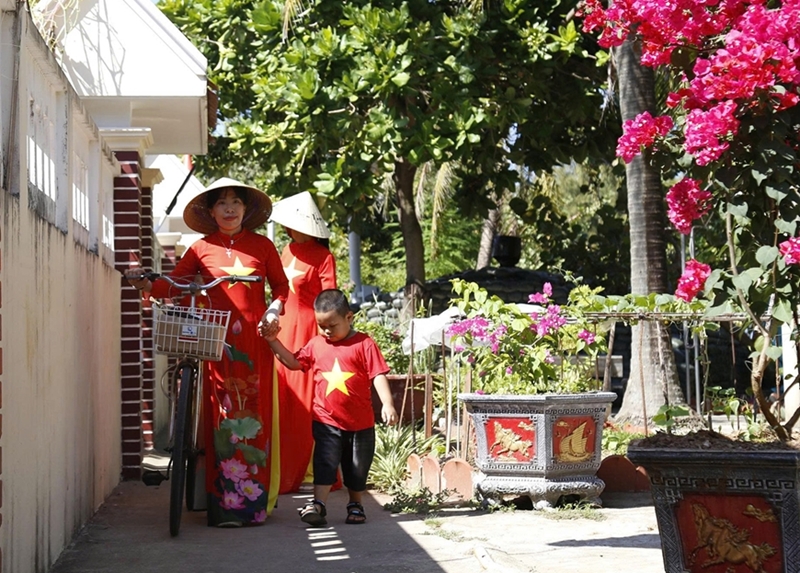
As the delegation set foot on Truong Sa, we were greeted by women in radiant red “ao dai,” standing in neat formation to welcome us. Pham Thi Bay, a local on the island, shared that she has lived there for three years. Every Monday morning, women on the island wear traditional “ao dai” and join officers and soldiers in the flag-raising ceremony. On holidays, Lunar New Year celebrations, anniversaries, or cultural performances, they always wear “ao dai.”
    |
 |
|
Women on Sin Cowe with their radiant red “ao dai” |
She also said that far from the mainland, women on the island constantly remind one another to preserve the traditional beauty of Vietnamese women. For her, “ao dai” is not only for festive or ceremonial occasions. It is a way for women on this remote island to remind themselves that, even amid the open sea, they still carry with them the values of home and village, the essence of the mainland brought to Truong Sa.
Le Thanh Tuan, born in Cam Lam district, Khanh Hoa province and now a local of Sin Cowe, grew up with the sea. As an adult, he volunteered to join the military and was stationed on Southwest Cay. After marriage, he and his wife decided to settle on Sin Cowe. In the early days, they were confused because life on the island was different from the mainland. However, thanks to the close-knit ties between civilians and the military, along with the support of officers, soldiers, and neighboring households, her family gradually adapted to their new life.
Nguyen Thi Ut Lan, another local on Sin Cowe, shared that living on the island, she misses home, the mainland, and her loved ones. But over time, she has grown accustomed to it. Then, when she returns to the mainland, she misses the island, misses the sound of the pagoda bell, children’s laughter, and others.
Lan added that the thing she was most worried about on the first day when she set foot on the island was not whether she herself could adapt, but whether her daughter could adjust to the new environment. She therefore devoted much of her time to guiding and nurturing her child to become a true “young citizen” of the island. Children on the island receive abundant care and sentiments from officers and soldiers, which helped her daughter quickly settle into the new life.
Amidst the vast expanse of the sea, the beauty of “ao dai” becomes all the more distinctive, helping women overcome their longing for the mainland as they build homes on these distant islands. This journey allowed me to witness “ao dai” fluttering at the harbor of Sin Cowe, flowing gracefully before the sovereignty marker on Truong Sa; and appearing on West London Reef A. What could be more beautiful, more sacred, more moving, and making us more proud?
Translated by Quynh Oanh